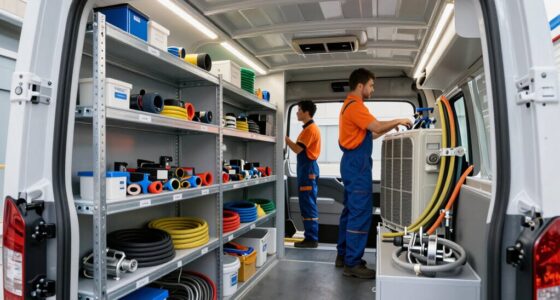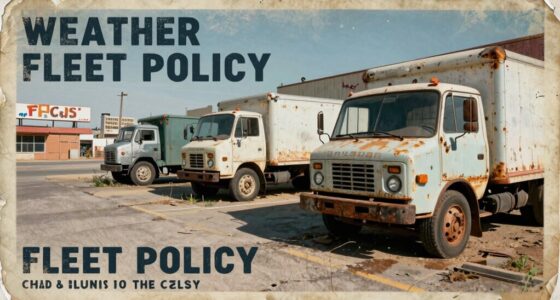
To optimize your fleet, monitor vehicle age, mileage, and performance signs like declining fuel efficiency and rising repair costs. Generally, consider repairing vehicles that have minor issues and are still relatively new, while replacing those with frequent breakdowns or over 150,000 miles or 8 years. Implement regular maintenance to prevent costly repairs, and stay aware of market trends to make smarter decisions. Keep exploring to master the best timing for repairs and replacements.
Key Takeaways
- Regularly monitor vehicle age, mileage, and performance indicators to determine optimal repair or replacement timing.
- Establish thresholds such as 150,000 miles or 8 years to evaluate when replacement becomes cost-effective.
- Prioritize preventive maintenance to detect early issues and extend vehicle lifespan efficiently.
- Compare repair costs against the expense of new vehicles to make informed replacement decisions.
- Incorporate technological trends and performance data to optimize fleet upgrades and ensure operational reliability.

Understanding the lifecycle of fleet vehicles is essential for managing costs, maintaining efficiency, and ensuring reliable operations. When you grasp how long your vehicles typically last and what signs indicate they need attention, you can make smarter decisions about repairs and replacements. Effective fleet maintenance is the backbone of this process, allowing you to extend vehicle life while controlling expenses. Regular inspections, oil changes, brake checks, and tire rotations help identify early issues before they become costly repairs. By staying proactive, you reduce downtime and keep your fleet running smoothly. Additionally, implementing preventive maintenance strategies can significantly prolong the lifespan of your vehicles and prevent unexpected breakdowns.
Understanding vehicle lifecycle helps manage costs and keep your fleet reliable.
But maintenance alone isn’t enough. You need to develop clear replacement strategies based on vehicle age, mileage, and condition. A well-thought-out plan helps you avoid the pitfalls of holding onto aging vehicles that become unreliable or expensive to repair. When a vehicle reaches a certain age or mileage—say, 150,000 miles or 8 years—it’s time to evaluate whether continued repairs make sense financially. If repair costs start to climb or safety becomes a concern, replacement becomes the more economical choice. This strategic approach ensures you don’t waste money on frequent fixes while still maintaining operational efficiency.
You should also consider the type of vehicle and its usage when planning replacements. Heavy-duty trucks, for example, may have a different lifespan than compact cars. Monitoring key indicators like fuel efficiency decline, increased breakdowns, or excessive repair costs can give you concrete data to support your decisions. If a vehicle’s performance deteriorates and repairs become more expensive than investing in a new one, it’s often more cost-effective to replace. This approach minimizes unexpected breakdowns that disrupt your operations and helps keep your fleet reliable.
Your replacement strategies should also factor in technological advancements and fuel economy improvements. Upgrading to newer models can reduce maintenance costs and carbon footprint, aligning with sustainability goals. When planning replacements, consider potential resale value and the impact on your budget. Regularly reviewing your fleet’s performance data enables you to fine-tune these strategies, ensuring you’re not over-investing in aging vehicles or missing out on efficiency gains from newer models. Furthermore, understanding vehicle lifespan can guide your timing for upgrades and replacements, optimizing overall fleet performance.

Heavy Duty Truck Diagnostic Scanner for 2024 V3 J-PRO Software(with Laptop)
- Diagnostic Tool Kit: Supports Class 4-8 Trucks with DLA+2.0
- Cost-Effective Solution: Quick fault detection for all skill levels
- Heavy-Duty Truck Compatibility: Ideal for diesel truck maintenance and troubleshooting
As an affiliate, we earn on qualifying purchases.
As an affiliate, we earn on qualifying purchases.
Frequently Asked Questions
How Do Fuel Efficiency Trends Influence Replacement Timing?
Fuel efficiency trends play a key role in your replacement timing decisions. As fuel efficiency declines, your vehicle becomes more expensive to operate, signaling it’s time for replacement. Conversely, if newer models show significant improvements in fuel efficiency, upgrading can cut costs and reduce emissions. Keep an eye on industry trends and your vehicle’s performance to optimize replacement timing, ensuring you save money and stay environmentally responsible.
What Role Do Maintenance Costs Play in Decision-Making?
You realize that maintenance costs can make or break your decision. A sudden spike in expenses signals it’s time for a cost analysis, revealing whether repair or replacement saves money. Regular maintenance scheduling keeps costs predictable, but neglecting this can lead to unexpected, skyrocketing expenses. Always weigh ongoing repairs against the potential benefits of replacing the vehicle, because in this game, staying ahead of costs keeps your fleet running smoothly and profitably.
Are There Specific Metrics to Assess Vehicle Depreciation?
You can assess vehicle depreciation by tracking the residual value and depreciation rate over time. Residual value indicates how much the vehicle is worth at a specific point, while the depreciation rate shows how quickly it loses value. Monitoring these metrics helps you determine when a vehicle’s worth drops below repair costs, guiding decisions to repair or replace, ensuring you maximize fleet value and minimize unnecessary expenses.
How Does Technological Obsolescence Affect Lifecycle Planning?
Technological obsolescence considerably impacts your fleet’s lifecycle planning because rapid technological upgrades can render vehicles outdated sooner. You need to incorporate obsolescence management strategies, like regularly evaluating when vehicles no longer meet operational needs or safety standards. By staying ahead of obsolescence, you can plan timely repairs or replacements, ensuring your fleet remains efficient and cost-effective. This proactive approach helps you avoid downtime and maximize the vehicle’s useful life.
What Legal or Regulatory Factors Impact Vehicle Replacement Policies?
You must follow legal and regulatory factors like insurance regulations and emissions standards, which can drastically influence your vehicle replacement policies. Ignoring these rules can lead to hefty penalties or insurmountable legal issues—your fleet might become obsolete overnight! Stay updated on local laws, verify your vehicles meet emissions standards, and comply with insurance requirements to avoid costly fines and keep your fleet running smoothly and legally.

ANCEL AD410 Enhanced OBD2 Scanner, Vehicle Code Reader for Check Engine Light, Automotive OBD II Scanner Fault Diagnosis, OBDII Scan Tool for All OBDII Cars 1996+, Black/Yellow
- Quickly Read and Clear Fault Codes: Understand and reset engine trouble codes
- Supports Full OBD2 Diagnostics: Read/clear codes, live data, tests
- Real-Time Vehicle Data: Monitor RPM, temperature, sensors
As an affiliate, we earn on qualifying purchases.
As an affiliate, we earn on qualifying purchases.
Conclusion
When you master the art of knowing when to repair or replace your fleet vehicles, you’re basically the superhero of transportation. You’ll save a fortune, dodge catastrophic breakdowns, and keep your operation running smoother than a race car at a finish line. Delay too long, and chaos erupts like a volcano — but get it right, and your fleet will run so flawlessly, you’ll feel like you’ve got a magic wand. Now go, conquer your fleet’s future!

Fleet Engineers Genuine Fleet Engineers Landing Gear Shoe – 013-01192
- Product Name: Fleet Engineers Landing Gear Shoe
- Model Number: 013-01192
- Package Dimensions: 15.31 x 10.86 x 6.25 inches
As an affiliate, we earn on qualifying purchases.
As an affiliate, we earn on qualifying purchases.

OEM 7000 Wireless Fuel Level Monitor
- Wireless ultrasonic fuel level monitor: Complete kit with receiver and transmitter
- Low oil warning: Provides visual and audible alerts
- Multiple receiver setup: Supports multiple receivers from one transmitter
As an affiliate, we earn on qualifying purchases.
As an affiliate, we earn on qualifying purchases.