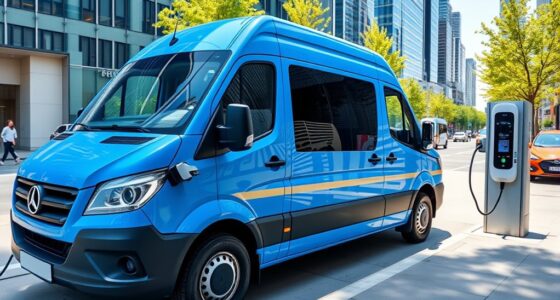

The Ford E‑Transit offers flexible charging options to suit your needs. You can use AC wall chargers at home or at work, which typically take 8–11 hours for a full charge, depending on the setup. For quick recharging, DC fast chargers deliver up to 115 kW, enabling you to recharge from 15% to 80% in about 34 minutes. If you want to maximize efficiency and convenience, exploring these options will help you stay powered up longer and smarter.
Key Takeaways
- The Ford E‑Transit supports DC fast charging up to 115 kW, enabling rapid recharges from 15% to 80% in about 34 minutes.
- It can be charged via Level 2 AC chargers up to 11.3 kW, suitable for home or commercial installations, with full charges in approximately 8 hours.
- Home charging options include Ford’s Connected Wallbox and hardwired Level 2 chargers, offering convenient overnight recharging.
- Public charging infrastructure features CCS connectors and a network of fast chargers, allowing quick top-ups during long routes.
- Compatibility with industry-standard connectors and smart charging management optimizes charging speed, convenience, and battery health.
Understanding the Charging Capabilities of Ford E‑Transit

Understanding the charging capabilities of the Ford E‑Transit is essential for maximizing its efficiency and minimizing downtime. With a maximum DC fast charging power of up to 115 kW, you can quickly recharge the battery from 15% to 80% in about 34 minutes. This rapid charging is ideal for commercial operations needing quick turnaround times, allowing for 0–100% recharge in roughly 2–3 hours at high-power public chargers. For home use, the onboard charger supports 11.3 kW AC charging, fully charging the vehicle in approximately 8.2 to 10 hours, depending on your setup. Compatibility with Type 2 AC sockets and CCS fast chargers ensures flexible options. These capabilities enable you to optimize vehicle uptime and keep your fleet running efficiently. Battery charging standards A comprehensive understanding of charging technology can further enhance operational planning and reduce downtime.
Exploring AC Charging Options and Their Benefits

AC charging speeds vary depending on power level and setup, from slower single-phase options to faster three-phase chargers that can add significant range per hour. Installing a home charger is usually straightforward and cost-effective, especially for overnight charging, and can be customized to fit your existing electrical system. These options give you flexible, affordable ways to keep your E‑Transit ready without relying on costly fast-charging infrastructure. Additionally, understanding high refresh rates can help optimize charging schedules based on your usage patterns. Recognizing real-world charging performance can further assist in planning your charging routine for efficiency and convenience. Moreover, selecting the appropriate charging infrastructure can greatly enhance your overall experience by reducing downtime and ensuring reliable power for your vehicle.
Charging Speed Variations
Charging speed for the Ford E‑Transit varies depending on the power level and setup of your charging station. Using a 10A outlet, it takes around 34 hours to fully charge. With a 15A caravan outlet, expect about 20 hours. A 32A single-phase home EVSE reduces this to roughly 10 hours, while a three-phase public charger at 16A or 32A cuts it to about 8.2 hours. The onboard charger limits maximum AC charging speed to roughly 11.3 kW, regardless of external power. Higher amperage and phases boost charging efficiency, but the onboard hardware caps the maximum rate. These variations influence how quickly you can recharge, making higher power setups more convenient for regular use and minimizing downtime. Understanding the onboard charger capabilities is essential for optimizing your charging strategy. Additionally, charger compatibility plays a crucial role in ensuring safe and efficient charging, as it impacts the overall charging infrastructure available to you.
Home Installation Tips
Considering the different home charging options for your Ford E-Transit can substantially impact convenience and efficiency. To guarantee a safe and reliable setup, follow these tips:
- Hire a professional certified electrician to handle installation, ensuring safety compliance.
- Use 3 AWG copper wire rated at 90°C or higher for AC connections to handle heat and meet code standards.
- Install a dedicated 100 A non-GFCI breaker for the charger to prevent overloads and electrical faults.
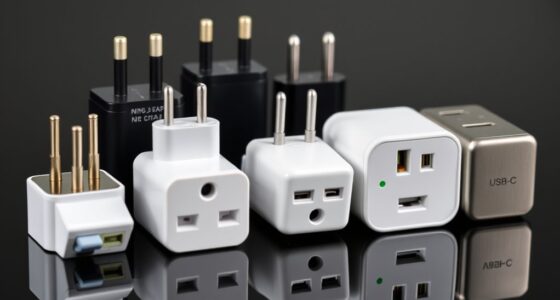
- Compatibility with European outlets ensures your charger can be properly connected without issues, avoiding potential damage or safety hazards.
- Verify that your electrical system supports the appropriate amperage for your charger to prevent overloads and ensure efficient charging.
- Understanding your electrical system’s safety standards is crucial to prevent hazards and ensure compliance with local codes. Staying informed about evolving regulations can help you adapt your setup accordingly.
Additional considerations include securing proper conduit connectors and employing torque drivers for tight, safe wiring connections. Make sure your electrical panel supports the charger’s amperage and consider upgrading if necessary. Proper planning and professional installation help maximize charging safety, speed, and system longevity.
Cost-Effective Charging
Exploring the different AC charging options for your Ford E-Transit reveals a range of cost-effective benefits. Lower power levels, like single-phase 230V AC at 1.4 to 7.4 kW, cost less to install and operate, making them ideal for overnight home or workplace charging. Using existing infrastructure, especially with three-phase supplies up to 11 or 22 kW, speeds up charging while keeping costs manageable. Extended charging times help you take advantage of off-peak electricity rates, reducing your overall expenses. Plus, Level 2 EVSE equipment is more affordable than DC fast chargers, and widespread compatibility with Type 2 sockets simplifies access at public stations. Overall, AC charging offers a budget-friendly way to keep your Ford E-Transit ready without hefty infrastructure or operational costs. Incorporating home charging setups can further enhance convenience and reduce your reliance on public charging stations. Additionally, understanding charging infrastructure options can help you make informed decisions about your vehicle’s power needs. Implementing smart charging solutions can optimize energy use and lower costs even further.
Harnessing DC Fast Charging for Rapid Replenishment
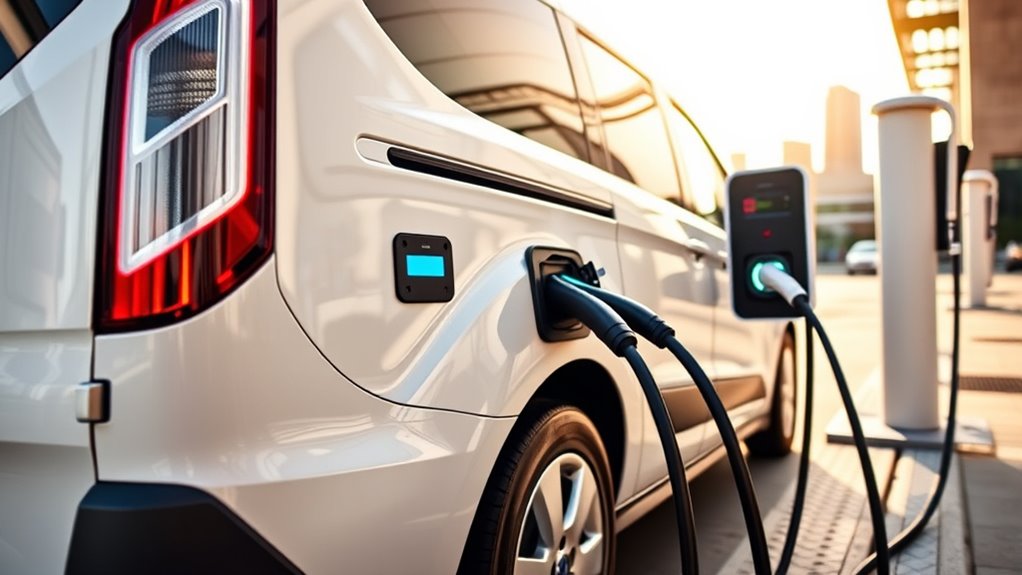
Using DC fast charging, you can quickly replenish your Ford E‑Transit’s battery in about 34 minutes at up to 115 kW, minimizing downtime. To get the best results, ideal charging conditions and proper thermal management are essential for preserving battery health during rapid sessions. With widespread infrastructure supporting CCS connectors, you can efficiently keep your fleet moving without long delays. Additionally, understanding battery safety and proper maintenance practices can further optimize charging performance and longevity. Incorporating thermal management systems can help maintain optimal battery temperature during fast charging, ensuring safety and prolonging battery life. Advances in energy efficiency technologies also contribute to more sustainable and cost-effective charging practices.
Fast Charging Speed
How quickly can the Ford E‑Transit recharge during a busy workday? With DC fast charging, you can rapidly replenish your vehicle’s range, minimizing downtime. For example:
- Charging from 20% to 80% at 50 kW takes about 45 minutes.
- Using chargers of 180 kW or more adds roughly 67 miles in just 15 minutes.
- Full 0-100% charging at 115 kW typically takes 2 to 3 hours, but partial top-ups are much faster.
The vehicle’s high-capacity 89 kWh battery absorbs fast chargers efficiently, especially between 20-80% SoC. This quick energy boost helps you stay on schedule, making the E‑Transit ideal for demanding commercial routes.
Optimal Charging Conditions
Ideal charging conditions maximize the benefits of DC fast charging by ensuring your Ford E‑Transit recharges quickly and safely. Maintaining suitable battery temperature is essential—liquid cooling systems help regulate heat during rapid charging, preventing overheating and degradation. Pre-conditioning the battery before charging can reduce time and thermal stress. Charging speeds are highest at low to mid SoC (10-50%) and slow near 80% to protect battery health. Ensuring compatibility with 115 kW CCS chargers is vital for maximum efficiency. Additionally, thermal management systems play a crucial role in maintaining optimal battery temperature during high-rate charging sessions, and implementing proper charging protocols can further enhance battery longevity. Proper battery thermal regulation is key to sustaining fast charging performance over the lifespan of your vehicle.
Infrastructure Availability
The growing density of DC fast charging stations across major cities and highway routes makes rapid recharging more accessible than ever for Ford E-Transit owners. With extensive networks supporting quick replenishment, you can rely on:
- Multiple chargers per station, allowing parallel sessions that reduce wait times.
- Ultra-fast chargers (100+ kW) that markedly cut down charging durations.
- Strategic locations at commercial hubs, transit centers, and logistics parks aligned with your operational zones. Additionally, the availability of charging infrastructure continues to improve, making it easier to plan long trips with confidence.
- Real-time availability via the Ford Pro charging app and online locators helps you plan routes efficiently. Most chargers support CCS connectors and Plug & Charge, simplifying the charging process. While infrastructure keeps expanding, rural areas may still pose challenges, so pre-planning your stops is essential. The EV Charging Station Locator provides a comprehensive resource to find nearby charging options across North America, including Canadian stations.
Setting Up a Home Charging Station for Convenience
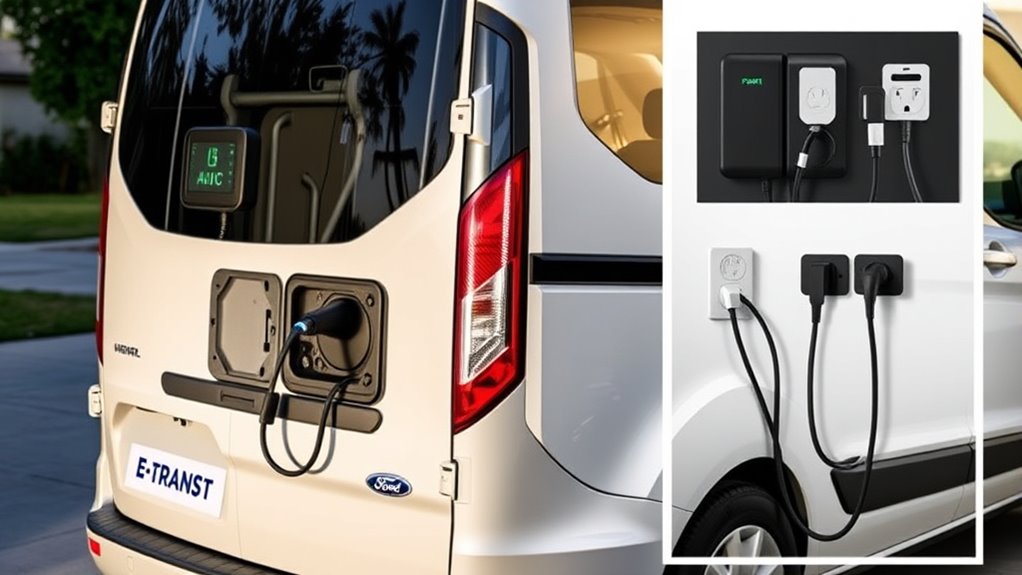
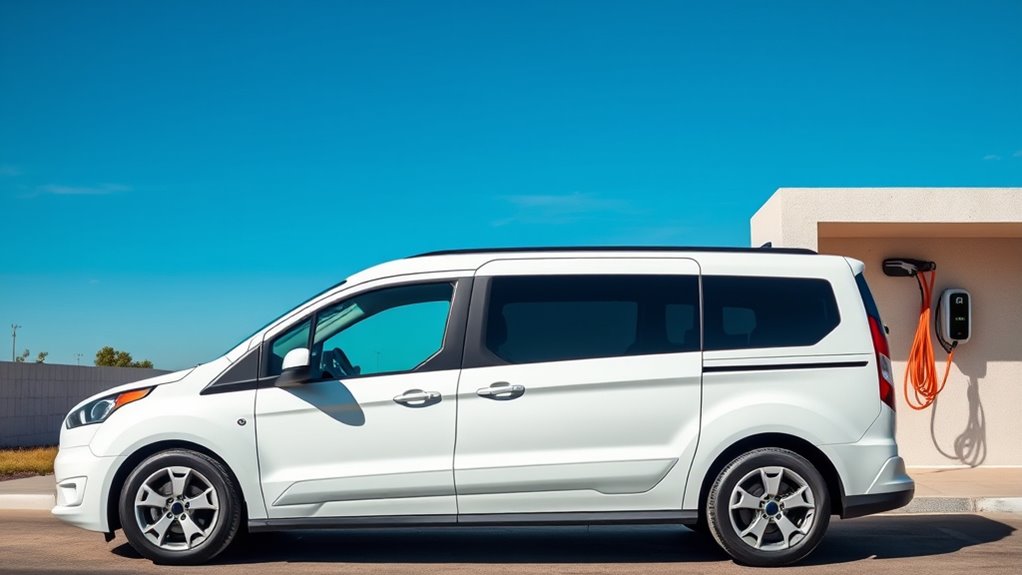
Setting up a home charging station for your Ford E‑Transit offers unmatched convenience and control over your vehicle’s charging routine. You can choose from several options, including a universal home charging cord that plugs into standard sockets, providing Level 1 charging but with longer 25-32 hour full charges. For faster and more efficient charging, consider installing a Ford Connected Wallbox, which offers up to 11 kW and can fully charge your vehicle in about 8 hours overnight, especially if you have three-phase power. Hardwired Level 2 chargers with 7.6 to 11.5 kW are ideal for quicker charging, taking roughly 8-11 hours. Make sure your electrical system can support the charger’s power requirements and consult a professional electrician for safe installation near your parking spot.
Compatibility With Public and Workplace Charging Networks
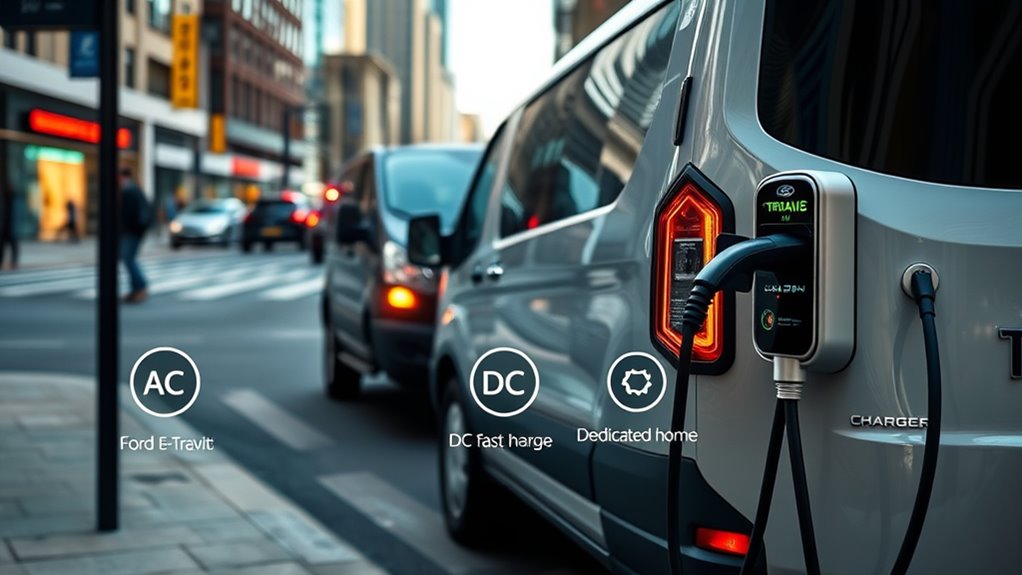
Compatibility with public and workplace charging networks guarantees your Ford E‑Transit stays ready for various driving needs. You’ll benefit from broad access, thanks to support for industry-standard connectors like CCS for DC fast charging and Type 2 for AC charging. Major networks are compatible, and apps simplify station access through Ford’s system. Key points include:
- Support for both J1772 (AC) and CCS (DC) standards ensures versatility across different networks.
- Workplace chargers with J1772 connectors efficiently meet daily needs, with some upgrading to DC fast chargers for rapid midday refueling.
- Ford’s integration with charging apps and payment systems streamlines access, billing, and management at public and workplace stations.
- Charging network compatibility is further enhanced by Ford’s ongoing partnerships with major providers, expanding the accessible charging options for fleet operators.
Optimizing Charging Efficiency and Performance
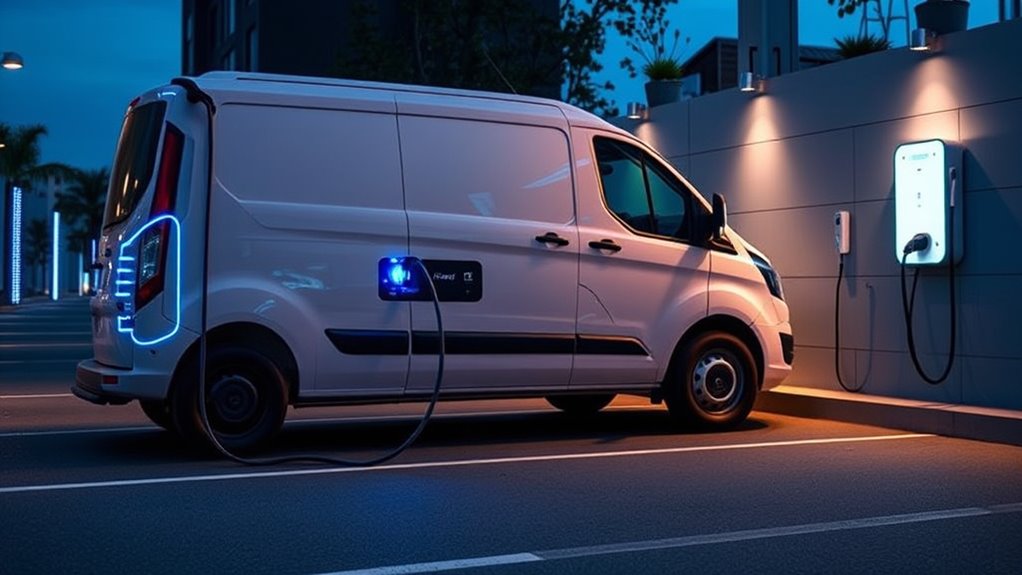
Maximizing your Ford E‑Transit’s charging efficiency involves more than just plugging in; it requires smart management of charging schedules and energy use. You can save costs by setting charging windows during off-peak hours, such as overnight or weekends, when electricity rates are lower. Scheduling when your vehicle charges helps avoid overcharging and prolongs battery life, especially when using features like regenerative braking recovery. Utilize intelligent software to pre-condition the battery, boosting range before trips and optimizing charging timing. Fleet telematics enable real-time monitoring, allowing you to adjust charging parameters for maximum efficiency and availability. Additionally, matching your charging hardware—like Level 2 AC or DC fast chargers—to your vehicle’s capabilities ensures fast, reliable charging without stressing the battery, maintaining peak performance while reducing energy waste. Segment-leading technology also means that Ford continuously updates the vehicle’s software to enhance charging algorithms, improving overall efficiency and user experience.
Integrating Solar Power and Smart Home Systems for Cost Savings
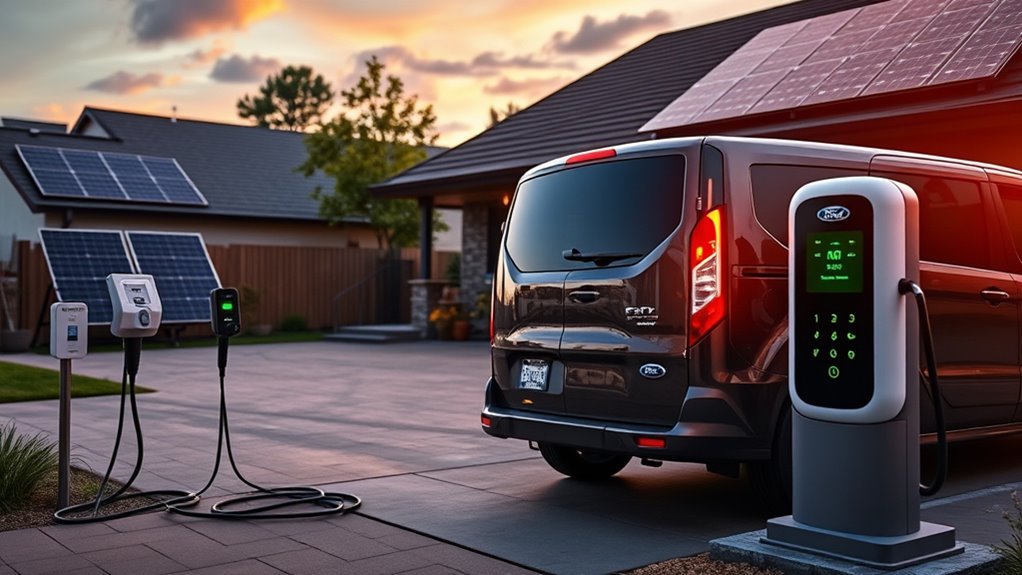
Integrating solar power and smart home systems with your Ford E-Transit can substantially reduce charging costs and increase energy efficiency. By combining these technologies, you maximize self-consumption and lower reliance on the grid. Consider these key benefits:
Maximize efficiency and savings by integrating solar power and smart systems with your Ford E-Transit.
- Smart inverters optimize solar energy use, directing excess power to your vehicle or home storage.
- Scheduling charging during peak solar production minimizes costs and maximizes renewable energy use.
- Battery storage stabilizes solar output, ensuring consistent charging even during cloudy days or at night.
- Efficient system integration ensures seamless operation between your solar panels, inverter, and vehicle charging system, maximizing overall energy savings.
Careful installation of roof-mounted or flexible solar panels is essential to connect effectively with your vehicle’s charging system. When combined, these systems not only save money but also promote sustainable, reliable energy management for your E-Transit.
Frequently Asked Questions
How Does Ambient Temperature Affect Ford E‑Transit Charging Performance?
Ambient temperature considerably impacts your Ford E-Transit’s charging performance. Cold weather slows down DC fast charging because lower battery chemistry activity increases charge times, but preconditioning can help. Hot temperatures cause more resistance and heat buildup, which may reduce charging speed or require active cooling. Using scheduled preconditioning, parking in sheltered areas, and avoiding fast charging during extreme heat can help maintain ideal charging efficiency.
Can I Upgrade My Home Charger to Support Faster Charging Speeds Later?
Think of your home charger as a garden that can flourish over time. Yes, you can upgrade it later to support faster charging speeds. You’ll need to make certain your electrical panel can handle the increased load and possibly install a higher-capacity Level 2 charger. With professional help, upgrading becomes a seamless shift, turning your charging setup into a powerful stream that fuels your journey without missing a beat.
Is There a Difference in Charging Time Between Different Ford E‑Transit Models?
Yes, different Ford E‑Transit models have varying charging times. Newer models with upgraded onboard chargers and larger batteries charge faster on Level 2 home stations, taking about 6 hours for a full charge. Older models or those with smaller batteries may take longer, around 10-12 hours. Upgrading your vehicle’s hardware or choosing a higher-capacity charger can improve your charging speed, but your model’s specifications still play a key role.
How Do I Monitor Charging Status Remotely Through Ford’s Digital Tools?
You can keep an eye on your charging status like a hawk using FordPass™ app’s remote monitoring. It’s as simple as opening the app, where you’ll see real-time updates on charge progress, battery levels, and notifications for completion or issues. You can start, stop, or schedule charging from anywhere, making sure your vehicle’s energy is managed smoothly — like having a personal charging assistant right in your pocket.
What Safety Precautions Are Recommended During Home EVSE Installation?
During home EVSE installation, you should always hire a licensed electrician to guarantee safety and code compliance. Make sure the electrical system can handle the charger’s load and install a dedicated circuit breaker. Use certified equipment, avoid extension cords, and keep a fire extinguisher nearby. Follow proper grounding procedures, don’t modify wiring, and inspect for damage before use. These precautions help prevent electrical hazards and ensure safe, reliable charging.
Conclusion
So, now you’re all set to charge your Ford E‑Transit like a pro—whether that’s slow AC, lightning-fast DC, or cozy home setups. Just remember, with all these options, you might never need to leave your driveway again. Who knew charging could be this complicated? But don’t worry, as long as you keep plugging in, you’ll stay powered up—because nothing says “green” like turning your daily commute into a full-blown charging marathon.