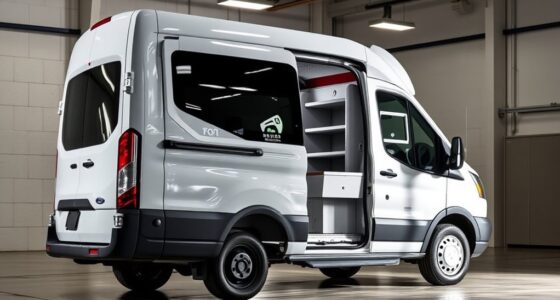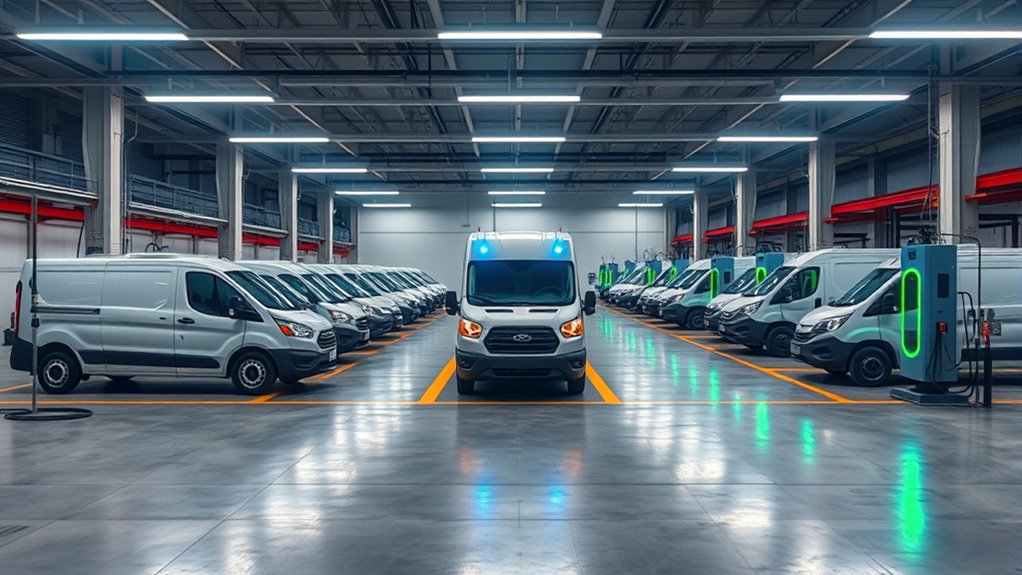

When planning workplace and depot charging, choose the right power levels based on your vehicle needs—Level 1 for basic overnight top-ups, Level 2 for daily shifts supporting 20-30 miles per hour, or fast chargers for quick turnaround. Design your layout with accessible, well-lit, and clustered chargers to guarantee efficiency and safety. Considering your electrical capacity now helps avoid costly upgrades later. Keep exploring to discover how to optimize your charging setup for scalable operations.

Get business pricing on garage and car supplies
- Business-only prices and quantity discounts
- Tax-exempt purchasing
- Multiple users, one account, clear invoices
Key Takeaways
- Select appropriate charging levels (Level 1, 2, or DC fast) based on fleet usage, operational needs, and budget.
- Position chargers in accessible, well-lit areas near parking to enhance safety and ease of use.
- Cluster chargers to simplify wiring, maintenance, and future expansion plans.
- Assess electrical capacity to prevent overloads and accommodate future infrastructure growth.
- Balance cost and speed requirements to optimize fleet readiness and operational efficiency.
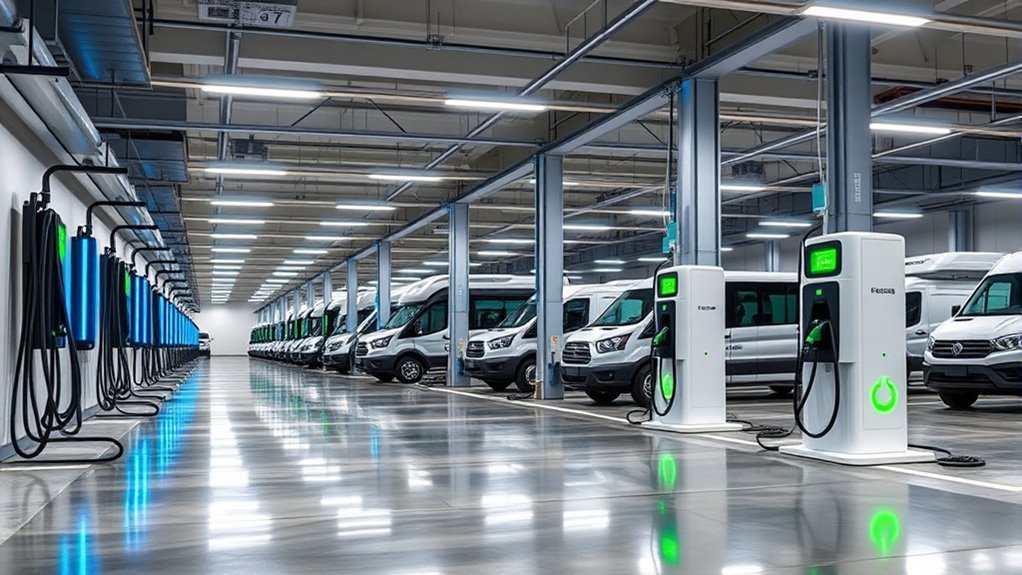
As electric vehicle adoption accelerates, implementing effective workplace and depot charging solutions becomes essential for fleets and employees alike. The way you choose to set up your charging stations, including power levels and layout, directly impacts operational efficiency, driver satisfaction, and overall fleet management. To maximize benefits, you need a clear understanding of the different charging levels and how to organize your charging infrastructure for optimal use.
Starting with power levels, Level 1 charging is the simplest and slowest option, using standard 120-volt outlets. It typically provides around 4-5 miles of range per hour of charging, making it suitable for overnight or occasional top-ups rather than daily use. However, for fleets with short daily routes or employees who park for extended periods, Level 1 might suffice.
Level 2 charging ramps up to 240 volts, delivering approximately 20-30 miles of range per hour. It strikes a balance between speed and cost, making it the most common choice for workplace and depot environments. Level 2 chargers are fast enough to recharge vehicles during typical work shifts, minimizing downtime and ensuring fleet readiness without significant infrastructure investment.
Fast charging, or Level 3 DC fast chargers, offers the highest power levels, often exceeding 50 kW, and can replenish 80% of a vehicle’s battery within 30 minutes. While attractive for quick turnaround, deploying fast chargers at workplaces or depots can be costly and may not be necessary for all fleets. You should evaluate your operational patterns to determine if fast charging aligns with your needs, such as supporting high-utilization vehicles or enabling quick charging during short breaks.
The layout of your charging stations plays a vital role in efficiency and safety. Positioning chargers in accessible, well-lit areas close to vehicle parking spots helps streamline operations. Consider the flow of vehicles and staff, avoiding congestion and ensuring safety standards.
You might also want to cluster chargers to facilitate easier wiring, maintenance, and future expansion. Incorporating flexible spacing allows for different vehicle sizes and future upgrades. It’s important to plan for electrical capacity, ensuring your site can handle the load without overloading circuits or requiring costly upgrades.
As an affiliate, we earn on qualifying purchases.
Frequently Asked Questions
What Are the Cost Differences Between Various Charging Power Levels?
Higher power level chargers typically cost more upfront due to advanced equipment and installation requirements. For example, fast chargers (50 kW or more) have higher installation and equipment costs compared to standard Level 2 chargers (up to 19.2 kW).
However, they can save you money over time by quickly charging vehicles, reducing downtime.
Lower power chargers are cheaper initially but might increase operational costs if charging times become longer.
How Do Layout Choices Impact Charging Station Accessibility?
A picture is worth a thousand words, and layout choices directly impact charging station accessibility. You want a design that guarantees easy, safe access for all users, avoiding tight spaces or obstructions.
Prioritize logical placement near work areas, clear signage, and sufficient space for vehicle maneuvering. By doing so, you make charging more convenient, encouraging consistent use, and maximizing your investment’s efficiency.
Good layout is the backbone of effective workplace charging.
What Safety Measures Are Essential for High-Power Depot Chargers?
You should implement vital safety measures like proper grounding, clear signage, and accessible emergency shut-offs to prevent accidents. Use sturdy barriers to protect against accidental collisions and guarantee adequate ventilation to manage heat and emissions.
Regular maintenance and safety inspections are essential for early detection of faults. Train staff on safety protocols, and keep fire extinguishers nearby. These steps help create a safe environment around high-power depot chargers.
How Can Workplaces Optimize Charging Station Placement?
You should analyze traffic flow and parking patterns to optimize charging station placement. Position chargers near main entrances or high-traffic areas to increase accessibility and usage.
Consider spacing stations to prevent congestion and guarantee safety. Use clear signage and lighting for visibility.
Regularly gather employee feedback to identify ideal locations. Proper placement not only boosts efficiency but also encourages more employees to charge their vehicles, maximizing your investment.
Are There Standards for Future-Proofing Charging Infrastructure?
Yes, there are standards for future-proofing charging infrastructure. You should follow industry guidelines like the IEC 61851 and ISO 15118, which guarantee compatibility and scalability.
Planning for higher power levels, modular designs, and adaptable layouts helps you accommodate future vehicle technologies. Regularly updating infrastructure and integrating smart management systems also guarantee your charging stations remain efficient and relevant as technology advances.
DC fast charger for electric vehicles
As an affiliate, we earn on qualifying purchases.
As an affiliate, we earn on qualifying purchases.
Conclusion
As you navigate the landscape of workplace and depot charging, remember it’s like planting seeds in a vast field. Each power level and layout is a drop of water nourishing your electric fleet’s future. With thoughtful planning, you’ll cultivate a thriving orchard of efficiency and sustainability, where every charge is a blossom blooming into progress. Embrace these strategies as your guiding sun, illuminating the path toward a cleaner, greener horizon for your operations.
workplace EV charging station setup
As an affiliate, we earn on qualifying purchases.
As an affiliate, we earn on qualifying purchases.
electric vehicle charging station clustering
As an affiliate, we earn on qualifying purchases.
As an affiliate, we earn on qualifying purchases.
Fall Picks
fall essentials
As an affiliate, we earn on qualifying purchases.