
TL;DR
The Rhode Island Department of Transportation is placing 700-pound concrete blocks over access covers to deter theft of streetlight copper wire. RIDOT says it has lost more than $1 million to copper theft, has installed 87 of 151 planned blocks, and reports the approach has worked so far. The agency puts the program cost at $75,000.
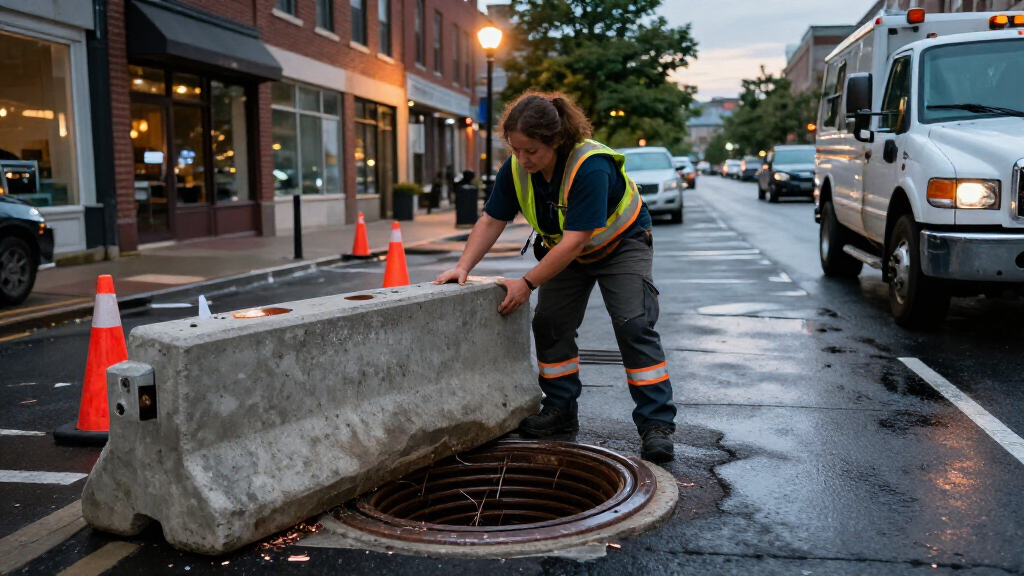
The Rhode Island Department of Transportation is placing 700-pound concrete blocks over access covers for streetlight wiring to deter repeated copper theft, after losses that interim director Robert Rocchio said exceeded $1 million. RIDOT says 87 of the 151 planned blocks have been installed and that the measures have worked so far.

Get business pricing on garage and car supplies
- Business-only prices and quantity discounts
- Tax-exempt purchasing
- Multiple users, one account, clear invoices
Rocchio told NBC 10 WJAR that crews have been installing the blocks over the last few months. The heavy units require equipment to move, making it harder for thieves to reach the wiring through the covered access points. RIDOT has not specified the period over which the reported $1 million-plus loss accumulated.
The department plans to install 151 blocks; 87 were in place at the time of the report. The program costs $75,000, according to the source report, which noted that WJAR corrected an earlier written figure of $750,000. Where the blocks sit near roads, the concrete is buried or ground down to lie flat; away from roadways, the blocks remain visible above ground.
Rocchio described the work as an ongoing cycle of restoring damaged wiring and returning to repair it after theft. He said the concrete-block approach had worked so far. That is RIDOT’s reported assessment; the source material does not provide a longer-term evaluation or a measured reduction in thefts.
Protecting Streetlights From Repeat Theft
Streetlight-wire theft can leave public lighting out of service while transportation crews repair damage and replace stolen material. The blocks are intended to make access more difficult and reduce the chance that wiring will be repeatedly stripped from the same locations. For residents and road users, the practical stakes include repair delays and streets left without functioning lights while repairs are pending.
The approach also represents a continuing public expense: RIDOT reports $75,000 in program costs, alongside more than $1 million in stolen copper losses. The source does not establish that the blocks will prevent theft everywhere or eliminate future repair costs, but RIDOT says the installations have been effective to date.
Products Worth Considering

Milwaukee M18 18V Cordless 4-Tool Combo Kit with Hammer Drill, Impact Driver, Reciprocating Saw, Work Light, 2 Batteries, Charger and Case

Autel MaxiCOM MK900BT Bidirectional Diagnostic Scanner

Autel MaxiCharger AC Home Level 2 EV Charger, 50A, J1772, Wi-Fi, Hardwired, 25 ft Cable
As an affiliate, we earn on qualifying purchases.
A Wider Copper Theft Problem
RIDOT interim director Rocchio told WJAR that the Rhode Island thefts began a few years ago, when copper prices rose significantly. He characterized the pattern as recurring: crews restore the wiring, thieves take copper again, and the department returns to make repairs. His comments describe the state’s experience; the report does not give a detailed timeline or a count of incidents.
The source report places Rhode Island’s problem alongside thefts elsewhere in the country. It cited Philadelphia, where stolen wires reportedly left a youth football team practicing in the dark, and California, where AT&T recorded 4,300 thefts of its wire last year. Those examples concern other locations and infrastructure, not RIDOT’s streetlight system. AT&T has promoted public awareness and offered rewards in multiple states for information related to investigations.
NPR reported that AT&T construction and engineering representative Scott Gonzaga described a typical cable-theft process: thieves cut cable, move it to a location, strip it, and burn away the outer sheath to recover copper for sale or recycling. That account provides context for how some wire thefts are carried out, but it does not establish that every Rhode Island incident followed that method.
““It’s a constant battle—we restore it, they steal the copper, we go back in.””
— Robert Rocchio, interim director of the Rhode Island Department of Transportation, speaking to NBC 10 WJAR
Theft Trend and Long-Term Results
The timeframe behind RIDOT’s more than $1 million in copper losses is not stated in the source material, and no incident count or cost breakdown is provided. It is also unclear how many streetlights were taken out of service or how long repairs typically took.
RIDOT says the blocks have worked so far, but the report gives no comparison of theft rates before and after installation and no period over which effectiveness was measured. The account does not explain whether the blocks will be adjusted if theft shifts to other access points or whether the program will expand beyond the planned 151 installations.
RIDOT Plans 64 More Installations
RIDOT’s stated plan is to install 151 concrete blocks. With 87 reported complete, 64 remained under that plan at the time of the report. The department has not provided a completion date in the source material.
Further reporting will be needed to establish whether the remaining installations are completed on schedule and whether thefts or repair costs change afterward. RIDOT’s current account is that the deterrent has worked so far, but longer-term results have not been reported.
Key Questions
Why is Rhode Island placing concrete blocks over access covers?
The Rhode Island Department of Transportation says the blocks are intended to make it harder for thieves to reach copper wiring that powers streetlights.
How many blocks are planned, and how many are installed?
RIDOT plans to install 151 blocks. The source report said 87 had been installed, leaving 64 under the stated plan.
How much has copper theft cost the state?
Interim director Robert Rocchio told NBC 10 WJAR that the state had lost more than $1 million in stolen copper. The timeframe for that figure was not specified.
How much does the concrete-block program cost?
The source report gives the program cost as $75,000. It says WJAR corrected an earlier written report that had listed $750,000.
Has RIDOT proved the blocks stop wire theft?
RIDOT said the approach had worked so far. The report does not provide a theft-rate comparison or a long-term evaluation, so the scale and durability of the effect remain unclear.
Source: thedrive.com