
TL;DR

Get garage and car supplies delivered free — and shop member deals
- Fast, free delivery on millions of items
- Access to Prime Big Deal Days deals on October 6–7
- Prime Video, Amazon Music and more included
Ford Transit cargo organizers fall into six categories — shelving, partitions, drawers, racks, flooring, and track systems — and the biggest buying mistake is ordering gear that doesn’t match your roof height and wheelbase. Steel shelving can add 200+ lbs to your van, cutting into a payload that ranges from roughly 2,000 to 4,000+ lbs. Budget $50–200 for basic organizers, $500–2,500 for modular shelving, and $3,000–10,000+ for a full professional upfit.
The most common way Ford Transit owners waste money on cargo organizers isn’t buying cheap gear. It’s buying gear that doesn’t fit their van. Order shelving for a medium-roof Transit when you own a high-roof, long-wheelbase model, and you’ll find out the hard way why fitment charts exist.
Here’s the thing: the Transit comes in three roof heights, three lengths, and multiple wheelbases — 130-inch, 148-inch, and 148-inch extended [1]. Ford Transit vans are among the most popular full-size cargo vans in North America, so the aftermarket is huge. That’s good news and bad news. Good: tons of options. Bad: tons of ways to order wrong.
In this guide, you’ll learn the six organizer categories, what they cost, how much weight they add, and how to match everything to how you actually use your van — whether you’re a contractor, a courier, or building a camper.
Match organizers to your exact Transit configuration — roof height, body length, and wheelbase (130", 148", or 148" extended) — before comparing brands or pric…
Steel shelving adds 200+ lbs; aluminum saves 30–50% of that weight; composite is lightest and best for E-Transit owners protecting range.
Budget tiers: $50–200 for basics, $500–2,500 for modular shelving (the sweet spot for most trades), $3,000–10,000+ for full professional upfits.
Clamp-on no-drill systems are DIY-friendly and removable; drill-in systems are more rigid — and drilling done properly generally won’t void your warranty.
Secure loose cargo with straps, latching bins, and a partition — loose cargo in a panic stop keeps moving at full speed, and DOT expects it secured.
The 6 Types of Transit Organizers (And What Each One Actually Does)
Ford Transit cargo organizers break down into six categories: shelving units, partitions, drawer systems, racks and tracks, flooring, and tie-down hardware. Each solves a different problem, and most working vans end up with some combination of four or more [1].
Think of your van’s cargo area as a warehouse with no aisles. Shelving is your vertical storage. Partitions are the wall between the office and the warehouse floor. Drawers are your filing cabinet. Tracks and tie-downs are the loading dock. Skip one, and the whole system wobbles.
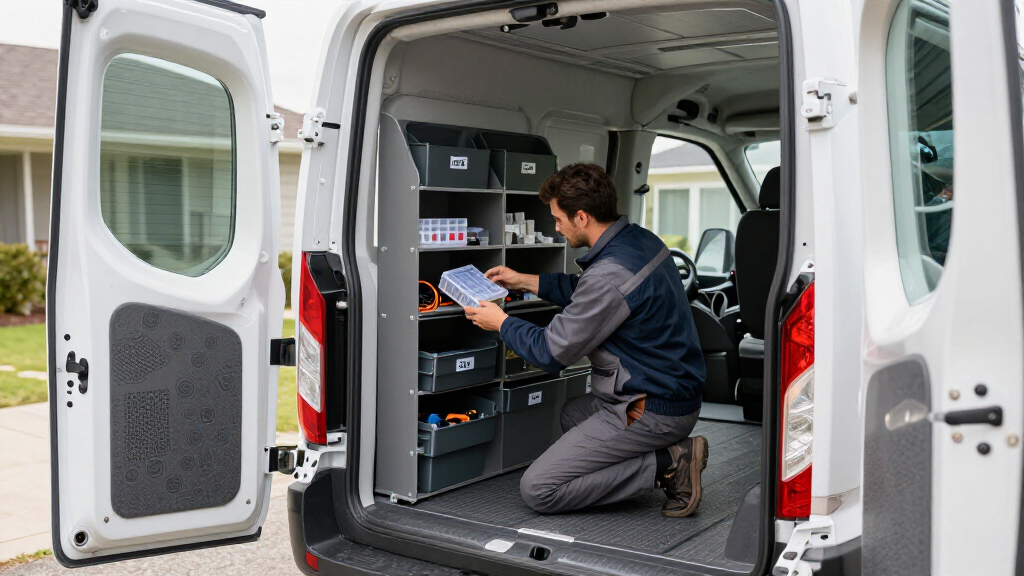
- Shelving units — Modular steel or aluminum systems from brands like Adrian Steel, Weather Guard, Ranger Design, and American Van. Full-shelf or half-shelf configurations preserve floor space [1].
- Partitions — Steel or mesh bulkheads separating the cab from cargo. Safety plus better climate control.
- Drawer systems — Under-floor drawers and shelf-mounted drawers, plus mobile workbenches with integrated storage.
- Racks and tracks — EcoTrack-style track systems, ladder racks, headache racks, adjustable tie-down points [1].
- Flooring and liners — Rubber mats, anti-slip coated plywood, or plastic liners like SyncSystems.
- Tie-downs — The unglamorous hardware that keeps loose cargo from becoming a projectile.
Here’s a scenario worth remembering: a plumber with floor-to-ceiling shelving on both walls but no partition loses heat from the cab all winter. The van feels like organizing a refrigerator. Add a mesh bulkhead, and the climate control problem mostly disappears.
Why Fitment Is the #1 Mistake: Match Your Roof Height and Wheelbase First
Before you compare brands or prices, write down your Transit’s exact configuration: roof height (low, medium, high), body length (regular, long, extended), and wheelbase (130″, 148″, or 148″ extended). Organizers must match these combinations, and buyers get burned by this constantly [1].
Why does this happen so often? Because a “Ford Transit shelving kit” product listing often hides the fitment details three clicks deep. A high-roof shelving unit installed in a medium-roof van wastes your vertical space. A unit designed for a 130-inch wheelbase won’t span a 148-inch extended cargo bay.
Picture an electrician ordering a $1,400 Adrian Steel kit on a Friday, excited for the weekend install. Box arrives Saturday morning. He unrolls the packing slip, checks the part number against his van — long wheelbase, medium roof — and realizes he ordered for a regular length. Now he’s eating a restocking fee and a return shipping label, and his Monday starts with a cluttered van instead of an organized one.
Before you click “buy,” photograph your van’s door-jamb sticker and send it to the seller. Ask them to confirm fitment in writing.
The 2024+ Transit updates also affected some fitment specs [1], so if you own a recent model year, confirm the kit covers it — don’t assume a listing written for a 2021 van fits your 2024.
Steel vs. Aluminum vs. Composite: The Weight Math That Decides Your Buy
Steel shelving can add 200+ lbs to your Transit [1], and that number directly attacks your payload, which ranges from roughly 2,000 to 4,000+ lbs depending on configuration. The material you pick is really a payload decision, not just a durability decision.
Here’s the tradeoff in plain terms: steel is cheapest and toughest but heaviest. Aluminum costs more, saves 30–50% of the weight, and still handles daily trade abuse. Composite and lightweight systems are the newest category — and they’ve grown fast for one reason: the E-Transit. Every pound in an electric van is range you’ll never get back.
| Material | Typical Weight Penalty | Durability | Best For |
|---|---|---|---|
| Steel | 200+ lbs full system | Highest — handles daily abuse | Heavy trade use, tight budgets |
| Aluminum | ~30–50% lighter than steel | Very good | Payload-conscious tradespeople |
| Composite/modular | Lightest | Good, improving fast | E-Transit, van life, weight-limited vans |
Run your own numbers before buying. Add up your organizer weight, your average tool load, and your body weight. If you’re a courier running near payload capacity daily with 600 lbs of packages, a 250-lb steel system might push you over. That’s a safety issue and a legal one.
What Organizers Actually Cost: Budget, Mid-Range, and Full Upfit
Ford Transit cargo organizers span an enormous price range: basic organizers run $50–200, modular shelving systems $500–2,500, and full professional upfits $3,000–10,000+ [1]. The right spend depends on how your van earns its living.
A weekend camper converting a used Transit can build a functional setup with track systems, rubber flooring, and a few bins for under $500. A HVAC company upfitting ten new vans for crews will spend $6,000–8,000 per van on shelving, partitions, and ladder racks — and write it off as a business expense because organized vans mean faster job times.
- Budget tier ($50–200): Rubber floor mats, cargo bars, track-and-hook kits, storage bins. Great start, limited capacity.
- Mid-range ($500–2,500): Modular shelving kits, mesh partitions, under-floor drawers. This covers 80% of tradespeople.
- Full upfit ($3,000–10,000+): Complete professional installation with shelving, drawers, workbenches, lighting, and racks — often via Ford Pro or a QVM (Qualified Vehicle Modifier) upfitter [1].
One nuance: the cheap end isn’t always false economy, but the middle tier usually is the sweet spot. A $150 cargo bar that keeps bins from sliding beats a $2,500 shelf system you don’t need — but a $90 no-name shelf kit that collapses under tool weight will cost you more in damaged gear than a proper Adrian Steel or Ranger Design unit.
DIY or Professional Install? What You Can Bolt On Yourself
Most Transit organizer kits are DIY-installable with basic tools, and drilling mounting holes generally does not void your warranty when done properly [1]. The real question is your time and your drill confidence.
Two mounting styles dominate the market. No-drill, clamp-on systems grip existing structural points — faster to install, easier to remove, and increasingly popular with the van life crowd who want removable, transferable setups. Drill-in systems are more permanent and rigid, which matters for heavy daily trade use.
A realistic Saturday install: a clamp-on shelving kit and a mesh partition take 3–5 hours with two people and a socket set. A full drill-in system with under-floor drawers? Budget a full weekend, and expect your arms to hate you by Sunday night.
- DIY-friendly: Cargo bars, track systems, rubber flooring, clamp-on shelving, most partitions.
- Consider a pro: Under-floor drawer systems, ladder racks requiring roof drilling, full upfits, anything electrical.
- Always use a pro: Anything touching structural integrity or safety systems. For safety-critical work, certified upfitters and mechanics are the right call — and check whether your Transit has open recalls at NHTSA.gov/recalls before you start cutting or drilling.
Fleet owners should also know about Ford’s QVM program — upfits done through qualified modifiers keep your warranty path cleaner than independent installs [1].
Secure Your Cargo Like It’s the Law — Because It Basically Is
Loose cargo in a Transit isn’t just messy — it’s dangerous and, in many jurisdictions, a legal problem. DOT rules and liability standards expect cargo to be secured against shifting, and a 40-lb tool box flying forward in a panic stop will clear a partition like it isn’t there.
The math is ugly. At a 30 mph sudden stop, loose cargo keeps moving at 30 mph. Your mesh partition is rated to catch a lot, but it’s not rated to catch everything. This is why tie-down points, cargo nets, and latched drawers earn their cost.
Start with the boring stuff: ratchet straps through factory track points, bins that latch shut, drawers with positive locks. Then add the partition. The partition is the last line of defense between your cargo and your head.
Rule of thumb: if you can’t flip your van sideways without anything moving, your cargo isn’t secured — it’s just arranged.
And if you’re running an older Transit, spend two minutes at NHTSA.gov/recalls checking for open recalls before you build storage over areas a dealer might need to service.
Van Life vs. Work Van: Why the Same Organizer Fails at Both Jobs
The van conversion community wants the opposite of what tradespeople want: modular, removable, lightweight systems that can transfer between vans [1]. A contractor’s drill-in steel shelving is a camper’s nightmare — permanent, heavy, and useless for a kitchen build.
Van lifers have driven real innovation here. The rise of drop-in modular systems — units that install without drilling and move to your next van — came directly from this crowd [1]. So did the push toward lightweight composites. Even 3D-printed custom-fit accessories are showing up, letting people print brackets and mounts for oddly specific Transit nooks [1].
So which are you? A working van should prioritize durability, security, and quick tool access — half-shelf configurations that preserve floor space for materials, drawers for small parts, a solid partition. A camper van should prioritize weight, removability, and multi-use furniture. Trying to do both with one system usually produces a van that’s mediocre at both.
If you’re somewhere in between — say, a courier who also camps on weekends — lean modular. Track systems with repositionable hooks let you reconfigure the cargo bay in twenty minutes when the weekend comes.
Frequently Asked Questions
Will installing shelving or drilling holes void my Ford Transit warranty?
Generally no, if the installation is done properly. Drilling mounting holes for shelving is a standard upfit practice and typically doesn’t void your warranty. For extra peace of mind, use a Ford QVM (Qualified Vehicle Modifier) upfitter, which keeps your warranty path cleaner than independent installs. Damage caused by improper installation, however, may not be covered.
How much weight do Ford Transit cargo organizers add to my van?
Full steel shelving systems can add 200+ lbs, which cuts directly into your payload (roughly 2,000–4,000+ lbs depending on configuration). Aluminum systems weigh 30–50% less, and composite or modular systems are lighter still. For E-Transit owners, the weight penalty also reduces driving range, making lightweight materials more valuable.
How do I know which organizer fits my Transit’s roof height and length?
Check your van’s configuration first: roof height (low, medium, high), body length (regular, long, extended), and wheelbase (130″, 148″, or 148″ extended). Then confirm the product listing explicitly covers your combo — and for 2024+ Transits, verify the kit covers the updated model. Photograph your door-jamb sticker and ask the seller to confirm fitment in writing before ordering.
Can I install Transit shelving myself, or do I need a professional?
Most kits are DIY-friendly. Clamp-on, no-drill shelving and mesh partitions take 3–5 hours with two people. Full drill-in systems with under-floor drawers warrant a weekend. Use a professional for ladder racks involving roof drilling, electrical work, or anything affecting structural integrity — and certified upfitters for safety-critical installs.
What’s the best organizer setup for a Transit camper conversion versus a work van?
Camper conversions favor lightweight, modular, removable systems — drop-in units that transfer to your next van and composite materials that protect payload. Work vans favor durable drill-in steel or aluminum shelving, drawers, and a solid partition for security and safety. Trying to split the difference usually leaves you with a setup that’s mediocre at both jobs.
Conclusion
Here’s the crisp version: write down your van’s roof height, length, and wheelbase. Weigh the organizer system before you buy it. Buy the middle tier unless your usage demands otherwise. Secure everything that can move. Those four steps prevent the mistakes that cost Transit owners real money.
Your van is a workshop, a warehouse, or a home on wheels — and the difference between a chaotic cargo bay and one that works for you is usually a weekend, a socket set, and about $1,200 spent in the right places. Which loose item in your van would you want flying at 30 mph? Start with that one.
Halloween Picks
halloween
As an affiliate, we earn on qualifying purchases.