
A smart battery maintainer for vans should match your battery chemistry and capacity, as well as how long the van sits between drives. My best overall pick is the Battery Tender 5A, a practical middle ground between gentle maintenance and useful charging power. For more demanding charging needs, the Victron Energy Blue Smart IP22 30A offers a much higher output, while the NOCO GENIUS2D suits owners who want an onboard setup. The main tradeoffs are charging speed versus a small, simple maintainer, and portable convenience versus permanent installation. Read on for all 14 options and guidance on choosing the right fit for your van.

Get business pricing on garage and car supplies
- Business-only prices and quantity discounts
- Tax-exempt purchasing
- Multiple users, one account, clear invoices
Complete the kit


Key Takeaways
- Five amps is the roundup’s useful middle ground: the Battery Tender 5A and NOCO GENIUS5 offer more charging capacity than the 750mA and 1A maintainers without moving into high-output equipment.
- Output changes the job a charger can do: the Victron 30A, E-FAST 25A, and Clore 20A models are better suited to larger charging demands than the low-amp options intended mainly for maintenance.
- Van installation style separates the NOCO GENIUS2D: its onboard design favors a fixed setup, while portable models are easier to move between vehicles or store when not in use.
- Battery chemistry support is not uniform: ECO-WORTHY lists lead-acid and LiFePO4 compatibility, so van owners with lithium house batteries should check chemistry support rather than assume a maintainer works with every battery.
- More features do not automatically mean a better fit: a compact 1A or 2A unit can suit long-term storage, while frequent use or a larger depleted battery may call for higher output and a clearer match to battery capacity.
| Battery Tender 5A 12V Smart Battery Charger and Maintainer |  | Best Overall for 12V Vans | Output voltage: 12 V DC | Charging current: 5 A | Compatible batteries: Lead-acid, AGM, gel, and LiFePO4 lithium | VIEW ON AMAZON | See Our Full Breakdown |
| PZ.P 15-Amp 12V/24V Smart Battery Charger and Maintainer |  | Best for 12V/24V Flexibility | Charging voltage and current: 12V at 15A; 24V at 8A | Compatible batteries: 12V and 24V LiFePO4 and lead-acid, including AGM, GEL, SLA, and flooded | Charging stages: 9 | VIEW ON AMAZON | See Our Full Breakdown |
| NOCO GENIUS1 1A 6V/12V Smart Battery Charger and Maintainer |  | Best Compact Trickle Maintainer | Supported battery voltages: 6V and 12V | Amperage: 1 A | Compatible battery types: Lead-acid and LiFePO4 | VIEW ON AMAZON | See Our Full Breakdown |
| Battery Tender 3-Amp 6V/12V Automatic Battery Charger and Maintainer |  | Best for Lead-Acid Simplicity | Supported battery voltages: 6V and 12V | Charging current: 3 A | Battery compatibility: Lead-acid, flooded, AGM, and gel | VIEW ON AMAZON | See Our Full Breakdown |
| NOCO GENIUS2 2A 6V/12V Smart Battery Charger and Maintainer | 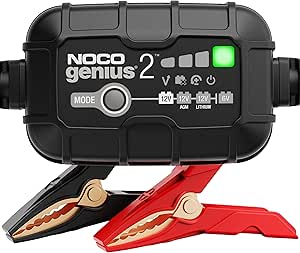 | Best for Deeply Discharged Batteries | Supported battery voltages: 6V and 12V | Amperage: 2 A | Battery types: Lead-acid, including AGM, gel, flooded, and deep-cycle; LiFePO4 | VIEW ON AMAZON | See Our Full Breakdown |
| Victron Energy Blue Smart IP22 12V 30A Battery Charger |  | Best for Fast, Connected Charging | Output voltage: 12 V DC | Input voltage: 120 V AC | Maximum output current: 30 A | VIEW ON AMAZON | See Our Full Breakdown |
| ECO-WORTHY 12V 5A Battery Charger for Lead-Acid and LiFePO4 Batteries |  | Best Value for Mixed Battery Types | Compatible batteries: 12V lead-acid and LiFePO4 | Output voltage: 12 V | Input voltage: 100–240 V AC | VIEW ON AMAZON | See Our Full Breakdown |
| NOCO GENIUS2D 2A 12V Onboard Battery Charger and Maintainer |  | Best for Permanent Onboard Maintenance | Output voltage: 12 V | Input voltage: 120 V | Current: 2 A | VIEW ON AMAZON | See Our Full Breakdown |
| Battery Tender Junior 12V 750mA Battery Charger and Maintainer |  | Best for Long-Term Storage of Small Batteries | Output voltage: 12 V | Amperage: 0.75 A | Battery types: Lead-acid, flooded, AGM, and gel cell | VIEW ON AMAZON | See Our Full Breakdown |
| Clore Automotive PL2320 20-Amp Automatic Battery Charger and Maintainer |  | Best for Flexible Charging Rates and 6V/12V Lead-Acid Batteries | Model: PL2320 | Voltage: 6 V and 12 V | Input voltage: 120 V AC | VIEW ON AMAZON | See Our Full Breakdown |
| CTEK MXS 5.0 Fully Automatic 12V Battery Charger and Maintainer |  | Best for Long-Term 12V Lead-Acid Maintenance | Output voltage: 12V | Input voltage: 120V | Compatible batteries: 12V lead-acid and AGM | VIEW ON AMAZON | See Our Full Breakdown |
| Battery Tender Plus 12V 1.25A Battery Charger and Maintainer |  | Best for Gentle, Simple Maintenance | Output voltage: 12V | Input voltage: 120V AC | Charging current: 1.25A | VIEW ON AMAZON | See Our Full Breakdown |
| E-FAST 25A Smart 12V/24V Battery Charger and Maintainer |  | Best for High-Capacity and 24V Van Systems | Output voltage: 12V and 24V | Input voltage: 110V | Maximum output: 25A at 12V; 15A at 24V | VIEW ON AMAZON | See Our Full Breakdown |
| NOCO GENIUS5 5A 6V/12V Smart Battery Charger and Maintainer |  | Best for Mixed Battery Chemistry and Recovery | Output voltage: 12V | Input voltage: 120V | Amperage: 5A | VIEW ON AMAZON | See Our Full Breakdown |
| smart battery maintainer for van | Warranty | Output voltage | Dimensions | Input voltage |
|---|---|---|---|---|
| Battery Tender 5A 12V Smart Ba | 5 years | 12 V DC | 1.87 x 3.86 x 8.3 in | — |
| PZ.P 15-Amp 12V/24V Smart Batt | 18 months | — | — | — |
| NOCO GENIUS1 1A 6V/12V Smart B | 3 years | — | — | — |
| Battery Tender 3-Amp 6V/12V Au | 5 years | — | 3.4 x 11.1 x 9.4 in | — |
| NOCO GENIUS2 2A 6V/12V Smart B | 3 years | — | — | — |
| Victron Energy Blue Smart IP22 | — | 12 V DC | 2.6 × 4.3 × 9.7 in | 120 V AC |
| ECO-WORTHY 12V 5A Battery Char | — | 12 V | 2.76 × 5.83 × 2.17 in | 100–240 V AC |
| NOCO GENIUS2D 2A 12V Onboard B | 3 years | 12 V | 3.47 × 3.43 × 6.5 in | 120 V |
| Battery Tender Junior 12V 750m | 5 years | 12 V | 3.3 × 1.3 × 2.4 in | — |
| Clore Automotive PL2320 20-Amp | 1 year | — | 8 × 9.4 × 4.5 in | 120 V AC |
| CTEK MXS 5.0 Fully Automatic 1 | — | 12V | 5.91 × 11.02 × 2.36 inches | 120V |
| Battery Tender Plus 12V 1.25A | 10 years | 12V | 2.9 × 2.15 × 4.4 inches | 120V AC |
| E-FAST 25A Smart 12V/24V Batte | — | 12V and 24V | — | 110V |
| NOCO GENIUS5 5A 6V/12V Smart B | 3 years | 12V | — | 120V |
More Details on Our Top Picks
Battery Tender 5A 12V Smart Battery Charger and Maintainer
For a van with a 12V battery that needs both charging and long-term upkeep, this Battery Tender is the most balanced pick in this group. Its 5A output is a better fit for replenishing a van battery than the 1A NOCO GENIUS1, while its automatic four-stage process shifts to float mode when charging is complete. Support for lead-acid, AGM, gel, and LiFePO4 also gives it broader battery flexibility than the 3A Battery Tender, which does not list lithium compatibility. The 11-foot combined cord reach and included ring-terminal and clamp leads help with different parking and connection setups. The tradeoff is that 5A remains modest for a large, deeply depleted van battery, and the listed 72-hour timer for marginal batteries may limit how it handles a persistently weak battery.
Pros:- Supports four battery chemistries, including LiFePO4
- Four-stage charging automatically moves to float maintenance
- 11-foot combined AC and DC cord reach with clamp and ring-terminal options
- Spark-proof connections and reverse-polarity detection
Cons:- 5A output can take a long time to replenish a large or heavily discharged van battery
- The 72-hour timer for marginal batteries may interrupt charging before a weak battery recovers
Best for: Van owners with a 12V lead-acid, AGM, gel, or LiFePO4 battery who want one charger for routine charging and plugged-in maintenance.
Not ideal for: Owners of 24V systems or large van batteries that need faster recovery; this is a 12V, 5A charger, not a high-output option.
- Output voltage:12 V DC
- Charging current:5 A
- Compatible batteries:Lead-acid, AGM, gel, and LiFePO4 lithium
- Charging stages:Qualification, bulk, absorption, and float
- Cord reach:11 ft combined: 6 ft AC and 5 ft DC
- Dimensions:1.87 x 3.86 x 8.3 in
- Weight:1.4 lb
- Warranty:5 years
Our verdict“I would choose this for a 12V van needing versatile, steady maintenance, but not for a 24V system or rapid recovery.”
PZ.P 15-Amp 12V/24V Smart Battery Charger and Maintainer
This is the lineup’s clearest choice for someone maintaining either a 12V or 24V battery. At 12V it supplies 15A, substantially more charging output than the 5A Battery Tender, and its 24V setting makes it more adaptable for vans with a higher-voltage system. The color display and nine-stage charging give more at-a-glance information than the LED indicators on the Battery Tender models, while support for LiFePO4 and several lead-acid types covers a broad range of setups. Its limits matter: the maker says it cannot charge completely dead batteries, it has one set of clamp connections, and the 6.7-foot cable is shorter than the Battery Tender’s combined 11-foot reach. I would pick it for a serviceable battery and mixed-voltage needs, not as a recovery tool or jump starter.
Pros:- Provides 15A at 12V and 8A at 24V
- Works with LiFePO4 and multiple lead-acid battery types
- Color display shows charging status and battery information
- Includes reverse-polarity, overcurrent, overvoltage, and short-circuit protections
Cons:- Cannot activate or charge completely dead batteries
- 6.7-foot cable reach may restrict placement beside a van
- Only one clamp connection is listed, with no ring-terminal cable option specified
Best for: Van owners or small-fleet operators who need one plug-in charger for compatible 12V and 24V LiFePO4 or lead-acid batteries.
Not ideal for: Drivers whose van battery may be completely dead, or anyone needing a jump starter, longer cable reach, or charging away from an AC outlet.
- Charging voltage and current:12V at 15A; 24V at 8A
- Compatible batteries:12V and 24V LiFePO4 and lead-acid, including AGM, GEL, SLA, and flooded
- Charging stages:9
- Cable length:6.7 ft
- Connector type:Battery clamps/alligator clips
- Display:Color screen
- Operating temperature:14°F to 82°F
- Warranty:18 months
Our verdict“I would choose this when 12V/24V compatibility and faster charging matter more than dead-battery recovery or long cable reach.”
NOCO GENIUS1 1A 6V/12V Smart Battery Charger and Maintainer
The GENIUS1 is the small-battery and long-storage specialist, not the right tool for quickly charging a van’s main battery. Its 1A output is far below the 5A Battery Tender and 15A PZ.P, so a depleted full-size van battery could take a long time to replenish. Where it earns a place is compact upkeep: it handles 6V and 12V lead-acid or LiFePO4 batteries, adjusts charging for ambient temperature, and can stay connected for indefinite maintenance. It also supports deeply discharged batteries down to 1V, with Force Mode for batteries at 0V—an ability the PZ.P explicitly lacks for completely dead batteries. Pulse charging is intended to help address sulfation and acid stratification. I’d reserve it for auxiliary batteries, storage, or patient maintenance rather than regular recovery of a large house battery.
Pros:- Compact charger supports 6V and 12V lead-acid and LiFePO4 batteries
- Temperature-adjusted charging adapts to ambient conditions
- Can charge batteries down to 1V and use Force Mode at 0V
- Supports indefinite connection for long-term maintenance
Cons:- 1A output makes charging a van-sized battery slow
- The listed charge-time figure is unclear, so it does not provide a useful planning estimate
Best for: Van owners maintaining a small auxiliary or starter battery during long storage, especially when compact size and support for 6V or 12V batteries matter.
Not ideal for: Owners who need to recharge a large van battery quickly; its 1A output is much lower than the 5A Battery Tender or 15A PZ.P.
- Supported battery voltages:6V and 12V
- Amperage:1 A
- Compatible battery types:Lead-acid and LiFePO4
- Minimum charge voltage:1 V; Force Mode can charge down to 0 V
- DC cable length:110 in
- Temperature adjustment:Charging adjusts for ambient temperature
- Warranty:3 years
Our verdict“I would pick the GENIUS1 for compact, patient maintenance or recovery of a smaller battery, not for fast charging a van’s main battery.”
Battery Tender 3-Amp 6V/12V Automatic Battery Charger and Maintainer
This Battery Tender suits van owners who want straightforward charging for a 6V or 12V lead-acid battery without lithium compatibility or a display. Its 3A output is a middle ground between the slow 1A NOCO GENIUS1 and the 5A Battery Tender: more useful for routine charging than the NOCO, but still modest for a large van battery. It automatically switches to float mode, and its LED provides basic status feedback. The included ring-terminal and alligator-clip combo cable and 11-foot combined reach give it practical connection flexibility. Compared with the 5A Battery Tender, though, it charges more slowly and does not list LiFePO4 support; compared with the NOCO, it also lacks 6V/12V lithium support and deep-discharge features. Its simple chemistry range is both its appeal and its boundary.
Pros:- Supports both 6V and 12V lead-acid battery systems
- Automatically switches to float mode for maintenance
- Includes ring-terminal and alligator-clip connections
- 11-foot combined cord reach with reverse-polarity detection and spark-proof leads
Cons:- 3A output is slower than the 5A Battery Tender for replenishing a large battery
- Listed compatibility excludes LiFePO4 batteries
Best for: Owners of 6V or 12V lead-acid, flooded, AGM, or gel batteries who want a simple maintainer with both clamp and permanent ring-terminal connections.
Not ideal for: Van owners with LiFePO4 batteries or a large battery that needs faster charging; this model is limited to 3A and does not list lithium compatibility.
- Supported battery voltages:6V and 12V
- Charging current:3 A
- Battery compatibility:Lead-acid, flooded, AGM, and gel
- Connectors:Ring-terminal and alligator-clip combo cable
- Combined cord reach:11 ft: 6 ft AC and 5 ft DC
- Dimensions:3.4 x 11.1 x 9.4 in
- Weight:1.4 lb
- Warranty:5 years
Our verdict“I would choose this for simple lead-acid maintenance with flexible connections, but not for lithium batteries or faster charging.”
NOCO GENIUS2 2A 6V/12V Smart Battery Charger and Maintainer
The GENIUS2 is a sensible step up from the GENIUS1 when a van owner wants deep-discharge support with a little more charging output. Its 2A current is still far below the 5A Battery Tender and 15A PZ.P, so it remains a patient charger for a full-size van battery. The added value is broader recovery flexibility: it works with 6V and 12V lead-acid or LiFePO4 batteries, can charge from 1V, and has Force Mode for batteries at 0V. Temperature adjustment and indefinite maintenance support also suit a vehicle that spends long periods parked. Compared with the GENIUS1, the GENIUS2 doubles the current; compared with the Battery Tender 5A, it gives up speed for 6V support and low-voltage recovery. Force Mode requires manual operation, and the listed charge-time figure is unclear.
Pros:- Supports 6V and 12V lead-acid and LiFePO4 batteries
- Can charge batteries from 1V, with Force Mode for 0V
- Temperature sensor adjusts charging for ambient conditions
- Supports indefinite connection and includes clamps, eyelet terminals, and mounting hardware
Cons:- 2A output is slow for replenishing a large van battery compared with the 5A Battery Tender
- Force Mode requires manual operation for completely dead batteries
- Listed battery charge-time figure is unclear
Best for: Van owners with 6V or 12V lead-acid or LiFePO4 batteries who prioritize low-voltage recovery and long-term maintenance over fast charging.
Not ideal for: Drivers who need to recharge a large van battery quickly; 2A is modest, and Force Mode requires manual operation for a battery at 0V.
- Supported battery voltages:6V and 12V
- Amperage:2 A
- Battery types:Lead-acid, including AGM, gel, flooded, and deep-cycle; LiFePO4
- Minimum charging voltage:1 V; Force Mode supports 0 V
- Included cables:72-inch AC cable and 80-inch DC cable
- Temperature adjustment:Temperature sensor adjusts charging for ambient conditions
- Included connections:Battery clamps and eyelet terminals
- Warranty:3 years
Our verdict“I would choose the GENIUS2 for low-voltage recovery and long-term care, but not when a van battery needs a quick recharge.”
Victron Energy Blue Smart IP22 12V 30A Battery Charger
The Victron Energy Blue Smart IP22 is the strongest fit here for van owners who need substantial charging output and want to monitor a charger from a phone. Its 30A adaptive charging can replenish a suitable house battery much faster than the 2A NOCO GENIUS2D or the 750mA Battery Tender Junior, while Bluetooth makes it possible to check voltage and current and adjust settings remotely. It also supports lead-acid and lithium-ion batteries, giving it broader chemistry flexibility than the lead-acid-only PL2320. The tradeoff is its single output: it cannot charge two batteries at once, and its 120V AC input means it needs shore power or a compatible inverter. Choose it for a van with a larger battery bank; skip it if your priority is a small, permanently installed maintainer.
Pros:- 30A output can charge a suitable van battery substantially faster than low-current maintainers.
- Bluetooth supports remote monitoring, setting changes, and charger updates.
- Adaptive charging supports lead-acid and lithium-ion batteries.
- Rated efficiency of up to 94%.
Cons:- Single output limits charging to one battery at a time.
- Requires 120V AC input, so it is not a direct 12V vehicle-powered charger.
- The listed charge time is 8 hours and may not suit buyers expecting rapid charging in every setup.
Best for: Van owners with a larger 12V battery who have shore power or inverter access and want app-based monitoring plus lithium compatibility.
Not ideal for: Drivers seeking a low-current onboard maintainer, charging multiple batteries simultaneously, or a charger that runs directly from the van’s 12V system.
- Output voltage:12 V DC
- Input voltage:120 V AC
- Maximum output current:30 A
- Battery compatibility:Lead-acid and lithium-ion
- Number of outputs:1
- Efficiency:Up to 94%
- Dimensions:2.6 × 4.3 × 9.7 in
- Weight:3.2 lb
- Certification:UL 1236
Our verdict“Pick the Victron for high-output, app-connected charging of one van battery when AC power is available.”
ECO-WORTHY 12V 5A Battery Charger for Lead-Acid and LiFePO4 Batteries
The ECO-WORTHY 5A takes a practical middle ground: it offers more charging current than the NOCO GENIUS2D or Battery Tender Junior, yet remains a smaller, simpler choice than the 30A Victron. Its support for both 12V lead-acid and LiFePO4 batteries is useful for van owners who have changed battery chemistry or maintain different vehicles. The included clips, O-ring leads, and fused SAE connection give you several ways to connect without sourcing a separate cable for each setup. Compared with the Victron, it lacks Bluetooth and much lower charging output, so it is less suited to frequent monitoring or a large battery that needs a quicker recharge. The stated two-hour charge time can vary with battery capacity and condition; I would treat this as a flexible maintainer and modest charger, not a guaranteed quick-charge solution.
Pros:- Supports both 12V lead-acid and LiFePO4 batteries.
- 5A output exceeds the current of the NOCO GENIUS2D and Battery Tender Junior.
- Includes battery clips, O-ring terminal leads, and an SAE connector.
- Automatic charging and maintenance functions suit storage as well as routine charging.
Cons:- No Bluetooth monitoring or remote setting control.
- 5A may be slow for a large van battery compared with the 20A PL2320 or 30A Victron.
- The listed two-hour charge time may vary substantially with battery size and condition.
Best for: Van owners with a modest 12V battery who want one charger for lead-acid or LiFePO4 and appreciate multiple connection styles.
Not ideal for: Owners of large van battery banks who need high charging current, app monitoring, or a clearly documented charging time for their particular battery.
- Compatible batteries:12V lead-acid and LiFePO4
- Output voltage:12 V
- Input voltage:100–240 V AC
- Output current:5 A
- Connector:SAE
- Fuse:10 A
- Included accessories:Battery clips and O-ring terminal cables
- Dimensions:2.76 × 5.83 × 2.17 in
- Weight:0.45 kg
Our verdict“Choose the ECO-WORTHY for a modest 12V van battery when chemistry flexibility and included connection options matter more than speed or app controls.”
NOCO GENIUS2D 2A 12V Onboard Battery Charger and Maintainer
The NOCO GENIUS2D is the most installation-oriented choice in this group: its mounting bracket, screws, and eyelet terminals make it suited to staying connected in a van rather than being moved between vehicles. At 2A, it is better viewed as a long-term maintainer for a compatible battery than as a rapid charger; the Victron’s 30A output is a much better match when a large battery needs a quicker recharge. Temperature compensation adjusts charging as conditions change, and Force Mode can address deeply discharged batteries, including those at 0V as described in the product data. Its limit is compatibility: it is for 12V lead-acid batteries up to 40Ah, not lithium or a large house bank. I’d choose it for a small auxiliary battery that stays in the van, not as the sole charger for a high-capacity camper conversion.
Pros:- Mounting hardware and eyelet terminals suit a fixed onboard installation.
- Temperature compensation adjusts charging for ambient conditions.
- Force Mode supports charging deeply discharged batteries, including batteries at 0V.
- Designed for ongoing connected maintenance and includes a 3-year warranty.
Cons:- 2A output is slow compared with the Victron Blue Smart IP22 and Clore PL2320.
- Limited to 12V lead-acid batteries with capacity up to 40Ah.
- The product data lists a 40-hour charge time.
Best for: Van owners who want to mount a charger for continuous maintenance of a 12V lead-acid auxiliary battery up to 40Ah.
Not ideal for: Owners with lithium batteries, larger house batteries, or a need to recharge quickly; its 2A output and 40Ah capacity limit narrow its role.
- Output voltage:12 V
- Input voltage:120 V
- Current:2 A
- Battery capacity:Up to 40 Ah
- Battery types:Lead-acid, including AGM, gel, flooded, marine, and RV
- Charging modes:Standard charging and Force Mode
- Cable terminals:Eyelet terminals
- Dimensions:3.47 × 3.43 × 6.5 in
- Warranty:3 years
Our verdict“Choose the GENIUS2D for a permanently mounted, low-current maintainer on a small lead-acid battery, not for a large van house bank.”
Battery Tender Junior 12V 750mA Battery Charger and Maintainer
The Battery Tender Junior is a straightforward pick for keeping a small 12V lead-acid battery charged during storage, rather than bringing a depleted van battery back quickly. After charging, it switches to float mode, while its four-step program and reverse-connection detection add useful safeguards for a charger that may remain attached for long periods. Its 12-foot output cord offers more reach than the short onboard cables listed for the NOCO GENIUS2D, but the Junior’s 750mA output is slower even than that NOCO’s 2A rate. Compared with the ECO-WORTHY 5A, it also gives up LiFePO4 compatibility. I’d favor it for a stored van’s lead-acid starting battery or another modest battery, especially when easy clip or ring-terminal connection matters; I would skip it for large house batteries or regular fast charging.
Pros:- Automatically switches to float mode after charging.
- Four-step charging program supports staged charging and ongoing maintenance.
- Includes both alligator clips and ring terminals.
- Spark-proof circuitry and reverse-connection detection support safer connection.
Cons:- 750mA output can take a long time to recharge a depleted battery.
- Limited to 12V lead-acid battery types, unlike the ECO-WORTHY’s LiFePO4 support.
- Not a practical choice for charging a large van house bank quickly.
Best for: Owners storing a van with a modest 12V flooded, AGM, or gel lead-acid battery who want automatic float maintenance and flexible terminals.
Not ideal for: Van owners with lithium batteries, large house banks, or batteries that need frequent, faster recharging; 750mA is a low charging rate.
- Output voltage:12 V
- Amperage:0.75 A
- Battery types:Lead-acid, flooded, AGM, and gel cell
- Charging program:Four-step: initialization, bulk, absorption, and float
- Connectors:Alligator clips and ring terminals
- Output cord length:12 ft
- Dimensions:3.3 × 1.3 × 2.4 in
- Weight:1 lb
- Warranty:5 years
Our verdict“Pick the Battery Tender Junior for slow, unattended maintenance of a stored 12V lead-acid battery, not for lithium or fast van-bank charging.”
Clore Automotive PL2320 20-Amp Automatic Battery Charger and Maintainer
The Clore Automotive PL2320 is the most versatile lead-acid option here if one charger needs to handle both a van battery and other 6V or 12V equipment. Its selectable 2A, 10A, and 20A rates let you favor gentler charging or move toward faster charging, a useful range missing from the single-rate Battery Tender Junior and NOCO GENIUS2D. Automatic multi-phase charging handles the charging process, while its stable power supply mode adds a function the other maintainers in this batch do not list. The tradeoff is chemistry: it supports several lead-acid types but not lithium, unlike the Victron and ECO-WORTHY. It also uses battery clamps rather than the onboard eyelet setup of the NOCO. I’d pick it for a mixed 6V/12V lead-acid workshop or van setup, but not for a lithium-powered conversion.
Pros:- Selectable 2A, 10A, and 20A charging rates suit different battery needs.
- Supports both 6V and 12V lead-acid batteries.
- Automatic multi-phase charging handles the charging process.
- Stable power supply mode adds flexibility beyond routine maintenance.
Cons:- Does not support lithium or LiFePO4 batteries, unlike the Victron and ECO-WORTHY.
- Battery clamps are less suited to a permanent onboard connection than the NOCO GENIUS2D’s eyelet terminals.
- The 1-year warranty is shorter than the listed warranties for the NOCO GENIUS2D and Battery Tender Junior.
Best for: Van owners who maintain 6V and 12V lead-acid batteries, want selectable charging rates, or need a stable power supply mode.
Not ideal for: Owners of lithium or LiFePO4 van batteries, or anyone seeking a dedicated, compact onboard charger with ring-terminal leads.
- Model:PL2320
- Voltage:6 V and 12 V
- Input voltage:120 V AC
- Charge rates:2 A, 10 A, and 20 A
- Battery types:Flooded, AGM, gel cell, spiral wound, marine, and deep cycle
- Connector type:Battery clamps
- Dimensions:8 × 9.4 × 4.5 in
- Safety certification:UL
- Warranty:1 year
Our verdict“Choose the PL2320 if you need adjustable charging for 6V and 12V lead-acid batteries; skip it for a lithium van system.”
CTEK MXS 5.0 Fully Automatic 12V Battery Charger and Maintainer
The CTEK MXS 5.0 suits van owners who want a set-and-maintain charger for a 12V lead-acid or AGM battery. Its eight-step program and float/pulse maintenance are aimed at keeping a parked van’s battery supported over time, while the reconditioning mode may help some batteries that have lost performance. Compared with the NOCO GENIUS5, CTEK is narrower in battery chemistry and voltage compatibility: it does not list 6V or LiFePO4 support. In return, its splash, dust, spark, and shock protection make it a practical choice for a garage or workshop environment. The tradeoff is charging pace; the listed charge time is 50 hours, so I would choose it for maintenance rather than rapid recovery. Its single clamp connection also makes it less convenient if a van’s battery is awkward to reach.
Pros:- Eight-step automatic charging supports a managed charge and maintenance cycle.
- Float/pulse charging is suited to keeping a parked van battery maintained.
- Reconditioning mode may help some underperforming batteries.
- Protection against splashes, dust, sparks, and shocks suits workshop use.
Cons:- Limited to 12V lead-acid and AGM batteries.
- Listed charge time of 50 hours makes it a slow choice for recovery charging.
Best for: Van owners with a 12V lead-acid or AGM battery who leave the vehicle parked for long stretches and want automatic float/pulse maintenance.
Not ideal for: Owners of LiFePO4 or 24V van batteries, or anyone who needs a quick charge rather than long-term maintenance.
- Output voltage:12V
- Input voltage:120V
- Compatible batteries:12V lead-acid and AGM
- Charging stages:8
- Connector type:Alligator clamps
- Dimensions:5.91 × 11.02 × 2.36 inches
- Weight:1.3 pounds
- Model number:40-206
Our verdict“Choose the CTEK MXS 5.0 for long-term care of a 12V lead-acid or AGM van battery, not for broad chemistry support or fast charging.”
Battery Tender Plus 12V 1.25A Battery Charger and Maintainer
The Battery Tender Plus is a low-current pick for van owners whose main goal is maintaining a healthy 12V battery between trips, not quickly charging a depleted one. Its four-step charging program and two-color status LED keep the basic process easy to follow, while the included ring-terminal harness can stay attached to the battery for convenient connection later. Compared with the CTEK MXS 5.0, this unit has a lower 1.25A output and fewer charging stages, so it is less suited to reviving a van battery after heavy discharge. Its small dimensions and support for several vehicle types make it a handy shared charger for a van, motorcycle, or lawn equipment. The limits are clear: it has just one port, and its modest current can mean a long wait on larger automotive batteries.
Pros:- Four-step program handles charging and maintenance automatically.
- Ring-terminal harness offers a convenient connection for a battery that is maintained regularly.
- Alligator clips provide an alternative connection method.
- Two-color LED gives a simple view of charging status.
Cons:- The 1.25A output is slow for charging a larger van battery.
- One charging port does not support maintaining multiple batteries at once.
Best for: Van owners who park a 12V vehicle for extended periods and want a straightforward maintainer with a quick-connect ring-terminal harness.
Not ideal for: Owners who need to recharge a large or deeply discharged van battery promptly, or who want support for 24V or LiFePO4 batteries.
- Output voltage:12V
- Input voltage:120V AC
- Charging current:1.25A
- Compatible devices:Cars, motorcycles, lawn mowers, and ATVs
- Connectors:Alligator clips and ring terminal
- Number of ports:1
- Dimensions:2.9 × 2.15 × 4.4 inches
- Warranty:10 years
Our verdict“Pick the Battery Tender Plus for uncomplicated, low-current maintenance when charging speed is not a priority.”
E-FAST 25A Smart 12V/24V Battery Charger and Maintainer
For a van owner who needs more than a small maintenance trickle, the E-FAST 25A brings adjustable output, 12V and 24V operation, and support for lead-acid and LiFePO4 batteries. Its 25A maximum at 12V gives it a different role from the lower-current NOCO GENIUS5: it can suit larger batteries and charging jobs where output matters, while five current settings let the user scale charging to the battery. Temperature-based seasonal modes and an eight-stage process add flexibility, and the 12V booster may assist in an emergency. That versatility comes with a larger, heavier unit and more settings to manage than a simple maintainer. The booster is limited to 12V, and the repair mode takes 16 hours, so neither feature makes it a fast fix for every battery problem.
Pros:- Supports 12V and 24V lead-acid batteries as well as LiFePO4.
- Up to 25A at 12V and five current settings offer flexibility across battery sizes.
- Temperature-based winter and summer modes adapt charging to conditions.
- Includes a 12V booster mode and an eight-stage process with battery repair.
Cons:- At 3.7 pounds and 8.5 × 4.9 × 7.5 inches, it is bulkier than compact maintenance-focused options.
- Booster mode works only with 12V batteries.
- Repair mode takes 16 hours.
Best for: Owners of larger vans, mixed 12V/24V fleets, or vans with LiFePO4 batteries who want adjustable charging current and broad battery compatibility.
Not ideal for: Drivers seeking a compact, simple maintainer for one conventional 12V battery, or anyone expecting the booster to work on 24V systems.
- Output voltage:12V and 24V
- Input voltage:110V
- Maximum output:25A at 12V; 15A at 24V
- Current settings:2A, 8A, 20A, 25A, and Auto
- Compatible batteries:Lead-acid (AGM, GEL, SLA, flooded, EFB) and LiFePO4
- Charging process:8-stage
- Booster mode:Up to 200 seconds; 12V batteries only
- Dimensions and weight:8.5 × 4.9 × 7.5 inches; 3.7 pounds
- Safety features:Reverse-polarity, spark, short-circuit, and overcharge protection
Our verdict“Choose the E-FAST when your van’s battery system calls for higher current, 24V support, or LiFePO4 compatibility and you can accommodate a larger charger.”
NOCO GENIUS5 5A 6V/12V Smart Battery Charger and Maintainer
The NOCO GENIUS5 is a flexible mid-current choice for van owners who want one charger for a 12V lead-acid battery and other batteries, including LiFePO4. Its temperature sensor adjusts charging to surrounding conditions, while support for batteries as low as 1V and manual Force Mode can help with a deeply discharged battery. Compared with the CTEK MXS 5.0, it adds 6V and LiFePO4 compatibility, though the CTEK specifies an eight-step program and reconditioning function for its supported battery types. At 5A, the NOCO is more capable than the Battery Tender Plus for a larger battery, but it remains far below the E-FAST 25A when faster charging or 24V support is needed. Force Mode also requires manual operation, so it is not a completely hands-off recovery option.
Pros:- Works with 6V and 12V lead-acid and LiFePO4 batteries.
- Temperature sensing adjusts charging to ambient conditions.
- Supports batteries as low as 1V, with Force Mode for completely dead batteries.
- Includes battery clamps, eyelet terminals, mounting hardware, and long AC and DC cables.
Cons:- Force Mode requires manual operation.
- The 5A output is slower than the E-FAST 25A for larger or depleted van batteries.
- Does not support 24V batteries.
Best for: Van owners with a 6V or 12V lead-acid or LiFePO4 battery who want temperature-adjusted charging and a way to address deeply discharged batteries.
Not ideal for: Owners of 24V van systems or large batteries needing high-current charging, and users who prefer recovery modes that need no manual activation.
- Output voltage:12V
- Input voltage:120V
- Amperage:5A
- Battery compatibility:6V and 12V lead-acid and LiFePO4
- Maximum battery capacity:120Ah
- Battery charge time:8 hours
- Included cables:72-inch AC cable and 80-inch DC cable
- Warranty:3 years
Our verdict“Choose the GENIUS5 for versatile 6V/12V charging and recovery features, but select a higher-current model for faster work on a large van battery.”

How We Picked
I ranked these maintainers around the jobs van owners actually face: keeping a parked vehicle ready, recovering a battery between trips, and supporting a larger or dual-purpose electrical setup. The main criteria were charging output, stated battery voltage and chemistry support, usability for portable or onboard installation, and how well each model’s role matched a van owner’s likely needs. I also weighed whether a product’s added capacity or installation features justify the extra complexity for someone who only needs storage maintenance.
The ranking favors adaptable choices that balance practical charging power and straightforward use, which puts the Battery Tender 5A first. Higher-output units rank well for vans with greater charging demands but are not automatic winners for simple storage care. Low-output models remain useful for long-term maintenance, though they rank lower as all-purpose van chargers. I treat stated compatibility and output as product distinctions, not proof that a charger suits every van battery; buyers should confirm the exact battery type and manufacturer requirements before connecting one.
Factors to Consider When Choosing Smart Battery Maintainer For Vans
Before choosing a model, I would start with the van’s battery and how it is used, not the charger’s largest headline number. These broader checks can prevent a mismatch between a maintainer designed for storage and a charger expected to restore a heavily discharged battery.
Match the charger to the battery’s job
A starter battery and a house battery may serve different purposes and may not share the same chemistry or charging needs. A maintainer can help a parked van’s starter battery stay ready, but that does not mean it can manage every battery in a camper conversion. Check the battery label and manufacturer guidance for voltage and chemistry before choosing a unit. If your van has separate starter and auxiliary batteries, decide whether you need one charger for one battery or a charging arrangement designed for both. A common mistake is buying a charger based on the word “smart” without checking its supported battery types. Chemistry compatibility should take priority over brand familiarity or extra modes.
Choose output for charging speed, not just storage
Low-output maintainers such as 750mA, 1A, or 2A models are better suited to keeping a healthy battery topped up over time than quickly restoring a depleted one. A 5A unit offers a broader middle ground, while 20A to 30A models address more demanding charging needs. Higher output does not make a charger inherently better for a van that sits with a small starter battery and only needs routine maintenance. Consider the battery’s capacity, its state of charge, and the charging time you can allow. Avoid expecting a small maintainer to recover a deeply discharged battery quickly. Check the battery maker’s permitted charging current before moving to a higher-output option.
Separate portable convenience from onboard installation
A portable charger can move between a van, a second vehicle, or a battery kept in storage, but it needs a safe place to connect and store it each time. An onboard maintainer can make repeat charging less of a chore when the van regularly returns to the same parking spot. That convenience depends on a suitable installation location, power access, and correct wiring. Do not assume an onboard label means installation is plug-and-play; follow the maker’s mounting and connection instructions. If the van is used in different locations, portability may matter more than permanent wiring. The right choice depends on where the van is parked as much as on how it is driven.
Check voltage and chemistry before counting on compatibility
Some models in this lineup support 6V and 12V batteries, others are 12V-only, and several support 12V/24V systems. Those labels describe electrical compatibility, not necessarily the battery chemistry or charging profile you need. Read the product’s supported battery types and modes alongside the battery manufacturer’s specifications. This matters especially for vans with LiFePO4 house batteries, since lead-acid charging assumptions may not apply. A charger that fits the vehicle’s voltage can still be the wrong match for its chemistry. If the van has multiple battery banks, check whether the product can serve the arrangement you plan to charge.
Plan for parking conditions and safe cable routing
How and where the van sits affects the practicality of any maintainer. A unit used in a garage needs a reliable mains outlet and cable routing that will not be pinched by a door or exposed to water. If the vehicle is stored outdoors, check the product’s stated environmental protection rather than assuming it can remain connected in all weather. Keep clamps and leads away from moving parts, hot components, and areas where people can trip over them. A permanent setup may reduce repeated handling, but it also makes correct installation more important. Think through the actual parking arrangement before choosing based on charging specs alone.
Pay for capacity or features only when your routine needs them
A higher-output charger or more involved setup earns its place when you frequently charge a larger battery, need faster recovery, or want a fixed van installation. For a vehicle that is stored with a healthy battery and checked regularly, a simple low-output maintainer may be enough. Dual-voltage capability can help owners with more than one vehicle, though it adds little value if every battery they own is 12V. Likewise, a compact unit is easier to store but may be slower for recovery charging. Decide which task happens most often, then select around that task rather than paying for unused capacity. This keeps the charger’s complexity aligned with your van ownership routine.
Frequently Asked Questions
Can a 1A or 2A maintainer keep a van battery charged while it is parked?
It can suit long-term maintenance when the battery is in sound condition and the charger supports its voltage and chemistry. These lower-output models are not the best choice when you need to restore a deeply discharged battery quickly. The van’s battery capacity and any ongoing electrical draw also affect how well a small unit can keep up. Check the charger and battery instructions for a suitable use case, and do not treat a maintainer as a fix for a battery that repeatedly loses charge. If the van has substantial parasitic draw, diagnose that problem rather than relying on a small charger to mask it.
Should I choose a 5A maintainer or a 20A-plus charger for a camper van?
Start with whether you need ongoing maintenance or faster charging after significant battery use. A 5A model is a more moderate choice for routine upkeep and light recovery, while a 20A or higher unit is aimed at larger charging demands. The battery’s permitted charge rate matters: more output is not automatically suitable for every battery. A camper van with a separate house battery may also need a charger intended for that battery chemistry and capacity. If you only maintain a starter battery during storage, the higher-output option may add capability you rarely use.
Can I use one maintainer for my van’s starter battery and LiFePO4 house battery?
Do not assume a single charger can safely serve both batteries just because they share a nominal voltage. The charger must explicitly support the chemistry and charging profile of each battery, and the batteries may need separate charging connections or equipment. In this lineup, ECO-WORTHY specifically lists lead-acid and LiFePO4 support; confirm its instructions match your exact battery setup. Check the battery manufacturer’s guidance as well, especially if the house battery has a built-in management system. If compatibility is unclear, ask the battery or charger maker before connecting it.
Is an onboard maintainer worth installing in a van?
An onboard model can make sense when the van regularly parks near mains power and you want charging connections ready without setting up a portable unit each time. It is less compelling if you move the charger between vehicles or rarely have access to a suitable outlet. Installation adds a wiring and mounting task, so follow the product instructions and use an appropriate location. Compare that permanent convenience with the flexibility of a portable charger before deciding. The NOCO GENIUS2D is the lineup’s dedicated onboard option, while the other listed models offer a more portable approach.
What should I check if my van battery still goes flat with a maintainer connected?
First verify that the charger is powered, connected correctly, and set for the battery’s voltage and chemistry. Then inspect the battery’s condition and check whether the van has an electrical draw that exceeds the maintainer’s output. A small maintainer may not keep up with accessories left running or a fault that drains the battery. Review the charger’s status indicators and instructions rather than assuming a connected unit is charging normally. If the battery repeatedly fails to hold charge, have the battery and vehicle charging system checked.
Conclusion
For most van owners seeking one practical balance of charging capacity and everyday maintenance, I recommend the Battery Tender 5A as the best overall choice. The NOCO GENIUS5 is a strong alternative if you want a 5A unit with 6V/12V support, while the Battery Tender Junior is the value-minded pick for simple, low-draw storage maintenance rather than fast recovery. Beginners who want a straightforward, moderate-output option can start with the Battery Tender 3-Amp, after confirming battery compatibility. For premium, higher-demand charging, consider the Victron Energy Blue Smart IP22 30A; for a permanent onboard setup, choose the NOCO GENIUS2D. If your van uses LiFePO4 batteries, give chemistry compatibility priority and check the ECO-WORTHY 12V 5A specifications against your battery maker’s requirements.
Evergreen bestsellers Picks

Samsung 65-Inch Class M70H Series 4K Mini LED Smart TV (2026)

TCL 55 T7 Series 4K 120Hz QLED Smart Google TV (55T7)

De'Longhi Magnifica Duo Fully Automatic Espresso Machine with Milk Frother, Silver
As an affiliate, we earn on qualifying purchases.