
TL;DR

Get business pricing on garage and car supplies
- Business-only prices and quantity discounts
- Tax-exempt purchasing
- Multiple users, one account, clear invoices
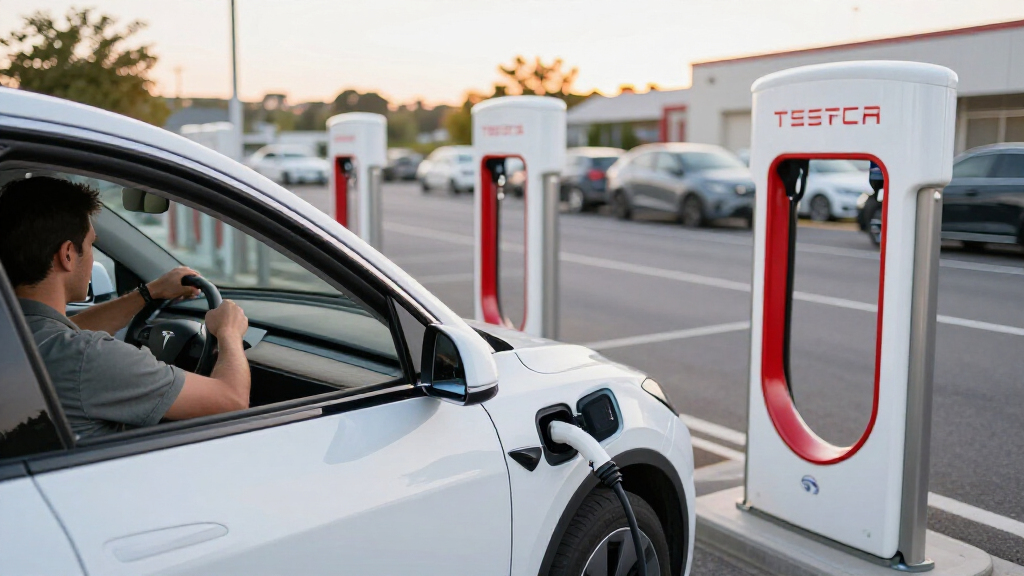
Tesla is rolling out Emergency Drive Away, an over-the-air feature that lets some vehicles shift into Drive and pull away while still plugged into a Supercharger. The company says it is for emergencies only and warns that using it will damage the vehicle and charger; availability is limited by model year, software version and location.
Tesla is rolling out Emergency Drive Away, a software feature that lets eligible cars shift into Drive and leave a Supercharger while still connected to its cable. Announced by Tesla Charging on X, the option is intended for emergencies and is designed to let drivers leave quickly without first unplugging manually, but the company warns that activating it will damage both the vehicle and the Supercharger.
To use the feature, a driver shifts into Drive while the charging connector is attached. An alert then appears on the car’s touchscreen; the driver must confirm before pulling away. Tesla’s demonstration shows the cable connection breaking as the vehicle moves, with a component falling to the ground. The video indicates the release is not damage-free.
Tesla said in a reply on X that Emergency Drive Away is “intended for emergency use only” and that it “will damage your vehicle and the Supercharger.” The company also warned of additional penalties for deliberate misuse. The feature requires software version 2026.38.3, is limited to U.S. Superchargers and does not work with pre-2021 Model S sedans or Model X crossovers.
The update is being delivered over the air, so compatible vehicles can receive it without a service-center visit. The source report does not specify how quickly the rollout will reach all eligible cars or whether every U.S. Supercharger site will support it at the same time.
A Costly Option for Leaving Fast
The feature addresses a narrow but serious situation: a driver may need to leave a charging location immediately and cannot safely spend time disconnecting the cable. It gives eligible Tesla drivers a way to override the normal shift lockout while connected, rather than requiring them to remain beside the charger to unplug first. The announcement follows a lethal shooting at a Tesla Supercharger in Idaho this summer, which The Drive cited as the immediate reason for the update.
That emergency option comes with a trade-off. Tesla’s warning that the vehicle and charger will be damaged means this is not a routine convenience feature or a substitute for ordinary unplugging. Damage could also leave equipment unavailable until it is inspected or repaired. The company’s warning about penalties for deliberate misuse signals that Tesla intends the feature to be reserved for genuine emergencies, although the source material does not detail how misuse would be assessed.
The feature may also be relevant to drivers who have difficulty handling heavy DC fast-charging cables. But it does not solve that access problem without potential damage: a driver who simply cannot manage the connector would still need another safe way to disconnect unless facing an emergency. Tesla’s announcement, as described in the report, presents the feature as an emergency exit mechanism, not an accessibility tool.
Products Worth Considering

Autel Home EV Charger up to 50A J1772 Hardwired Level 2 Charger with 25 ft Cable

Autel MaxiCharger Level 2 EV Charger, 40A, 240V, Indoor/Outdoor, 25‑Foot Flexible Cable, NEMA 14‑50 Plug (White)

Innova 5610 OBD2 Bidirectional Scan Tool
As an affiliate, we earn on qualifying purchases.
How the Supercharger Release Works
Tesla vehicles normally prevent shifting into Drive while a charging cable is connected. Emergency Drive Away changes that behavior after the driver confirms an on-screen warning. The connector is designed to break away when the car moves, allowing the vehicle to leave without taking the charging cable and equipment along with it. Tesla’s demonstration also shows why the company describes the action as damaging rather than as a normal release.
Tesla has delivered other software features through over-the-air updates, but this one is tied to a specific safety concern rather than a general charging improvement. The company’s announcement was made through the Tesla Charging account on X earlier this week, according to The Drive. The account’s demonstration and replies are the source for the feature’s stated operating process and warnings.
The limits matter for owners checking whether they can use it: the stated software requirement is 2026.38.3; pre-2021 Model S and Model X vehicles are excluded; and the feature applies only at U.S. Superchargers. The source report does not describe support at non-Tesla charging networks.
““Intended for emergency use only.””
— Tesla Charging, in a reply on X
Rollout and Damage Details Remain Open
The announcement does not establish how long the rollout will take, how Tesla will identify or review emergency use, or what the stated additional penalties for deliberate misuse could involve. The report also does not give repair costs, explain which specific parts may be damaged in different cases, or say how quickly a damaged Supercharger would return to service.
It is also unclear whether Tesla plans to extend the feature to excluded vehicles, charging locations outside the United States or other charging networks. The demonstration shows a connector breaking away, but the source material does not provide technical details about how the system behaves in different cable or charger conditions. Tesla has not, in the cited material, described a way to disconnect without causing damage.
Owners Should Check Software Availability
Tesla owners can check whether their vehicle has received software version 2026.38.3 and whether their model and charging location meet the stated limits. Drivers should treat the feature as an emergency-only option and follow the touchscreen warning; Tesla says using it will damage the vehicle and Supercharger. Further information from Tesla about rollout timing, penalties and repair procedures would clarify how the feature will operate in practice.
Key Questions
What does Tesla Emergency Drive Away do?
It lets an eligible Tesla shift into Drive and pull away while still connected to a Supercharger, after the driver confirms an alert on the touchscreen. The charging connection breaks as the car moves.
Will using Emergency Drive Away damage the car?
Yes. Tesla says the feature will damage the vehicle and the Supercharger and is intended for emergency use only.
Which Tesla vehicles and chargers are eligible?
The feature requires software version 2026.38.3, is limited to U.S. Superchargers and does not work with pre-2021 Model S or Model X vehicles, according to the report.
Can drivers use it as a normal way to unplug?
No. Tesla says it is for emergencies and warns that deliberate misuse may lead to additional penalties. The source material does not specify what those penalties are.
Source: rss