
As a transit owner, you’ll notice EU van regulations focus heavily on strict safety standards, advanced emission controls, and promoting eco-friendly technologies, while US rules offer more flexibility with safety features and have historically been less stringent on emissions. EU requirements can impact vehicle design and maintenance, whereas US standards influence long-term costs and compliance routines. Continuing these insights will help you better understand how these regulatory differences affect your fleet management.
Open a free Amazon Business account
Business pricing, bulk buying and tax-exempt orders.
As an affiliate, we earn on qualifying purchases.
Key Takeaways
- EU mandates rigorous safety standards and advanced crash testing, while the U.S. emphasizes crashworthiness and electronic stability controls with more flexibility.
- EU enforces stricter emission limits and requires advanced emission control technologies, unlike the more lenient U.S. standards.
- EU promotes energy-efficient and alternative fuel vehicles, with regulations incentivizing greener technology; U.S. standards are less aggressive but tightening.
- EU’s detailed regulations impact vehicle design, maintenance, and compliance routines, whereas U.S. regulations allow more flexibility in safety features.
- Fleet operators must navigate regional differences to ensure vehicle compliance, safety, and environmental standards across EU and U.S. markets.
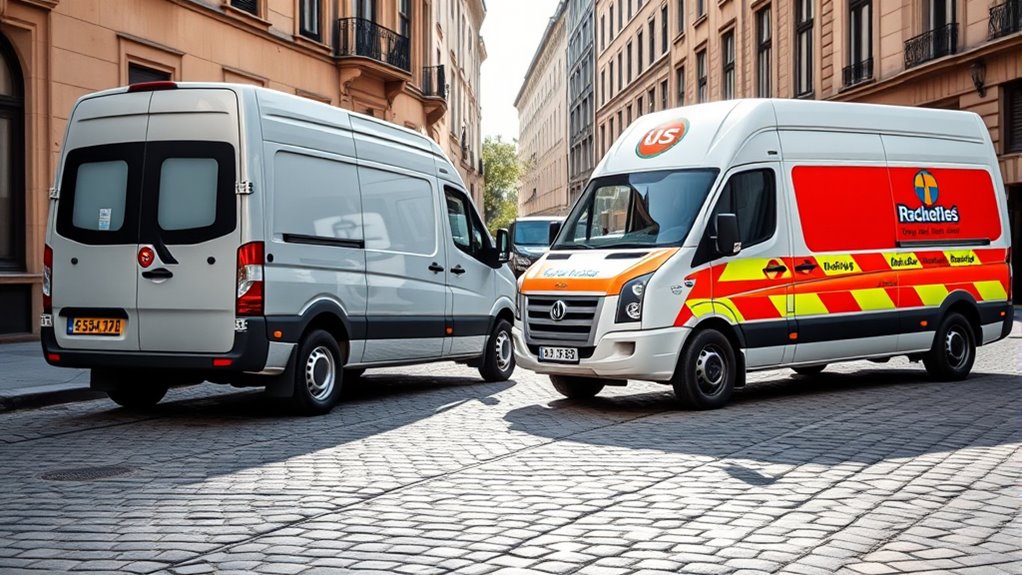
When it comes to van regulations, the European Union and the United States have developed distinct standards that impact manufacturers and drivers alike. If you’re operating or considering acquiring a van, understanding these differences is vital, especially regarding vehicle safety and emission standards. In the EU, regulations prioritize safety through rigorous testing and a thorough approval process before a van hits the road. This includes strict crash safety tests, mandatory safety features like advanced braking systems, and clear labeling to ensure vehicles meet high safety benchmarks. The EU’s vehicle safety standards aim to minimize accidents and protect occupants and pedestrians alike, making safety a top priority for manufacturers. Meanwhile, emission standards in the EU are among the strictest globally. The EU enforces detailed regulations to reduce pollutants, including limits on nitrogen oxides (NOx), particulate matter, and carbon dioxide (CO2). Manufacturers must comply with these standards by employing advanced emission control technologies, such as particle filters and selective catalytic reduction systems. As a result, vans sold in Europe tend to have lower emission footprints, aligning with the EU’s aggressive climate goals. Additionally, the EU’s emphasis on energy-efficient technology encourages manufacturers to innovate and develop cleaner vehicle options. This focus on sustainable design also promotes the integration of alternative fuel systems, which are increasingly becoming standard in new models. Moreover, the EU’s regulatory framework often incentivizes the adoption of alternative fuel systems, fostering a shift toward greener transportation options. Increased investment in alternative fuel infrastructure further supports this transition, making alternative fuels more accessible for fleet operators. Across the Atlantic, U.S. regulations also place a strong emphasis on vehicle safety, but the approach differs. The U.S. relies heavily on the Federal Motor Vehicle Safety Standards (FMVSS), which specify minimum safety performance requirements. These include crashworthiness, airbag deployment, and electronic stability controls. While these standards ensure the safety of vehicles on American roads, they sometimes offer manufacturers more flexibility in how safety features are implemented compared to the EU’s prescriptive rules. Regarding emission standards, the U.S. has historically been more lenient than Europe, although recent advancements have brought stricter regulations. The Environmental Protection Agency (EPA) enforces emission limits, which are less aggressive than the EU’s but are tightening over time. U.S. manufacturers often have to incorporate emission-reducing technologies like catalytic converters and fuel-injection controls, but they might not face the same level of restrictions as their European counterparts. For transit owners, these regulatory differences mean you need to be aware of where your van is registered and operated. EU compliance often requires adherence to more detailed safety and environmental standards, which can influence purchase decisions and maintenance routines. In the U.S., regulatory requirements might be less demanding but are evolving, especially around emissions, which could impact long-term operating costs and vehicle lifespan. Additionally, understanding the regulatory landscape helps fleet managers anticipate future compliance needs and plan for technological upgrades accordingly. Ultimately, understanding these standards helps you guarantee your fleet remains compliant, safe, and environmentally responsible, regardless of where your operations take place.

For 2015-2025 Ford Transit 350 DRW 16 Inch Painted Silver Rim - OE Direct Replacement - Road Ready Van Wheel
- Compatibility: Compatible with OEM equipment including TPMS sensors and lug nuts
- Easy Installation: Engineered for straightforward, factory-accurate fit
- Versatile Fitment: Suitable for single, full set, or spare replacements
As an affiliate, we earn on qualifying purchases.
Frequently Asked Questions
How Do Emission Standards Differ Between the EU and US Vans?
You’ll find that EU vans face stricter emission standards, requiring rigorous emission testing to meet environmental standards. In contrast, US regulations are generally more lenient, with phased implementation for cleaner emissions. As a transit owner, you need to stay updated on these differences to guarantee compliance. The EU’s focus on reducing pollutants leads to tighter controls, while the US emphasizes gradual improvements, impacting vehicle design and operational costs.
Are There Specific Safety Features Mandated Differently in EU and US Vans?
Did you know US vans require more advanced safety features? In the US, vehicle security mandates include electronic stability control and backup cameras, which are standard. EU vans focus heavily on pedestrian safety, requiring features like advanced emergency braking systems. These safety features directly influence how you design and operate your fleet, ensuring compliance and better protection for drivers and cargo alike. Staying updated helps you meet regulations efficiently.
What Are the Differences in Van Registration Processes Across the Regions?
You’ll find registration procedures differ markedly between the EU and US. In the EU, you typically need to submit detailed documentation, including proof of compliance with regional safety standards, and register through local authorities, often requiring vehicle inspections. In the US, registration is usually simpler, focusing on proof of ownership, emissions testing, and insurance, with documentation requirements varying by state. Be prepared for regional variations in both regions’ registration processes.
How Do Fuel Efficiency Requirements Vary Between EU and US Regulations?
You might think fuel efficiency requirements are similar, but they actually differ markedly. In the EU, stricter fuel economy standards push you to adopt greener technologies for regulatory compliance. Meanwhile, US regulations focus on optimizing fuel economy through different testing procedures and emission standards. Staying aware of these differences helps you meet regional mandates effectively, ensuring your vans are compliant and environmentally friendly across markets.
Are There Regional Restrictions on Van Modifications in the EU Versus US?
Yes, regional restrictions on van modifications differ between the EU and US. In the EU, you face stricter aesthetic restrictions and more controls over regional customization to guarantee uniformity and safety standards. The US offers greater flexibility, allowing more extensive modifications and personalized touches. You should always verify local regulations before customizing your van, as these regional restrictions impact how you can modify and personalize your vehicle in each region.

Van Shelving Package - Set of 3 for Ford Transit Medium & High Roof
- Number of Shelving Units: Set of 3 steel units
- Dimensions: 59"High x 45"Long x 16"Deep
- Compatibility: Fits Ford Transit 2015-2025
As an affiliate, we earn on qualifying purchases.
Conclusion
Understanding the key differences between EU and US van regulations helps you navigate the complexities of transit ownership more confidently. With each region’s unique standards, aren’t you glad to be better equipped for compliance and safety? Staying informed ensures you avoid costly mistakes and keep your operations running smoothly. So, why settle for uncertainty when knowledge empowers you to make smarter decisions and protect your investment? The choice is clear—be proactive and stay ahead of the regulations.

for 2015-2025 Ford Transit 150 16 Inch Painted Silver Rim - OE Direct Replacement - Road Ready Van Wheel
- Vehicle Compatibility: Fits 2015-2025 Ford Transit 150
- Finish: Painted Silver
- Tire Size: 215/75R16
As an affiliate, we earn on qualifying purchases.
College move-in / dorm season Picks
dorm essentials
As an affiliate, we earn on qualifying purchases.