For most owners, I’d start with the NOCO GENIUS10: its 10A output is a useful middle ground for maintaining and recharging a Transit battery without stepping up to a bulky high-output unit. The E-FAST 25A suits buyers who need faster charging and 12V/24V flexibility, while the NOCO GENIUS5 is a simpler match for routine 12V battery care. The main tradeoffs are charging speed, battery-voltage compatibility, portability, and whether you need an onboard charger or only a plug-in maintainer. A Transit’s battery type, capacity, and electrical setup matter more than the model name alone. Read on for the full comparison and guidance on choosing a charger that fits your van and parking routine.

Get business pricing on garage and car supplies
- Business-only prices and quantity discounts
- Tax-exempt purchasing
- Multiple users, one account, clear invoices
Complete the kit


Key Takeaways
- The NOCO GENIUS10 is the roundup’s best overall balance: it offers more charging capacity than the 1A and 2A maintainers without moving into the high-output, engine-start category.
- Higher amperage is useful when a Transit battery needs a quicker recharge, not automatically better for storage. The 25A E-FAST and TowerTop stand apart for higher-output needs, while lower-output models suit long-term maintenance.
- Several chargers are limited to 12V systems, while others support 6V or 24V batteries. That flexibility matters for owners maintaining more than one vehicle, but Transit owners should verify their van’s battery system before paying for it.
- The NOCO GENIUS2D is the distinct fit for a fixed installation: its onboard design addresses a different need from portable plug-in chargers, which are easier to move between vehicles.
- Small maintainers trade speed for gentle upkeep. The GENIUS1, GENIUS2, VibeXtr, and MOTOPOWER are better suited to extended maintenance than recovering a deeply discharged van battery quickly.
| NOCO GENIUS5 5A 6V/12V Smart Battery Charger and Maintainer |  | Best Overall for Routine Transit Battery Care | Amperage: 5A | Battery compatibility: 6V and 12V lead-acid and LiFePO4 | Maximum battery capacity: 120Ah | VIEW LATEST PRICE | See Our Full Breakdown |
| VibeXtr 1.5A 6V/12V Automatic Car Battery Charger & Maintainer |  | Best for Long-Reach Maintenance | Output voltage: 6V / 12V | Current: 1.5A | Input voltage: 120V | VIEW LATEST PRICE | See Our Full Breakdown |
| E-FAST 25A Smart 12V/24V Battery Charger and Maintainer with Booster Mode |  | Best for Fast Charging and 24V Systems | Output voltage: 12V / 24V | Maximum current: 25A at 12V | 24V output current: 15A | VIEW LATEST PRICE | See Our Full Breakdown |
| NOCO GENIUS1 1A 6V/12V Smart Battery Charger and Maintainer |  | Best for Low-Draw Storage Maintenance | Amperage: 1A | Battery compatibility: 6V and 12V lead-acid and LiFePO4 | Battery capacity: Up to 30Ah | VIEW LATEST PRICE | See Our Full Breakdown |
| 12V 6A Smart Battery Charger and Maintainer, Blue |  | Best for a Simple 12V Setup | Amperage: 6A | Voltage: 12V | Input: AC 110–240V, 50/60Hz | VIEW LATEST PRICE | See Our Full Breakdown |
| 12V 6A Automatic Smart Car Battery Charger and Maintainer |  | Best Compact, Straightforward Maintainer | Output voltage: 12V | Charging current: 6A | Compatible battery types: AGM, GEL, SLA, flooded lead-acid | VIEW LATEST PRICE | See Our Full Breakdown |
| NEXPEAK 10-Amp Smart Battery Charger and Maintainer for 12V/24V Batteries |  | Best for 12V/24V Flexibility | Output voltage: 12V or 24V | Charging current: 10A at 12V; 5A at 24V | Charging stages: 7 | VIEW LATEST PRICE | See Our Full Breakdown |
| CTEK MXS 5.0 Fully Automatic 12V Battery Charger and Maintainer, 4.3A |  | Best for Weather-Exposed Storage | Output voltage: 12V | Current: 4.3A | Input voltage: 120V | VIEW LATEST PRICE | See Our Full Breakdown |
| Corebox 12V 6-Amp Automatic Smart Battery Charger and Maintainer |  | Best for Reach and Flexible Connection | Output voltage: 12V | Charging current: 6A | Charging stages: 7 | VIEW LATEST PRICE | See Our Full Breakdown |
| TowerTop 12V Smart Battery Charger and Maintainer, 2A/10A/25A, with Engine Start and Battery Repair |  | Best High-Current Option | Output voltage: 12V | Charging current settings: 2A, 10A, 25A, Auto | Maximum charging current: 25A | VIEW LATEST PRICE | See Our Full Breakdown |
| NOCO GENIUS10 10A Smart Battery Charger and Maintainer |  | Best for Faster Garage Charging | Output voltage: 12 volts | Input voltage: 120 volts | Charging current: 10 A | VIEW LATEST PRICE | See Our Full Breakdown |
| NOCO GENIUS2 2A 6V/12V Smart Battery Charger and Maintainer | 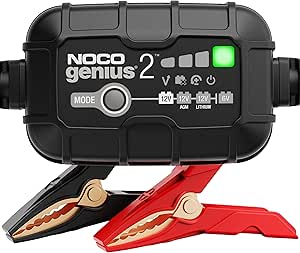 | Best for Low-Draw Maintenance | Charging current: 2 A | Battery voltage support: 6V and 12V | Compatible battery types: Lead-acid and LiFePO4 | VIEW LATEST PRICE | See Our Full Breakdown |
| MOTOPOWER MP00205A 12V 800mA Automatic Battery Charger, Maintainer, and Desulfator |  | Best Simple Lead-Acid Maintainer | Output voltage: 12V DC | Input voltage: 110V AC | Charging current: 800mA | VIEW LATEST PRICE | See Our Full Breakdown |
| NOCO GENIUS2D 2A 12V Onboard Battery Charger and Maintainer |  | Best Onboard Mounting Option | Output voltage: 12 volts | Input voltage: 120 volts | Charging current: 2 A | VIEW LATEST PRICE | See Our Full Breakdown |
| Ford Transit cargo van battery charger | Input voltage | Output voltage | Warranty | Charging current |
|---|---|---|---|---|
| NOCO GENIUS5 5A 6V/12V Smart B | 120V | — | 3 years | — |
| VibeXtr 1.5A 6V/12V Automatic | 120V | 6V / 12V | 1 year | — |
| E-FAST 25A Smart 12V/24V Batte | — | 12V / 24V | — | — |
| NOCO GENIUS1 1A 6V/12V Smart B | 120V | — | 3 years | — |
| 12V 6A Smart Battery Charger a | — | — | — | — |
| 12V 6A Automatic Smart Car Bat | — | 12V | — | 6A |
| NEXPEAK 10-Amp Smart Battery C | 110V | 12V or 24V | — | 10A at 12V; 5A at 24V |
| CTEK MXS 5.0 Fully Automatic 1 | 120V | 12V | — | — |
| Corebox 12V 6-Amp Automatic Sm | 120V | 12V | 2 years | 6A |
| TowerTop 12V Smart Battery Cha | 120V AC | 12V | — | — |
| NOCO GENIUS10 10A Smart Batter | 120 volts | 12 volts | 3 years | 10 A |
| NOCO GENIUS2 2A 6V/12V Smart B | — | — | 3 years | 2 A |
| MOTOPOWER MP00205A 12V 800mA A | 110V AC | 12V DC | 2 years | 800mA |
| NOCO GENIUS2D 2A 12V Onboard B | 120 volts | 12 volts | 3 years | 2 A |
More Details on Our Top Picks
NOCO GENIUS5 5A 6V/12V Smart Battery Charger and Maintainer
For a Transit owner who wants one charger for regular battery upkeep without stepping up to a large shop-style unit, I’d put the NOCO GENIUS5 first. Its 5A output is a more practical fit for a van battery than the GENIUS1’s 1A trickle-oriented output, while remaining compact enough for home storage. It supports 6V and 12V lead-acid and LiFePO4 batteries, and temperature-adjusted charging helps tailor the process as conditions change. The included eyelet terminals also make a semi-permanent connection easier than clamp-only setups. Its tradeoff is speed: 5A can still take time with a large or deeply depleted Transit battery, and the listed output-voltage spec says 12V despite 6V compatibility. I’d choose the E-FAST for faster charging or 24V use, but for ordinary 12V van maintenance, this is the more measured all-rounder.
Pros:- 5A output is a stronger fit for a van battery than the 1A NOCO GENIUS1
- Compatible with 6V and 12V lead-acid and LiFePO4 batteries
- Temperature-adjusted charging and indefinite connected maintenance support ongoing upkeep
- Includes clamps, eyelet terminals, and mounting hardware
Cons:- 5A output may make charging a large or heavily discharged battery slow
- Product specs list 12V output despite stated 6V battery compatibility
Best for: Transit owners who want a versatile charger for routine 12V battery charging and long-term maintenance, including owners with compatible LiFePO4 batteries.
Not ideal for: Fleet operators who need to recharge large, depleted batteries quickly, or owners who need a clearly specified 24V charger.
- Amperage:5A
- Battery compatibility:6V and 12V lead-acid and LiFePO4
- Maximum battery capacity:120Ah
- Input voltage:120V
- Battery charge time:8 hours
- AC cable length:72 inches
- DC cable length:80 inches
- Warranty:3 years
Our verdict“Choose the GENIUS5 for flexible, ongoing care of a Transit’s 12V battery, but pick the E-FAST if higher charging current or 24V support matters more.”
VibeXtr 1.5A 6V/12V Automatic Car Battery Charger & Maintainer
The VibeXtr’s clearest advantage for a parked Transit is its 10-foot cable: it gives more flexibility when the van sits far from an outlet, unlike the shorter leads listed for the NOCO GENIUS5. At 1.5A, it is best viewed as a maintenance and gradual-recovery charger, not a quick way to restore a depleted cargo-van battery before a shift. Its automatic operation, temperature compensation, and compatibility with lead-acid types and LiFePO4 give it broader battery coverage than the 12V-only Ywdiml 6A charger. Pulse repair is another feature, though it should not be treated as a guarantee that a failing battery can be revived. The main compromises are the low current for a large Transit battery, clamp-only connections, and a plastic housing that may feel less robust than the E-FAST’s aluminum case.
Pros:- 10-foot cable provides more placement flexibility than the listed NOCO GENIUS5 leads
- Supports 6V and 12V lead-acid, AGM, Gel, SLA, flooded, and LiFePO4 batteries
- Temperature compensation and automatic charging support unattended upkeep
- Pulse repair function is included for desulfation and recovery attempts
Cons:- 1.5A output is slow for a large or substantially discharged Transit battery
- Alligator clamps are less suited to a permanent connection than eyelet terminals
- Plastic housing is a less rugged design than the aluminum E-FAST
Best for: Transit owners who park within reach of a household outlet but need extra cable length for slow battery maintenance across several battery types.
Not ideal for: Drivers who need a fast recharge before returning a work van to service, or anyone seeking permanent ring-terminal connections and a rugged metal case.
- Output voltage:6V / 12V
- Current:1.5A
- Input voltage:120V
- Compatible battery types:Lead Acid, AGM, Gel, SLA, flooded, LiFePO4
- Cable length:10 ft
- Connector type:Alligator clamps
- Dimensions:3.35 × 2.18 × 1.96 in
- Warranty:1 year
Our verdict“Pick the VibeXtr when cable reach and broad battery compatibility matter more than charging speed or a permanent connection.”
E-FAST 25A Smart 12V/24V Battery Charger and Maintainer with Booster Mode
The E-FAST is the performance pick here: its up-to-25A 12V output can replenish a compatible Transit battery much faster than the NOCO GENIUS5 or GENIUS1, both of which trade speed for smaller, maintenance-focused designs. Five current settings let owners choose a gentler charge or a higher rate, and its support for 12V and 24V batteries makes it more versatile for mixed vehicle or equipment fleets. The aluminum housing, cooling fan, and electrical protections suit a higher-output unit better than the VibeXtr’s lightweight plastic body. The tradeoff is size and complexity: this is more charger than many owners need for routine overnight maintenance. Its 24V output tops out at 15A, and booster mode applies only to 12V batteries, so the headline capability does not apply equally across systems.
Pros:- Up to 25A at 12V supports faster charging than the NOCO GENIUS5
- Supports both 12V and 24V lead-acid and LiFePO4 batteries
- Five current settings allow charging to be adjusted for the task
- Aluminum housing, cooling fan, and built-in electrical protections
Cons:- 24V charging is limited to 15A rather than the 25A 12V maximum
- Booster mode works only with 12V batteries
- Higher output and added functions make it less suited to simple maintenance needs
Best for: Transit owners with frequent charging needs, heavily used vehicles, or a mixed 12V/24V fleet who can use the adjustable higher current.
Not ideal for: Owners who only need a compact maintainer for a parked van, or who want booster support on a 24V battery.
- Output voltage:12V / 24V
- Maximum current:25A at 12V
- 24V output current:15A
- Current settings:2A, 8A, 20A, 25A, Auto
- Compatible batteries:Lead-acid (AGM, GEL, SLA, flooded, EFB) and LiFePO4
- Booster mode:Up to 200 seconds; 12V batteries only
- Charging process:8-stage
- Housing and weight:Aluminum alloy; 3.7 lb
Our verdict“Choose the E-FAST when charging speed and 24V compatibility justify a larger, more capable unit; skip it for basic Transit battery tending.”
NOCO GENIUS1 1A 6V/12V Smart Battery Charger and Maintainer
The GENIUS1 is the most maintenance-focused option in this group. Its 1A output and up-to-30Ah capacity make it better suited to keeping a compatible battery topped up during long periods of storage than recovering a large Transit battery on a tight schedule. For faster routine charging, the GENIUS5 is the more practical NOCO choice; it provides 5A and lists support up to 120Ah. The GENIUS1 still brings useful flexibility, including 6V and 12V lead-acid and LiFePO4 compatibility, temperature-adjusted charging, and Force Mode for batteries at zero volts. Integrated eyelet terminals help with a fixed maintenance connection, and it supports indefinite connection. Its central limitation is a poor match between low current and the demands of a full-size cargo van battery, so I’d reserve it for storage upkeep rather than regular recharge duty.
Pros:- Supports 6V and 12V lead-acid and LiFePO4 batteries
- Temperature-adjusted charging and indefinite maintenance support long-term connection
- Force Mode can charge batteries at zero volts
- Includes clamps and integrated eyelet terminals
Cons:- 1A output is slow for a large Transit battery
- Listed battery capacity is limited to 30Ah, below the GENIUS5’s stated 120Ah
Best for: Transit owners maintaining a compatible battery up to 30Ah during extended storage, especially when a low-current, long-term connection is the goal.
Not ideal for: Owners charging a typical full-size cargo-van battery or needing a quick recovery; the GENIUS5 offers more current and a higher stated capacity.
- Amperage:1A
- Battery compatibility:6V and 12V lead-acid and LiFePO4
- Battery capacity:Up to 30Ah
- Input voltage:120V
- Battery charge time:10 hours
- Included accessories:Battery clamps and integrated eyelet terminals
- Warranty:3 years
- Design origin:USA
Our verdict“Choose the GENIUS1 for low-current upkeep of a compatible small battery in storage, not as the main charger for a full-size Transit battery.”
12V 6A Smart Battery Charger and Maintainer, Blue
For a Transit owner who wants a straightforward 12V charger with a clear status display, the Ywdiml offers a useful middle ground: 6A output is higher than the NOCO GENIUS5’s 5A and far above the GENIUS1, while its backlit LCD makes charging progress easier to check. It combines charging, maintenance, trickle charging, and desulfation, with temperature-aware adjustment for changing conditions. The compact ABS body is easy to store, but the listed output cable is only about 26 inches, which can limit where the charger sits relative to the van’s battery connection. It also supports 12V vehicle batteries only, unlike the E-FAST’s 12V/24V coverage or the NOCO models’ 6V support. I’d favor it for a single 12V Transit setup, but not for buyers who need lithium compatibility or a longer lead.
Pros:- 6A output is slightly higher than the NOCO GENIUS5’s 5A
- Backlit LCD displays charging status and battery condition
- Combines charging, maintenance, trickle charging, and desulfation
- Temperature-aware adjustment is included
Cons:- Designed for 12V batteries only
- Output cable length is about 25.59 inches, limiting placement flexibility
- Compatible battery information does not specify LiFePO4 support
Best for: Transit owners with a 12V vehicle battery who want a readable charging display and a modest step up in current from the NOCO GENIUS5.
Not ideal for: Owners needing 24V or 6V support, specified LiFePO4 compatibility, or more freedom to position the charger away from the battery.
- Amperage:6A
- Voltage:12V
- Input:AC 110–240V, 50/60Hz
- Output:13.8–15.5V
- Compatible batteries:12V vehicle batteries
- Display:Backlit LCD
- Cable lengths:Output: 25.59 in; input: 35.43 in
- Dimensions and weight:5.91 × 3.35 × 2.44 in; 450 g
Our verdict“Pick this charger for a single 12V Transit battery when a display and 6A output matter more than multi-voltage compatibility or longer cables.”
12V 6A Automatic Smart Car Battery Charger and Maintainer
For a Transit owner who wants a simple charger for a compatible 12V lead-acid battery, this 6A model pairs useful charging capacity with a compact body measuring under six inches deep. It supports AGM, GEL, SLA, and flooded batteries, then switches to float/trickle maintenance after charging—handy when a cargo van sits between jobs. Compared with the CTEK MXS 5.0, it supplies more current and covers more lead-acid battery types, while the CTEK adds an eight-step process and a stated splash- and dust-resistant design. The tradeoff is that this charger is 12V only, so it is not suited to 24V equipment, and its pulse-repair feature is user-initiated rather than a reason to expect recovery of a failing battery. I’d choose it for routine upkeep, not as a heavy-duty recovery tool.
Pros:- 6A output offers more charging current than the CTEK MXS 5.0’s 4.3A
- Supports AGM, GEL, SLA, and flooded lead-acid batteries
- Automatically switches to float/trickle maintenance after charging
- Compact dimensions and protections against reverse polarity, overcharging, short circuits, and overheating
Cons:- Works with 12V batteries only
- Pulse repair is user-initiated and should not be treated as a fix for a failed battery
Best for: Transit owners with a 12V AGM or other supported lead-acid battery who want a compact charger for routine charging and parked-van maintenance.
Not ideal for: Owners maintaining 24V equipment or seeking a high-current charger for a large, deeply discharged battery.
- Output voltage:12V
- Charging current:6A
- Compatible battery types:AGM, GEL, SLA, flooded lead-acid
- Display:LED
- Dimensions:5.74 x 3.34 x 3.34 inches (D x W x H)
- Maintenance mode:Automatic float/trickle charging
- Protection features:Reverse polarity, overcharging, short circuit, overheating
Our verdict“Choose this compact 6A charger for routine maintenance of a Transit’s compatible 12V lead-acid battery, but skip it if you need 24V support or higher output.”
NEXPEAK 10-Amp Smart Battery Charger and Maintainer for 12V/24V Batteries
The NEXPEAK stands apart in this group because it can charge both 12V and 24V lead-acid batteries, giving owners who also maintain larger equipment more flexibility than the 12V-only Corebox charger. Its output is 10A at 12V and 5A at 24V, with a seven-stage process, LCD status display, temperature compensation, and pulse repair for some sulfated batteries. For a Transit with a 12V battery, the 10A setting is a more substantial charging option than the 6A models here; the extra voltage range matters mainly if your other equipment needs 24V. The main limitation is explicit: it cannot charge completely dead batteries, and compatibility is limited to lead-acid types. I’d pick it for a mixed 12V/24V garage, but a Transit-only owner may prefer a simpler 12V charger.
Pros:- Supports both 12V and 24V lead-acid batteries
- Provides 10A at 12V and 5A at 24V
- LCD shows charging and battery status
- Temperature compensation and multiple electrical safety protections
Cons:- Cannot activate or charge completely dead batteries
- Limited to lead-acid battery types
- 24V output is lower than its 12V output at 5A
Best for: Transit owners who also maintain 24V lead-acid equipment and want one charger with an LCD and temperature compensation.
Not ideal for: Buyers who need to revive a completely dead battery, charge lithium batteries, or maintain only a Transit and want the simplest setup.
- Output voltage:12V or 24V
- Charging current:10A at 12V; 5A at 24V
- Charging stages:7
- Compatible battery types:AGM, GEL, SLA, flooded lead-acid
- Input voltage:110V
- Connector:Alligator clips
- Display:LCD
- Safety features:Reverse polarity, overcurrent, overcharge, short-circuit protection, temperature compensation
Our verdict“Pick the NEXPEAK if your garage includes both 12V and 24V lead-acid batteries; for a Transit alone, its extra voltage range may go unused.”
CTEK MXS 5.0 Fully Automatic 12V Battery Charger and Maintainer, 4.3A
The CTEK MXS 5.0 makes the most sense when a Transit is stored where dust or splashes are part of the routine: its IP65-rated design is described as resistant to water and dust, as well as sparks and shock. Its eight-step charging process includes reconditioning and float/pulse maintenance, giving it a more detailed charging approach than the straightforward 6A charger in this lineup. That added process comes with a speed tradeoff: output is 4.3A, and the listed battery charge time is 50 hours. It also supports only 12V lead-acid and AGM batteries, whereas the NEXPEAK handles 24V and several more lead-acid variants. I’d favor the CTEK for a compatible Transit battery kept in a dusty or splash-prone setting, not for quick charging or broad equipment coverage.
Pros:- Eight-step automatic charging includes reconditioning and float/pulse maintenance
- IP65 water- and dust-resistance rating
- Designed for spark and shock resistance, with reverse-polarity protection
- Suitable for 12V lead-acid and AGM batteries
Cons:- 4.3A output is lower than the 6A and 10A options in this batch
- Limited to 12V batteries
- Listed battery charge time is 50 hours
Best for: Transit owners who store a compatible 12V lead-acid or AGM battery in a dusty or splash-prone area and value a staged maintenance process.
Not ideal for: Drivers who need faster charging, 24V support, or compatibility beyond 12V lead-acid and AGM batteries.
- Output voltage:12V
- Current:4.3A
- Input voltage:120V
- Compatible batteries:12V lead-acid and AGM
- Charging stages:8
- Water and dust resistance:IP65
- Dimensions:5.91 x 11.02 x 2.36 inches
- Weight:1.3 pounds
Our verdict“Choose the CTEK for weather-resistant maintenance of a compatible 12V Transit battery, but look to a higher-output model if charging speed matters more.”
Corebox 12V 6-Amp Automatic Smart Battery Charger and Maintainer
The Corebox is a practical fit when the outlet is not right beside the Transit: its 7-foot cable and choice of AC plug or ring-terminal connection give owners more setup flexibility than the NEXPEAK’s listed alligator clips. It supplies 6A at 12V through a seven-stage process, with temperature compensation, pulse repair, and support for AGM, GEL, SLA, and flooded batteries. That makes it a better match for routine maintenance than a charger aimed at faster, higher-current charging, such as the TowerTop. Corebox also lists a four-hour charge time, though actual charging depends on battery condition and capacity. Its boundary is clear: it cannot repair a completely dead battery and does not support 24V systems. I’d shortlist it for a parked Transit with a compatible battery and a less convenient outlet location.
Pros:- Seven-foot cable provides added reach from the outlet
- AC plug and ring-terminal connection options
- Seven-stage charging with temperature compensation and pulse repair
- Supports AGM, GEL, SLA, and flooded lead-acid batteries
Cons:- Cannot repair a completely dead battery
- Supports 12V lead-acid batteries only
- 6A output is less suited to buyers prioritizing high-current charging
Best for: Transit owners with a compatible 12V lead-acid battery who need extra cable reach or want a ring-terminal connection for regular maintenance.
Not ideal for: Owners who need 24V charging, high-current charging, or a charger to recover a completely dead battery.
- Output voltage:12V
- Charging current:6A
- Charging stages:7
- Compatible battery types:AGM, GEL, SLA, flooded lead-acid
- Connector types:AC plug, ring terminal
- Cable length:7 feet
- Input voltage:120V
- Warranty:2 years
Our verdict“Choose Corebox for flexible connection and cable reach while maintaining a compatible 12V Transit battery, not for 24V systems or dead-battery recovery.”
TowerTop 12V Smart Battery Charger and Maintainer, 2A/10A/25A, with Engine Start and Battery Repair
Among these five, the TowerTop offers the broadest range of charging output: select 2A, 10A, 25A, or Auto to match routine maintenance or a more demanding charge. For a Transit owner who also maintains several types of 12V lead-acid batteries, it supports STD, AGM, GEL, wet, MF, EFB, calcium, and deep-cycle batteries. The built-in 100A engine-start assistance adds an emergency-oriented feature absent from the CTEK and Corebox, though activation is limited to 100 seconds and does not make it a substitute for a proper repair. It is larger than the compact 6A options and cannot repair completely drained batteries. I’d rank it for buyers who value selectable output and wider battery compatibility over a smaller, simpler maintainer.
Pros:- Selectable 2A, 10A, 25A, and automatic charging modes
- Supports a wide range of 12V lead-acid battery types, including EFB and deep-cycle
- Includes maintenance, desulfation, repair, and winter modes
- 100A engine-start assistance and LCD status display
Cons:- Cannot repair completely drained batteries
- Engine-start assistance is limited to a 100-second activation
- Larger than the compact 6A chargers in this batch
Best for: Transit owners with compatible 12V lead-acid batteries who want selectable charging rates and maintain other battery types or deep-cycle batteries.
Not ideal for: Buyers seeking a compact maintainer, 24V support, or a dependable way to recover a completely drained battery.
- Output voltage:12V
- Charging current settings:2A, 10A, 25A, Auto
- Maximum charging current:25A
- Engine-start current:100A
- Charging stages:8
- Compatible batteries:12V STD, AGM, GEL, wet, MF, EFB, calcium, deep-cycle lead-acid
- Input voltage:120V AC
- Dimensions:7.68 x 10.04 x 4.92 inches
Our verdict“Pick the TowerTop if you want adjustable high-current charging and broad 12V lead-acid compatibility; skip it if compact size or 24V support is the priority.”
NOCO GENIUS10 10A Smart Battery Charger and Maintainer
The GENIUS10 is the strongest fit here when a Transit’s battery needs more than slow off-season upkeep: its 10A output and support for batteries up to 230 amp-hours give it more headroom than the GENIUS2 or GENIUS2D. It works with both lead-acid and LiFePO4 batteries, useful if your van’s battery setup differs from a standard lead-acid starter battery. Temperature-adjusted charging and long-term maintenance support also suit a van that spends stretches parked. Force Mode can address a deeply discharged battery, though I would not treat that as a substitute for checking battery condition. The tradeoff is a more involved setup: the manual matters, and this is a plug-in charger rather than an onboard unit. Choose it for versatile charging; skip it if you only need a compact maintainer.
Pros:- 10A output charges faster than the 2A GENIUS2 and GENIUS2D
- Compatible with 6V and 12V lead-acid and LiFePO4 batteries
- Temperature-adjusted charging and indefinite maintenance support
- Force Mode can charge batteries that are deeply discharged
Cons:- Requires careful reading of the manual to use its modes correctly
- Not designed as a direct-mount onboard charger
- Its extra charging capacity may be unnecessary for a small battery used only for maintenance
Best for: Transit owners who want a versatile garage charger for larger batteries, occasional recovery, and long-term maintenance.
Not ideal for: Owners seeking a permanently mounted onboard charger or a simple, low-output maintainer for a small auxiliary battery.
- Output voltage:12 volts
- Input voltage:120 volts
- Charging current:10 A
- Battery compatibility:6V and 12V lead-acid and LiFePO4
- Maximum battery capacity:Up to 230 amp-hours
- AC cable length:72 inches
- DC cable length:80 inches
- Warranty:3 years
Our verdict“Choose the GENIUS10 if you want one flexible plug-in charger with more output for a Transit battery than the smaller NOCO maintainers.”
NOCO GENIUS2 2A 6V/12V Smart Battery Charger and Maintainer
The GENIUS2 makes the most sense when a Transit battery needs steady upkeep rather than a quick recharge. Its 2A output is better suited to maintenance and smaller batteries than recovering a large van battery on a tight schedule; the GENIUS10 is the clearer choice when charging speed and capacity matter. Unlike the 12V-only GENIUS2D, this model supports 6V and 12V batteries and both lead-acid and LiFePO4 chemistries, adding flexibility for owners who maintain more than one battery type. Temperature compensation, Force Mode, and pulse desulfation add useful functions, but its stated capacity is limited to up to 40 amp-hours. The included clamps, eyelet terminals, and mounting hardware offer connection options, though they do not make it a direct-mount onboard charger.
Pros:- Supports 6V and 12V lead-acid and LiFePO4 batteries
- Temperature compensation helps tailor charging to ambient conditions
- Force Mode and pulse desulfation add support for deeply discharged or sulfated batteries
- Includes clamps, eyelet terminals, and mounting hardware
Cons:- 2A output can make charging a larger battery slow
- Stated charging capacity is limited to up to 40 amp-hours
- Not a dedicated direct-mount onboard charger like the GENIUS2D
Best for: Transit owners maintaining a small auxiliary or secondary battery, especially if they also need to charge 6V or LiFePO4 batteries.
Not ideal for: Owners who need to recharge a large Transit battery quickly or maintain a battery above the stated 40-amp-hour capacity.
- Charging current:2 A
- Battery voltage support:6V and 12V
- Compatible battery types:Lead-acid and LiFePO4
- Charging capacity:Up to 40 amp-hours
- AC cable length:72 inches
- DC cable length:80 inches
- Included accessories:Battery clamps, integrated eyelet terminals, mounting bracket, and screws
- Warranty:3 years
Our verdict“Pick the GENIUS2 for modest batteries and ongoing maintenance when broad battery compatibility matters more than charging speed.”
MOTOPOWER MP00205A 12V 800mA Automatic Battery Charger, Maintainer, and Desulfator
The MOTOPOWER MP00205A is a straightforward pick for keeping a parked Transit’s 12V lead-acid battery maintained, not for quickly bringing a depleted van battery back into service. Its 800mA output is far below the GENIUS10’s 10A and even the GENIUS2’s 2A, so this model suits routine upkeep better than time-sensitive charging. It covers flooded, AGM, and gel-cell batteries and adds automatic desulfation, spark-free connection, and protection against overcharge, short circuits, and reverse polarity. That simpler scope is also its main limitation: it does not support 6V batteries or LiFePO4 chemistry like the GENIUS2. The small body and included ring-terminal cable can suit a fixed parking spot, but buyers wanting faster charging or broader chemistry support should choose another option.
Pros:- Automatic maintenance and pulse desulfation in one unit
- Supports flooded, AGM, and gel-cell 12V lead-acid batteries
- Includes spark-free connection and overcharge, short-circuit, and reverse-polarity protection
- Compact body with both alligator clips and a ring-terminal cable
Cons:- 800mA output is slow for charging a Transit battery
- Limited to 12V lead-acid batteries
- Does not offer the stated temperature compensation and battery-chemistry range of the GENIUS2
Best for: Transit owners with a 12V lead-acid battery who want a compact, simple maintainer for a van parked between trips.
Not ideal for: Owners who need faster charging, support for LiFePO4 or 6V batteries, or a charger for a deeply depleted large battery.
- Output voltage:12V DC
- Input voltage:110V AC
- Charging current:800mA
- Compatible batteries:12V flooded, AGM, and gel-cell lead-acid
- Charging voltage:Up to 14.4V
- Maintenance voltage:13.6V
- Dimensions:2 x 4.1 x 1.5 inches
- Warranty:2 years
Our verdict“Choose the MP00205A for simple, low-current upkeep of a parked Transit with a 12V lead-acid battery.”
NOCO GENIUS2D 2A 12V Onboard Battery Charger and Maintainer
For a Transit owner who wants a charger mounted in the van rather than carried out to the battery, the GENIUS2D has the clearest role in this group. Its direct-mount design and eyelet connections suit a fixed installation, while temperature-adjusted charging, Force Mode, and pulse charging support ongoing care of a 12V lead-acid battery. The tradeoff is speed: at 2A and with a stated maximum capacity of 40Ah, it is aimed at maintenance and smaller batteries, not rapid recovery of a large Transit battery. The GENIUS10 offers much more output and supports LiFePO4, while the GENIUS2 adds 6V compatibility; the GENIUS2D gives up those advantages for onboard mounting. Its 24-inch cables may also limit placement, so check the intended mounting location before choosing it.
Pros:- Direct-mount onboard design with included mounting hardware
- Temperature-adjusted charging and Force Mode for deeply discharged batteries
- Supports several 12V lead-acid types, including AGM, gel, flooded, and deep-cycle
- Eyelet terminals provide a fixed connection suited to installation
Cons:- 2A output is slow for charging a large Transit battery
- Limited to 12V lead-acid batteries, unlike the LiFePO4-compatible GENIUS10
- 24-inch cables can restrict mounting and outlet placement
Best for: Transit owners who want a permanently mounted charger for maintaining a compatible 12V lead-acid battery while the van is parked.
Not ideal for: Owners needing faster charging, LiFePO4 compatibility, 6V support, or more than the stated 40Ah capacity.
- Output voltage:12 volts
- Input voltage:120 volts
- Charging current:2 A
- Maximum battery capacity:40 Ah
- Compatible battery types:Lead-acid, AGM, gel, SLA, VRLA, flooded, maintenance-free, and deep-cycle
- Connector type:Eyelet terminals
- Cable lengths:24-inch AC and DC cables
- Dimensions:3.47 x 3.43 x 6.5 inches
- Warranty:3 years
Our verdict“Choose the GENIUS2D if fixed onboard installation matters more than high charging output or broad battery chemistry support.”
How We Picked
I ranked these Ford Transit cargo van battery chargers by how well their stated charging output, voltage compatibility, and maintenance functions match common van-owner needs. I gave more weight to models that balance useful charging speed with practical everyday operation, then separated high-output options, low-current maintainers, and fixed-installation designs by their distinct use cases. A charger’s suitability still depends on the Transit’s battery chemistry, capacity, and electrical configuration; the product name alone cannot confirm compatibility.
I also considered ease of use, portability, and versatility, including whether a model supports more than one battery voltage or adds features such as engine-start capability. The ranking favors a broadly useful charger over a specialized one, but specialization earns a place when it solves a real need. Products with lower amperage rank lower for rapid recovery, not because they are poor maintainers; high-output models rank lower for routine use when their extra capability may go unused.
Factors to Consider When Choosing Ford Transit Cargo Van Battery Chargers
Before choosing a charger, match it to the way your Transit is parked and used—not just the highest amperage on the label. I’d confirm the battery details first, then decide whether the priority is recovering a low battery, maintaining a parked van, or keeping a charger permanently installed.
Match the charger to the battery in your specific Transit
Transit model year, engine, and equipment can affect the battery setup, so check the battery label and the owner’s manual rather than relying on a general vehicle listing. Confirm 12V system compatibility and the battery chemistry the charger supports before connecting it. A 6V/12V or 12V/24V charger offers flexibility, but extra voltage options do not make it a better match if your van only needs 12V. Pay attention to any auxiliary or dual-battery arrangement; charging one battery may not maintain the whole setup. If the documentation is unclear, ask a qualified technician to identify the system before buying.
Choose amperage for the job, not as a contest
Higher amperage can shorten charging time when a battery is substantially depleted, while lower-output chargers are commonly chosen for gradual maintenance. A Transit’s battery capacity and condition affect how useful a given output will be, so a charger that works well for a small car battery may feel slow on a work van. On the other hand, buying a high-output unit for a van that sits connected mainly to preserve charge can add capability you rarely use. Check the manufacturer’s guidance for the battery and charger pairing, especially for older or damaged batteries. Treat engine-start or booster functions as separate features, not proof that a charger is suitable for every battery problem.
Decide between plug-in portability and an onboard installation
A portable charger makes sense if you move it among vehicles or only connect it when the Transit is parked near an outlet. It also avoids committing to a permanent installation, though you will need a safe place to store it and a routine for connecting it. An onboard charger can be more convenient for a van that returns to the same parking spot and gets plugged in regularly. Installation adds work, and the mounting location, cable routing, and exposure to moisture or road debris need attention. Do not choose an onboard model just for convenience unless its installation instructions suit your vehicle and intended use.
Check maintenance modes and battery chemistry carefully
Many options in this roundup combine charging with maintenance, but those labels do not guarantee compatibility with every battery type. Check the manual for explicit support for your battery’s chemistry, including any AGM or other specialty battery installed in the van. A maintenance mode is useful when the vehicle spends long periods parked, but it does not repair a battery that has reached the end of its service life. Desulfation or repair modes should be treated as limited functions, not a substitute for testing a failing battery. When the van has sensitive electronics, follow the vehicle maker’s connection and charging guidance.
Plan for the van’s parking conditions and daily routine
A charger only helps when you can connect it safely and consistently. Check that the parking space has a suitable outlet, that the charger’s cables can reach the battery, and that the unit can be kept dry and protected as directed. If the Transit is parked outside, weather protection and cable placement matter as much as portability. A low-output maintainer may fit a predictable overnight or long-term parking routine, while a higher-output charger is more useful when downtime is limited. Avoid routing cords where doors, wheels, or foot traffic can pinch or damage them.
Compare the full use case before paying for extra features
Voltage flexibility, a display, repair modes, and engine-start assistance can be useful, but each feature should answer a real need in your garage or fleet. For a single Transit used on a stable 12V setup, straightforward charging and maintenance may matter more than multi-voltage support. If you maintain several vehicles, a more versatile unit can reduce the need for separate chargers. Consider how often you will use any booster or repair function and whether the charger’s size and storage needs fit the van. I’d prioritize battery compatibility and a suitable output before adding features that are unlikely to see use.
Frequently Asked Questions
Can I use a 6V/12V charger on a Ford Transit?
A 6V/12V charger can be used only when it is set to, or automatically detects, the correct voltage for the battery being charged. The Transit battery is typically a 12V system, but confirm the battery label and vehicle manual rather than assuming. Check that the charger supports the battery’s chemistry as well as its voltage. Do not connect a 6V mode to a 12V battery or select a voltage based only on the charger’s title. If the charger has a manual mode selector, verify the setting before connecting it.
Is a 1A or 2A maintainer enough for a Transit cargo van?
A low-current maintainer can suit a healthy battery that needs to hold its charge while the van is parked for extended periods. It is not the quickest choice for recovering a significantly discharged battery, particularly when the battery capacity is larger than that of a typical passenger car. The GENIUS1, GENIUS2, and similar low-output models are best viewed as maintenance-focused options. Check the charger maker’s supported battery capacity and follow the vehicle’s charging guidance. If the van needs frequent recovery charging, a higher-output model may be a more practical fit.
Should I buy a 25A charger for faster charging?
A 25A charger may be useful when faster charging is a real need and the battery manufacturer permits that charging rate. It can be more charger than necessary for a van that mostly needs occasional maintenance while parked. Check the battery’s condition, capacity, and chemistry before choosing an output, since high amperage cannot make a damaged battery healthy. Also account for the charger’s size, power requirements, and any extra operating steps. For routine upkeep, a moderate-output model may offer a simpler fit.
Can one charger maintain both the Transit’s starter and auxiliary batteries?
Do not assume that a single charger will maintain two batteries just because the van has multiple batteries. Whether both can be charged together depends on how the batteries are wired, their chemistry and voltage, and the charger’s instructions. A charger connected to one battery may not maintain a separate auxiliary battery. Review the Transit’s electrical documentation or ask a technician to identify the configuration before making connections. For a fleet or conversion van, a setup designed for the actual battery arrangement is safer than improvising with one charger.
Is an onboard charger better than a portable charger for a Transit?
An onboard charger can be more convenient if the van returns to the same location and you want a repeatable plug-in routine. A portable model is easier to share among vehicles and does not require permanent mounting or cable routing. The GENIUS2D addresses fixed installation, while the other NOCO GENIUS models in this list are portable choices. Installation conditions, moisture exposure, and access to an outlet should guide the decision. If you park in different places or only charge occasionally, portability may matter more than a permanent setup.
Conclusion
For the broadest mix of regular charging and maintenance, I’d choose the NOCO GENIUS10 as best overall. The 12V 6A Smart Battery Charger and Maintainer, Blue is a sensible best-value direction for Transit owners who want moderate output without prioritizing high-output extras, while the E-FAST 25A is my premium pick for buyers who need more charging capacity and 12V/24V flexibility. Beginners who want a straightforward, portable charger can start with the NOCO GENIUS5; owners focused on long-term upkeep of a parked van can look to the lower-output maintainers. For a fixed installation, the NOCO GENIUS2D is the specialized choice. Before buying any of them, confirm your Transit’s battery voltage, chemistry, and configuration.
Halloween Picks

MGparty 14.5FT Halloween Inflatable Walk-in Pumpkin House with LED Lights

Kalolary 11 ft Halloween Inflatable Archway Ghost House Tunnel

HOPOCO Halloween Pumpkin Fog Machine with 12 LED Colors & 4 Light Modes
As an affiliate, we earn on qualifying purchases.