Choosing among portable power stations for vans comes down to one core tradeoff: capacity versus space and weight. For most van lifers, the BLUETTI Elite 300 (3014.4Wh) is the best overall pick because it can run fridges, laptops, and even induction cooking across multi-day trips without a recharge. If you want a smarter middle ground, the Anker SOLIX S2000 balances serious capacity with app control and faster input, while the Jackery Explorer 1000 v2 is the easiest entry point for weekend travelers who just need lights, a laptop, and a cooler. Budget buyers face the biggest compromises: the sub-300Wh units here are genuinely useful but only for minimal loads. Continue reading for the full ranked breakdown.

Get business pricing on garage and car supplies
- Business-only prices and quantity discounts
- Tax-exempt purchasing
- Multiple users, one account, clear invoices
Complete the kit


Key Takeaways
- Capacity splits this lineup into three clear tiers — roughly 200Wh day-trippers (VTOMAN, MARBERO, DaranEner, ZeroKor), the 1000–1200Wh weekend class (Jackery 1000 v2, 1024Wh LiFePO4 unit, UDPOWER S1200), and the 2–3kWh full-time van life tier (Anker SOLIX S2000, BLUETTI Elite 300) — and picking the wrong tier matters more than picking the wrong brand.
- Every unit in this roundup except the Jackery Explorer 1000 v2 and BLUETTI Elite 300 uses a LiFePO4 battery, which means the budget field has largely caught up on cycle life — what still separates cheap units is inverter quality and surge handling.
- Solar input capability, not included battery capacity, was the strongest predictor of real-world van performance — the UDPOWER S1200 ships with a 120W panel while several larger units require you to buy panels separately.
- The 300W-class units (VTOMAN FlashSpeed 300, DYNESS, DARAN, MARBERO) cannot run a van fridge or any heating device, making them strictly supplemental power despite their marketing as ‘solar generators.’
- Weight-to-capacity ratio ranged dramatically: the BLUETTI Elite 300 stores nearly 3kWh but demands permanent mounting consideration, while the 192Wh units slide under a seat — no single pick wins for every van layout.
| BLUETTI Elite 300 Portable Power Station for RV & Home Backup, 3014.4Wh |  | Best for RV-Style Van Setups | Capacity: 3014.4Wh | Output: 2400W; 4800W surge | Battery: LiFePO4; 6000+ cycles | VIEW LATEST PRICE | See Our Full Breakdown |
| VTOMAN FlashSpeed 300 Portable Power Station, 300W, 230Wh LiFePO4 Battery |  | Best for Small Loads | Capacity: 230Wh | Output: 300W; 600W peak | Battery: LiFePO4; over 3,000 cycles | VIEW LATEST PRICE | See Our Full Breakdown |
| Jackery Explorer 1000 v2 Portable Power Station, 1070Wh, 1500W, Dune White |  | Best Balance of Capacity and Portability | Capacity: 1,070Wh | Output: 1,500W running; 3,000W surge | Battery: LFP; retains over 70% capacity after 4,000 cycles | VIEW LATEST PRICE | See Our Full Breakdown |
| DYNESS Portable Power Station 300W, 256Wh Solar Generator with LiFePO4 Battery |  | Best Compact Solar-Ready Pick | Capacity: 256Wh | Output: 300W | Battery: LiFePO4 | VIEW LATEST PRICE | See Our Full Breakdown |
| Anker SOLIX S2000 Portable Power Station, 2,010Wh, 1,500W |  | Best for Extended Off-Grid Stays | Capacity: 2,010Wh | Output: 1,500W continuous; 3,000W peak | Battery: LFP; claimed lifespan up to 10,000 cycles | VIEW LATEST PRICE | See Our Full Breakdown |
| Portable Power Station 192Wh with 100W AC Outlet, LiFePO4 Battery |  | Best Ultralight Grab-and-Go | Capacity: 192Wh | Battery Type: LiFePO4 | Battery Cycles: 3,000+ | VIEW LATEST PRICE | See Our Full Breakdown |
| DARAN NEO300L Portable Power Station, 288Wh LiFePO4 Battery, 350W (600W Peak) Solar Generator |  | Best for Overnight CPAP and Medical Devices | Battery Capacity: 288Wh | Battery Type: LiFePO4 | Ports: 2x AC, 1x USB-C (60W PD), 2x USB-A (18W), 1x DC I/O | VIEW LATEST PRICE | See Our Full Breakdown |
| DARAN Portable Power Station 288Wh LiFePO4 Solar Generator with 600W AC Output |  | Best Small Station for Fast Recharges | Battery Capacity: 288Wh | Battery Type: LiFePO4 | AC Output: 600W (1,200W surge) | VIEW LATEST PRICE | See Our Full Breakdown |
| 1000W Portable Power Station with 1024Wh LiFePO4 Battery |  | Best Weekend-Plus Capacity | Battery Capacity: 1024Wh | Battery Chemistry: LiFePO4 | Continuous Output: 1000W | VIEW LATEST PRICE | See Our Full Breakdown |
| DaranEner 192Wh Portable Power Station with LiFePO4 Battery |  | Best Compact Dual-Outlet Value | Capacity: 192Wh | Battery Type: LiFePO4 | Charge Cycles: 3,500+ | VIEW LATEST PRICE | See Our Full Breakdown |
| MARBERO M82 Portable Power Station 300W, 237Wh Solar Generator |  | Best Budget Companion for Weekend Van Trips | Capacity: 237Wh (64,000mAh) | Output Power: 300W (375W peak) | AC Outlets: 2 (pure sine wave, 110V) | VIEW LATEST PRICE | See Our Full Breakdown |
| DaranEner 300W Portable Power Station, 192Wh LiFePO4 Solar Generator |  | Best for CPAP and Overnight Device Charging | Capacity: 192Wh | Output Power: 300W (600W surge) | Battery Chemistry: LiFePO4 | VIEW LATEST PRICE | See Our Full Breakdown |
| UDPOWER S1200 1190Wh Solar Generator Kit with 120W Solar Panel |  | Best Full Off-Grid Van Life Setup | Battery Capacity: 1190Wh | Battery Type: LiFePO4 | Battery Life: 4,000+ cycles, 80% capacity retention | VIEW LATEST PRICE | See Our Full Breakdown |
| ZeroKor Portable Power Station 120W, 110V Battery Generator with AC DC Outlets |  | Best Ultra-Light Emergency Backup | Wattage: 120W | Battery Capacity: 97.6Wh / 26,400mAh | Total Outlets: 6 (2 AC, 1 DC, USB-A, QC USB, USB-C) | VIEW LATEST PRICE | See Our Full Breakdown |
| portable power stations for van | Weight | Capacity |
|---|---|---|
| BLUETTI Elite 300 Portable Pow | 58 pounds | 3014.4Wh |
| VTOMAN FlashSpeed 300 Portable | Listed as 7 or 7.4 pounds | 230Wh |
| Jackery Explorer 1000 v2 Porta | 23.8 pounds | 1,070Wh |
| DYNESS Portable Power Station | — | 256Wh |
| Anker SOLIX S2000 Portable Pow | 35.7 pounds | 2,010Wh |
| Portable Power Station 192Wh w | 3.9 lbs | 192Wh |
| DARAN NEO300L Portable Power S | 8.2 lbs | — |
| DARAN Portable Power Station 2 | 8.86 lbs | — |
| 1000W Portable Power Station w | 27.73 lbs | — |
| DaranEner 192Wh Portable Power | 5.73 lbs | 192Wh |
| MARBERO M82 Portable Power Sta | 4.6 lbs | 237Wh (64,000mAh) |
| DaranEner 300W Portable Power | 5.73 lbs | 192Wh |
| UDPOWER S1200 1190Wh Solar Gen | — | — |
| ZeroKor Portable Power Station | 2.2 lbs | — |
More Details on Our Top Picks
BLUETTI Elite 300 Portable Power Station for RV & Home Backup, 3014.4Wh
The BLUETTI Elite 300 suits van owners who want a large battery and RV-style connections in one compact-for-its-capacity unit. Its TT-30 outlet and 12V/30A DC output make it a closer fit for RV-ready equipment than the Jackery Explorer 1000 v2, while its 3,014.4Wh capacity gives more energy for longer stops without charging. The tradeoff is weight: at 58 pounds, it is harder to lift in and out of a van than the Jackery’s 23.8-pound unit. It also lists only two power outlets, so users with several AC devices may need to plan connections carefully. I’d rank it for van builds that prioritize capacity and RV compatibility over easy carrying.
Pros:- 3,014.4Wh capacity for longer off-grid use
- TT-30 RV outlet and 12V/30A DC output
- 2400W output with 4800W surge capacity
- LiFePO4 battery rated for 6000+ cycles
Cons:- 58-pound weight makes frequent repositioning difficult
- Only two listed power outlets may limit simultaneous connections
- The 10ms UPS feature is less relevant to van travel than its size and weight
Best for: Van owners with RV-compatible gear who want several days of substantial battery capacity between recharges.
Not ideal for: Solo travelers who frequently move their power station by hand or need many AC devices connected at once.
- Capacity:3014.4Wh
- Output:2400W; 4800W surge
- Battery:LiFePO4; 6000+ cycles
- Weight:58 pounds
- Dimensions:14.4 × 12 × 11.7 inches
- RV connections:TT-30 outlet; 12V/30A DC output
- Recharge:AC, solar, car, lead-acid, or generator; 0–80% in as little as 78 minutes
- Outlets:2 listed
Our verdict“Choose the Elite 300 if RV-style connections and long stays matter more than keeping your van power station light.”
VTOMAN FlashSpeed 300 Portable Power Station, 300W, 230Wh LiFePO4 Battery
The VTOMAN FlashSpeed 300 is a compact choice for van travelers who mainly need to charge phones, cameras, and other small devices. Its seven outlets give it more connection options than the DYNESS 300W, and USB-C input/output rated at 100W adds flexibility for compatible gear. At 230Wh and 300W output, though, it sits in a very different class from the Jackery Explorer 1000 v2: it is for light-duty charging, not running larger appliances or powering a van setup for long stretches. Four recharge methods and the built-in light are useful when camping, but the listing gives two different weights and conflicting wall-charge timing claims. I’d favor it as a grab-and-go companion, not the van’s main power supply.
Pros:- Seven outlets for a compact station
- 100W USB-C input/output
- Four listed recharging methods
- Built-in LED light with steady, strobe, and SOS modes
Cons:- 230Wh capacity and 300W output limit it to small loads
- Product information lists its weight as both 7 and 7.4 pounds
- Wall-charge timing claims differ in the supplied listing
Best for: Van travelers who want a small backup for phones, cameras, lights, and other low-draw electronics.
Not ideal for: Travelers who need to run appliances, charge several high-draw devices, or rely on one station for extended off-grid stays.
- Capacity:230Wh
- Output:300W; 600W peak
- Battery:LiFePO4; over 3,000 cycles
- Weight:Listed as 7 or 7.4 pounds
- Dimensions:10.24 × 4.72 × 7.87 inches
- Outlets:7: 2 AC, 1 USB-C, 3 USB-A, 1 DC
- USB-C:100W input/output
- Recharging:Wall outlet, solar, car outlet, or USB-C PD
Our verdict“Pick the FlashSpeed 300 as a compact charging hub for small electronics, while using a larger station for appliances or longer stays.”
Jackery Explorer 1000 v2 Portable Power Station, 1070Wh, 1500W, Dune White
The Jackery Explorer 1000 v2 offers a middle ground for van owners who need more than a pocket-size backup but do not want to handle the BLUETTI Elite 300’s 58 pounds. At 23.8 pounds, it is easier to move around a vehicle, and its 1,070Wh capacity with 1,500W output can serve a broader range of devices than the VTOMAN FlashSpeed 300. It has three AC outlets plus USB and DC ports, giving a van traveler options for charging several kinds of gear. Solar panels are sold separately, and solar charging is listed as compatible only with Jackery panels, which narrows expansion choices. Its one-hour charging claim also depends on enabling emergency charging in the app; the default time is 1.7 hours.
Pros:- 1,070Wh capacity with 1,500W running output
- 23.8-pound weight is easier to handle than the BLUETTI Elite 300
- Three AC outlets plus USB-C, USB-A, and DC ports
- App offers quiet overnight charging and emergency charging modes
Cons:- Solar panels are not included
- Solar charging compatibility is limited to Jackery panels
- One-hour charging requires emergency mode in the app
Best for: Van travelers who want to run a mix of electronics and moderate appliances while keeping the station manageable to lift.
Not ideal for: Buyers seeking very high capacity for long stationary stays or a solar setup that can use panels from other brands.
- Capacity:1,070Wh
- Output:1,500W running; 3,000W surge
- Battery:LFP; retains over 70% capacity after 4,000 cycles
- Weight:23.8 pounds
- Dimensions:12.9 × 8.8 × 9.7 inches
- AC outlets:3 pure sine wave ports
- Other ports:2 USB-C, 1 USB-A, 1 DC car port
- Charging time:1 hour with emergency charging enabled; 1.7 hours by default
- Solar compatibility:Solar panels sold separately; compatible with Jackery solar panels
Our verdict“Choose the Explorer 1000 v2 for a useful mix of van-friendly portability, capacity, and appliance output.”
DYNESS Portable Power Station 300W, 256Wh Solar Generator with LiFePO4 Battery
The DYNESS 300W makes sense for van owners who want a modest, portable station for electronics and small loads, with the option to recharge from a car or solar panel. Its 256Wh capacity is slightly higher than the VTOMAN FlashSpeed 300’s 230Wh, while the VTOMAN supplies more listed outlets and adds a built-in light. DYNESS instead includes two DC outputs and a car outlet alongside USB and a pure sine wave AC outlet, which may suit travelers with compatible 12V accessories. The 300W ceiling is the main limit: this is not a substitute for larger stations such as the Jackery Explorer 1000 v2 when appliance use or longer off-grid stretches are expected. Solar panels are not included, so solar use requires a separate panel.
Pros:- 256Wh capacity in a portable design
- LiFePO4 battery chemistry
- Pure sine wave AC outlet
- AC, solar, car, and dual-input recharging options are listed
Cons:- 300W output limits the appliances it can run
- Solar panel is sold separately
- Only one AC outlet is listed
Best for: Van travelers who need a compact station for small electronics and 12V accessories, with car or solar recharging available.
Not ideal for: People planning to power larger appliances or run several high-draw devices away from hookups.
- Capacity:256Wh
- Output:300W
- Battery:LiFePO4
- AC outlet:1 × 110V pure sine wave
- Other ports:1 USB-C, 1 USB-A, 2 DC, 1 car outlet
- Recharging:AC wall outlet, solar panel, car charger, or dual input
- Solar panel:Sold separately
Our verdict“Choose the DYNESS for small van loads and flexible recharging, but step up to the Jackery Explorer 1000 v2 for appliance use.”
Anker SOLIX S2000 Portable Power Station, 2,010Wh, 1,500W
The Anker SOLIX S2000 is aimed at van owners who want substantial stored energy without moving up to the BLUETTI Elite 300’s 3,014.4Wh capacity and 58-pound weight. Its 2,010Wh battery and 1,500W continuous output provide more capacity than the Jackery Explorer 1000 v2, while its 35.7-pound weight is still a notable load to lift or secure in a van. Six recharge methods, including up to 400W solar input and an alternator charger, give travelers several ways to replenish it between stops. The key van-specific omission is a 12V DC port, which may rule it out for gear that expects a direct 12V connection. I’d place it ahead of smaller stations for longer stays, provided its ports suit the build.
Pros:- 2,010Wh capacity exceeds the Jackery Explorer 1000 v2
- 1,500W continuous output and 3,000W peak output
- Up to 400W solar input and six listed recharge methods
- Eight outlets and UPS switchover under 10ms
Cons:- No 12V DC port
- 35.7-pound weight can be awkward to reposition in a van
- Appliance runtime varies with usage and conditions
Best for: Van travelers planning extended off-grid stays who can use its AC and USB connections and want several recharge options.
Not ideal for: Buyers whose van setup depends on a dedicated 12V DC output or who need a particularly light station to move often.
- Capacity:2,010Wh
- Output:1,500W continuous; 3,000W peak
- Battery:LFP; claimed lifespan up to 10,000 cycles
- Weight:35.7 pounds
- Dimensions:8.2 × 11.1 × 12.7 inches
- Outlets:8
- Solar input:Up to 400W
- Recharging:Six methods, including AC, solar, generator, alternator charger, and car outlet
- UPS:Switchover under 10ms
Our verdict“Choose the SOLIX S2000 for longer off-grid stays if its lack of a 12V DC port fits your van equipment.”
Portable Power Station 192Wh with 100W AC Outlet, LiFePO4 Battery
At 3.9 lbs and roughly DSLR-camera sized, this is the unit that actually fits in a backpack pocket or a van’s glovebox, which no other pick in this lineup can claim. Compared with the DaranEner 192Wh (Product 10), it gives up half the AC output — 100W versus 300W — so it runs a laptop and camera batteries happily but a mini-fridge is off the table. What it offers in return is pure portability plus a UPS function that switches over instantly during outages, and a LiFePO4 chemistry rated past 3,000 cycles. The seven ports punch above the station’s size class. For van lifers who want emergency backup and device charging without dedicating storage space, this pick makes sense; anyone planning to run appliances overnight should look at the DARAN models instead.
Pros:- Extremely light at 3.9 lbs — smallest footprint in the roundup
- LiFePO4 battery rated for 3,000+ cycles
- UPS function for seamless backup power
- Seven ports covering AC, USB-C, USB-A, and DC
Cons:- 100W AC output can’t handle most appliances
- 192Wh capacity drains quickly under sustained loads
Best for: Solo travelers and minimalists who mostly charge phones, laptops, and camera gear and value weight savings above all
Not ideal for: Anyone wanting to run a 12V fridge, fan, or CPAP overnight — the 100W inverter and 192Wh capacity will run out fast
- Capacity:192Wh
- Battery Type:LiFePO4
- Battery Cycles:3,000+
- AC Output:100W, 110V
- Ports:1 AC, 2 USB-C, 2 USB-A, 2 DC
- Weight:3.9 lbs
- Dimensions:4.6 x 4.6 x 7 inches
- Warranty:1 year
Our verdict“Choose this only if packability is your top priority and your power needs stop at laptops and phones.”
DARAN NEO300L Portable Power Station, 288Wh LiFePO4 Battery, 350W (600W Peak) Solar Generator
The NEO300L stands out for one thing above all: runtime efficiency for low-draw overnight devices. Its high conversion rate means a 30W CPAP machine runs for over eight hours on a single charge — enough for a full night in the van without anxiety. Compared with its sibling, the DARAN 288Wh 600W model (Product 8), it trades raw inverter power (350W vs 600W) for a lighter 8.2 lb frame and a cleaner focus on sustained, efficient low-wattage delivery. The dual AC outlets and 60W USB-C PD port cover a laptop, a mini-fridge, and a phone simultaneously. The catch: solar panels and car charging cables are sold separately, and DARAN recommends two full charge-discharge cycles before first real use — a setup hassle weekend travelers may not expect.
Pros:- Runs a 30W CPAP for over 8 hours per charge
- Lightweight 8.2 lb design with 7 ports including dual AC
- Charges via wall, 12V car socket, or solar
- BMS protection guards against overcharge and overheating
Cons:- Solar panel and car cable sold separately
- Requires two conditioning cycles before first full use
- 350W ceiling limits appliance options
Best for: Van travelers or campers who need reliable overnight power for CPAP machines, breast pumps, or other medical devices
Not ideal for: Anyone wanting to run a blender, electric kettle, or space heater — 350W continuous output rules those out entirely
- Battery Capacity:288Wh
- Battery Type:LiFePO4
- Ports:2x AC, 1x USB-C (60W PD), 2x USB-A (18W), 1x DC I/O
- Weight:8.2 lbs
- Dimensions:10.0 x 6.6 x 8.2 inches
- Charging Methods:AC wall, 12V car, solar (optional)
Our verdict“The safest choice in this batch for sleep-critical devices, as long as your loads stay modest.”
DARAN Portable Power Station 288Wh LiFePO4 Solar Generator with 600W AC Output
Same 288Wh capacity as the NEO300L (Product 7), but a very different personality. This model doubles the inverter to 600W continuous (1,200W surge), which means a portable induction plate, a small blender, or a heated blanket becomes viable — loads the NEO300L simply refuses. Its real differentiator, though, is fast AC charging to 80% in two hours, which matters enormously in van life: a lunchtime café stop becomes a meaningful recharge window instead of a trickle. Compared with the larger 1024Wh station (Product 9), you give up about two-thirds of total capacity, but at 8.86 lbs it’s a one-hand carry rather than a two-hand lug. Six simultaneous outputs and a built-in SOS light round out a well-balanced package, provided you budget for the separately sold solar and car cables.
Pros:- 600W continuous output handles small appliances the 350W class can’t
- Reaches 80% charge in 2 hours via AC
- Six-device simultaneous charging across AC, USB, and car socket
- LiFePO4 chemistry with BMS protection
Cons:- Solar panel and car/solar cables not included
- 600W ceiling still blocks kettles, microwaves, and hair dryers
Best for: Weekend van campers who recharge frequently at campsites or cafés and occasionally need 600W appliance power
Not ideal for: Extended off-grid travelers — 288Wh won’t carry a fridge and devices through multiple cloudy days without a solar panel purchase
- Battery Capacity:288Wh
- Battery Type:LiFePO4
- AC Output:600W (1,200W surge)
- Ports:2x AC, 1x car socket, 1x USB-C, 2x USB-A
- Charging Time:2 hours to 80% (AC)
- Solar Input:Up to 100W (panel not included)
- Weight:8.86 lbs
Our verdict“The best-balanced mid-size option here for van lifers who pair quick wall recharges with occasional higher-wattage needs.”
1000W Portable Power Station with 1024Wh LiFePO4 Battery
This is the power hub of the batch — 1024Wh paired with a 1000W inverter — sitting between the compact DARAN units above and heavyweight options like the Anker SOLIX S2000 or BLUETTI Elite 300 elsewhere in this guide. That middle position is its whole appeal: enough capacity to run a 12V fridge overnight plus laptops and lights, for a couple of days, without hauling a 2,000Wh-class unit. The 300W solar input is the standout spec — triple what the DARAN 600W model accepts — meaning a proper panel setup can meaningfully replenish the battery during a park-up day. The tradeoff is plain: 27.73 lbs makes this a dedicated-bay van item, not something you carry to the picnic table. USB-C tops out at 60W, which feels dated for a station this size when modern laptops pull 100W.
Pros:- 1024Wh capacity supports multi-day off-grid use
- 1000W inverter runs most kitchen and comfort appliances
- Up to 300W solar input for serious off-grid recharging
- 3,000+ cycle LiFePO4 lifespan
Cons:- 27.73 lbs is heavy to move regularly
- USB-C limited to 60W, slow for modern laptops
- Solar panel optional and extra
Best for: Van lifers who park up for days at a time and need fridge-plus-devices power with real solar replenishment
Not ideal for: Car campers who move daily or lift gear in and out — at nearly 28 lbs it stays in the van whether you need it or not
- Battery Capacity:1024Wh
- Battery Chemistry:LiFePO4
- Continuous Output:1000W
- AC Outlets:2 x 110V
- USB-C Output:1 x 60W PD
- USB-A Ports:2
- Solar Input:Up to 300W
- Cycle Life:Over 3,000 cycles to 80% capacity
- Weight:27.73 lbs
Our verdict“The right step-up if the 288Wh models leave you rationing power but a full-size station feels like overkill.”
DaranEner 192Wh Portable Power Station with LiFePO4 Battery
Where the 192Wh 100W unit (Product 6) prioritizes featherweight carry, this DaranEner spends a little more weight (5.73 lbs) to deliver something far more usable in a van: 300W pure sine wave output across two AC outlets. That pure sine wave matters for sensitive electronics, and dual outlets mean a laptop and a small fan can run at once — neither is true of the lighter competitor. Its 3,500+ cycle rating is also the highest longevity claim in this batch, and six simultaneous charging ports plus a 60W USB-C input/output keep cable clutter down. Against the DARAN 288Wh 600W model (Product 8), you’re giving up half the capacity and half the inverter headroom. And as with most of this brand’s lineup, the solar panel and car cables are separate purchases rather than bundled.
Pros:- 300W pure sine wave output, safe for sensitive electronics
- 3,500+ cycle LiFePO4 battery — best longevity in this batch
- Six devices charge simultaneously across AC, USB, and DC
- Charges via AC, car, or solar
Cons:- Not capable of running rice cookers, hair dryers, or kettles
- Solar panel and car charging cables sold separately
Best for: Budget-conscious van travelers who want clean sine-wave power for electronics and dual AC outlets in a sub-6 lb package
Not ideal for: Cooks and appliance users — 300W and 192Wh rule out anything that heats, and overnight fridge duty is unrealistic
- Capacity:192Wh
- Battery Type:LiFePO4
- Charge Cycles:3,500+
- AC Output:300W (600W peak), pure sine wave
- Ports:2x AC, 1x USB-C (60W PD), 2x USB-A (18W QC3.0), 1x 12V DC
- Weight:5.73 lbs
Our verdict“A smart small-station value pick for electronics-first travelers who still want two proper AC outlets.”
MARBERO M82 Portable Power Station 300W, 237Wh Solar Generator
The MARBERO M82 earns its place by keeping things simple and affordable for short van getaways. Its 237Wh capacity covers a weekend of phone charges, camera batteries, and laptop top-ups, and the built-in dual LED lanterns with SOS mode reduce the gear you need to pack. Compared with the DaranEner 300W, it offers more capacity (237Wh vs. 192Wh), but its standard lithium-ion chemistry won’t match that model’s 3,500+ cycle LiFePO4 lifespan. At 4.6 lbs, it’s noticeably heavier than the ZeroKor 120W yet still easy to slide under a van seat. The tradeoff is charging speed: a full 8-hour recharge from a car adapter means you should top it up at campsites rather than on the road.
Pros:- Lightweight 4.6 lb design fits easily in van storage
- Pure sine wave AC is safe for sensitive electronics
- Built-in dual LED lanterns with SOS mode save packing space
- Three recharge methods including solar input
Cons:- Solar panel sold separately
- 8-hour car charging is slow compared to the DaranEner’s 2-hour AC recharge
- Lithium-ion chemistry has fewer charge cycles than LiFePO4 rivals
Best for: Weekend van campers who want affordable capacity for phones, laptops, and lighting without a big investment
Not ideal for: Full-time van lifers or CPAP users — the capacity and lithium-ion chemistry won’t support nightly multi-device loads for years
- Capacity:237Wh (64,000mAh)
- Output Power:300W (375W peak)
- AC Outlets:2 (pure sine wave, 110V)
- USB Ports:4x USB-A, 1x USB-C PD
- Weight:4.6 lbs
- Recharge Time:6 hours (AC), 8 hours (car)
- Battery Type:Lithium Ion
Our verdict“A sensible budget pick for occasional van trippers who need lighting and device charging, not serious power.”
DaranEner 300W Portable Power Station, 192Wh LiFePO4 Solar Generator
This DaranEner model stands out for two things the budget options can’t match: a LiFePO4 battery rated for 3,500+ cycles and a remarkably fast 2-hour AC recharge. That chemistry matters if the station lives in your van year-round — it will outlast the MARBERO M82’s lithium-ion pack by years. The PD 60W USB-C port handles modern laptops at full speed, and the pure sine wave output makes it a realistic option for running a CPAP machine overnight, though the 192Wh ceiling limits it to roughly 2–4 hours of CPAP runtime, so it suits single nights rather than off-grid stretches. Compared with the VTOMAN FlashSpeed 300’s 230Wh, you’re trading a little capacity for faster charging and quieter operation under 50dB.
Pros:- LiFePO4 chemistry rated for 3,500+ cycles and 10+ years of use
- Fast 2-hour AC recharge gets you back on the road quickly
- PD 60W USB-C charges modern laptops at full speed
- Quiet operation under 50dB suits overnight van use
Cons:- 192Wh capacity limits runtime for multi-day off-grid trips
- Only 2–4 hours of CPAP runtime makes it marginal for medical reliance
- Cannot run high-wattage appliances like rice cookers
Best for: Van travelers who charge laptops and small devices daily and want a battery that lasts years, plus occasional CPAP users on short trips
Not ideal for: Anyone running kitchen appliances or needing multi-night CPAP backup — the 192Wh capacity and 300W ceiling fall short
- Capacity:192Wh
- Output Power:300W (600W surge)
- Battery Chemistry:LiFePO4
- Battery Cycles:3,500+
- AC Recharge:2 hours
- Solar Recharge:3.5 hours (60W panel)
- Weight:5.73 lbs
Our verdict“The pick for daily drivers who want durable chemistry and fast recharges for electronics, not appliances.”
UDPOWER S1200 1190Wh Solar Generator Kit with 120W Solar Panel
The UDPOWER S1200 is the only entry in this group that can genuinely replace shore power for van lifers. With 1190Wh of LiFePO4 capacity, 1800W of output, and five AC outlets, it runs induction cooktops, kettles, and power tools that the MARBERO M82 and DaranEner units can’t touch. Unlike the Jackery Explorer 1000 v2, this kit includes a foldable IP65-rated 120W solar panel, so you get a complete off-grid charging loop out of the box rather than buying panels separately. The UPS switching under 0.01 seconds also lets it double as home backup. The catch: capacity like this means weight and cost, and the panel and station ship separately, so deliveries may arrive days apart.
Pros:- 1190Wh LiFePO4 battery rated for 4,000+ cycles
- 1800W output with 5 AC outlets runs real kitchen appliances
- Includes foldable IP65 120W solar panel for genuine off-grid living
- UPS switching under 0.01 seconds doubles as home backup
Cons:- Power station and solar panel ship separately, risking staggered delivery
- Large and heavy compared to sub-6-lb alternatives like the ZeroKor or M82
- Overkill in cost and capacity for casual weekend use
Best for: Long-term van lifers and remote workers who need appliance-level power and a complete solar charging setup in one purchase
Not ideal for: Weekend campers and weight-conscious minimalists — this is far more station than a phone-and-laptop traveler needs
- Battery Capacity:1190Wh
- Battery Type:LiFePO4
- Battery Life:4,000+ cycles, 80% capacity retention
- AC Output:1800W
- Charging Ports:5 AC, 2 USB-C (100W), 4 USB-A, 1 car port, 2 DC5521
- Solar Panel:120W, foldable, IP65-rated
- UPS Switching:Under 0.01 seconds
Our verdict“If your van is your home, this kit is the most complete off-grid power solution in this lineup.”
ZeroKor Portable Power Station 120W, 110V Battery Generator with AC DC Outlets
At just 2.2 lbs with a built-in handle, the ZeroKor is the grab-and-go option of this roundup — small enough to live permanently in a glovebox or van door pocket. Unlike the MARBERO M82 or DaranEner 300W, it accepts charging from a plain USB-C wall adapter or even a car USB port, which means no bulky wall brick to store. The reality check is the 120W output ceiling: the two AC outlets handle a small fan, LED lights, or a phone/laptop chain, but a coffee maker or hair dryer is completely off the table. Runtime sits around 5 hours for light loads, positioning this as an emergency and convenience unit rather than a primary power source like the UDPOWER S1200.
Pros:- Featherweight 2.2 lb design with carrying handle
- Charges via USB-C wall adapter or car USB port — no dedicated brick
- Six total outlets including 2 AC, DC, and USB-C
- Built-in BMS protections and LED flashlight with SOS mode
Cons:- 120W output cannot power coffee makers, hair dryers, or most kitchen gear
- Around 5 hours of runtime limits it to short excursions
- Solar panel not included
Best for: Minimalist van travelers and day-trippers who want a featherweight backup for lights, phones, and small fans
Not ideal for: Anyone expecting to run appliances, workstations, or medical devices — the 120W limit and 97.6Wh capacity rule that out
- Wattage:120W
- Battery Capacity:97.6Wh / 26,400mAh
- Total Outlets:6 (2 AC, 1 DC, USB-A, QC USB, USB-C)
- Voltage:110V/120V AC, 60Hz
- Runtime:Approx. 5 hours
- Weight:2.2 lbs
- Charging Methods:Solar (panel not included), USB-C adapter, car USB port
Our verdict“A pocketable insurance policy for lights and device charging — just don’t ask it to run anything with a heating element.”
How We Picked
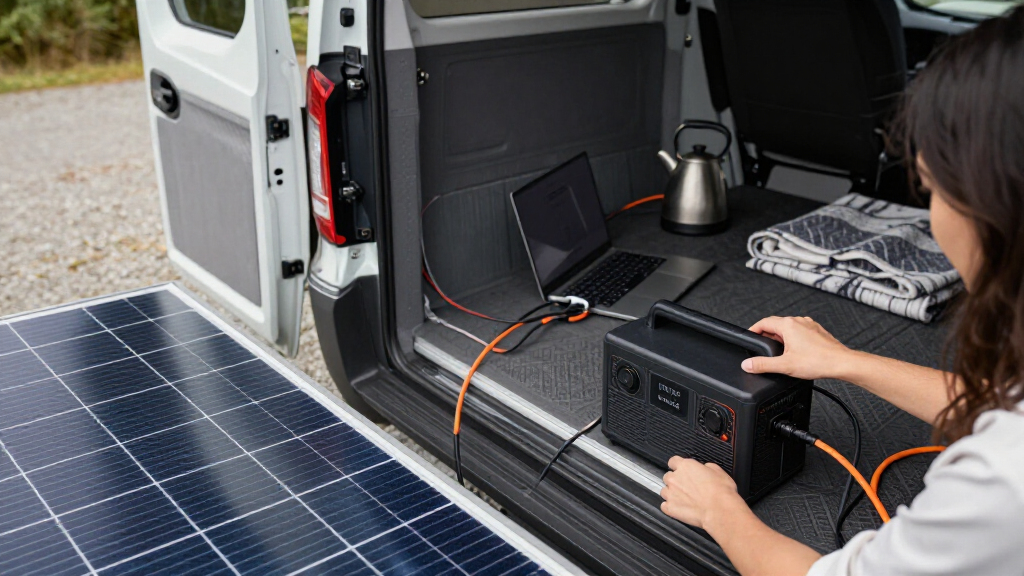
I evaluated each station through the specific demands of van life rather than generic spec-sheet comparisons. The criteria that mattered most: usable capacity versus weight and footprint (since van storage is finite), inverter output and surge tolerance (can it start a compressor fridge or a power tool?), solar input ceiling and recharge speed (because off-grid living depends on refill rate, not just tank size), battery chemistry and cycle life (LiFePO4 units were weighted favorably for longevity), and outlet variety for van-relevant devices like 12V accessories, USB-C laptops, and small kitchen appliances.
The ranking logic is tier-based. Full-time and long-trip travelers get the most value from the 2–3kWh class, so the BLUETTI Elite 300 leads despite its weight, with the Anker SOLIX S2000 close behind. Weekend van campers are better served by the ~1kWh class, where the Jackery Explorer 1000 v2 earns the beginner spot for usability and the generic 1024Wh LiFePO4 unit and UDPOWER S1200 compete hard on value. The sub-300Wh units are ranked for what they actually are: lightweight supplemental power for day trips, emergency backup, or minimal setups — not whole-van energy systems.
Factors to Consider When Choosing Portable Power Stations For Vans
Before settling on a specific model, it helps to understand how van power needs differ from home backup or camping-trailer needs. Space is scarcer, recharging options are more variable, and the devices you run dictate your minimum specs more than any marketing claim. These are the factors I weighed most heavily, plus the mistakes that cost van builders the most money.Size Your Capacity to Your Actual Trip Length
The most common mistake in this category is buying a big battery for small needs — or the reverse. A realistic starting point is 30–60Wh per day for phones, lights, and a laptop; add 40–80Wh for a 12V fridge running around the clock, and 800Wh or more per hour for devices like induction cooktops or hair dryers. That math is why a 200Wh unit works for overnight trips but fails within a day once a fridge enters the picture. A useful discipline: list every device you will actually run, multiply watts by hours, add 20% for inverter losses, then buy for your longest typical trip, not your dream scenario. Buyers who skip this step either lug 60 pounds of unused battery or run dry on night two.
Inverter Wattage Decides What You Can Plug In
Battery capacity gets the marketing attention, but continuous inverter output is what physically limits your devices. A 300W station — like several budget models in this roundup — cannot run a blender, a microwave, or most hair tools no matter how charged it is. Motors and compressors also demand surge power well above their running wattage, sometimes 2–3x, so a fridge that draws 60W may need 180W just to start. Van dwellers planning any kitchen appliance beyond a coffee maker should treat 1000W continuous as the practical floor. If you plan to cook with electricity rather than propane, only the 1500W-class units here (Jackery 1000 v2, Anker S2000, BLUETTI, and the 1024Wh unit) are realistic candidates.
Solar Recharge Rate Matters More Than Tank Size
Off-grid, your station is only as useful as its refill speed. A 3kWh battery that takes two sunny days to recharge behaves worse than a 1kWh battery that refills in one afternoon. Check the maximum solar input wattage — not just whether solar is ‘compatible’ — and note whether panels are included, since a separate 100W panel can add meaningful cost to an apparently cheap station. The UDPOWER S1200 stands out in this roundup for shipping as a complete kit with a 120W panel. Also verify the charge controller supports the panel voltage you intend to use; mismatched third-party panels are a frequent and frustrating buying error.
Battery Chemistry and Cycle Life Affect Total Cost
LiFePO4 batteries typically rate for 3,000+ charge cycles before degrading to 80% capacity, versus roughly 500–800 for older NMC chemistries. For a van used weekly, that difference can stretch useful life from under two years to a decade. This roundup reflects a real market shift: nearly every budget model now uses LiFePO4, so chemistry alone no longer justifies a premium price. What still separates price tiers is cell quality, battery management sophistication, and thermal design — areas where established brands maintain an advantage. Buyers should also factor in depth-of-discharge behavior; LiFePO4 tolerates full depletion far better, which suits the irregular charge patterns of van life.
Physical Footprint and Mounting in a Moving Vehicle
A power station that sits safely in a living room becomes a 60-pound projectile during a hard brake. Before buying, measure your intended storage spot — under-seat bays, garage cabinets, or bed platforms — and check both dimensions and handle design for lifting. Heavier units in the 2–3kWh class generally belong strapped or bolted down, which means planning ventilation, since batteries warm during fast charge and discharge cycles. Smaller 200Wh-class units trade convenience for capacity but can move between van, home backup, and campsite duty, which is a legitimate value argument for part-time van users. Weight distribution also affects handling in smaller camper vans more than most buyers anticipate.
Know Which Devices Are Realistic at All
No portable station in this lineup will run an air conditioner for a full night — that task realistically requires a dedicated van electrical system or an enormous battery bank. Electric heaters, likewise, draw 1,000–1,500W continuously and will flatten even the BLUETTI Elite 300 in about two to three hours. The devices vans run well are efficient loads: LED lighting, laptops, camera gear, 12V fridges, CPAP machines, and small kitchen appliances used briefly. If your must-run list includes heating or cooling, the honest answer is to change the appliance (diesel heater, propane stove) before upsizing the battery. Matching loads to chemistry and capacity saves far more money than buying bigger.
Frequently Asked Questions
Is a portable power station good enough for full-time van life, or do I need a fixed electrical system?
For most full-time van dwellers, a large portable station like the BLUETTI Elite 300 or Anker SOLIX S2000 genuinely can replace a hardwired system, with caveats. You get plug-and-play setup, no lithium-specific installation knowledge, and the flexibility to take the unit home as backup power. The tradeoffs are weight (a fixed system distributes batteries low in the chassis), theft risk since portables are easy to steal, and typically slower solar charging than a purpose-built setup with a quality MPPT controller. If your loads stay under 1,500W and you charge primarily from solar or driving, a portable is a defensible choice. Heavy permanent loads or roof-AC ambitions still favor a fixed installation.
Can any of these power stations run a 12V van fridge overnight?
Running the fridge is easy; the question is what else runs alongside it. A typical compressor fridge draws 40–60Wh per hour at worst, so a 1,000Wh-class unit covers a full 24 hours easily. The real trap is the sub-300Wh tier — the VTOMAN, MARBERO, DYNESS, and DaranEner units will run a fridge for roughly four to six hours only, leaving nothing for phones or lights. Also confirm the station has a regulated 12V output (car-style port or DC barrel), because converting 12V DC to AC and back wastes 15–20% of your energy. For fridge-centric setups, the 1kWh class is the honest minimum.
How much solar panel wattage do I need to keep a van power station charged?
A practical rule for vans: assume you harvest about 4–5 peak sun hours per day, so 200W of panel yields roughly 800–1,000Wh daily in good conditions — enough to offset modest daily use. Cloudy weather, panel angle, and roof shading can cut that by half or more, so most van builders oversize panels 1.5–2x their daily consumption. Check your station’s maximum solar input before buying panels; feeding it more watts than it accepts wastes money on hardware you cannot use. The UDPOWER S1200 kit approach makes sense for beginners, but anyone staying out longer than a weekend will want 200W or more regardless of which station they choose.
Are the cheap 200–300Wh power stations worth buying at all for a van?
Yes — if you are honest about their role. These units excel as supplemental power: charging laptops and cameras on a work trip, running lights and a fan for a night, or serving as emergency backup when your main system is depleted. Several in this roundup, including the DARAN NEO300L and MARBERO M82, offer pure sine wave output and LiFePO4 chemistry at a low price point, which is respectable value. Where they fail is being asked to be a primary system — no fridge, no kettle, no heating. Weekend van campers with genuinely minimal loads can build a complete setup around one of these plus a small panel and be very satisfied.
Should I pay more for a brand-name station or take a chance on lesser-known models?
The meaningful differences today are less about the battery cells and more about what surrounds them. Off-brand units often match capacity and chemistry specs but cut corners on the battery management system, surge handling, connector quality, and warranty support — all things you only notice when something goes wrong mid-trip. Brands like BLUETTI, Anker, and Jackery maintain service networks, replacement parts, and firmware updates; a no-name 1024Wh unit may offer no recourse at all. My suggested split: go brand-name for the 1kWh-plus tier where you are investing real money, and feel comfortable going budget on small 200Wh units where the financial risk is low and the duty is light.
Conclusion
The right pick here depends entirely on how you use your van. For full-time or long-trip van life, the BLUETTI Elite 300 is my best overall recommendation — 3,014Wh of capacity handles fridges, cooking, and work-from-van loads for days, provided you accept the weight and plan for serious solar. The Anker SOLIX S2000 is the best premium alternative for buyers who want similar seriousness with a lighter footprint and smarter app-based control. At the other end of the budget scale, the 1024Wh LiFePO4 unit and UDPOWER S1200 kit are the best value plays, especially the UDPOWER for including a solar panel and letting you start harvesting power immediately. For beginners and weekend campers, the Jackery Explorer 1000 v2 is the easiest onboarding into van power, with enough capacity to learn your real consumption before committing bigger money. And if your needs are genuinely small — day trips, emergency backup, a laptop and some lights — the DARAN NEO300L and MARBERO M82 cover the best compact role without wasting van storage. Match the tier to your trips, verify your fridge and cooking loads before buying, and this lineup has a defensible winner for every van and every budget.
Halloween Picks
halloween
As an affiliate, we earn on qualifying purchases.