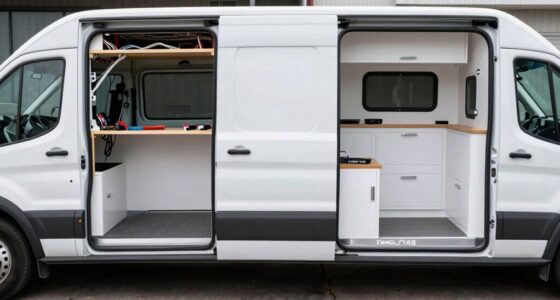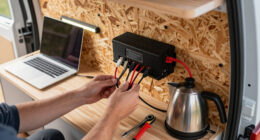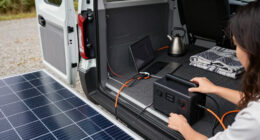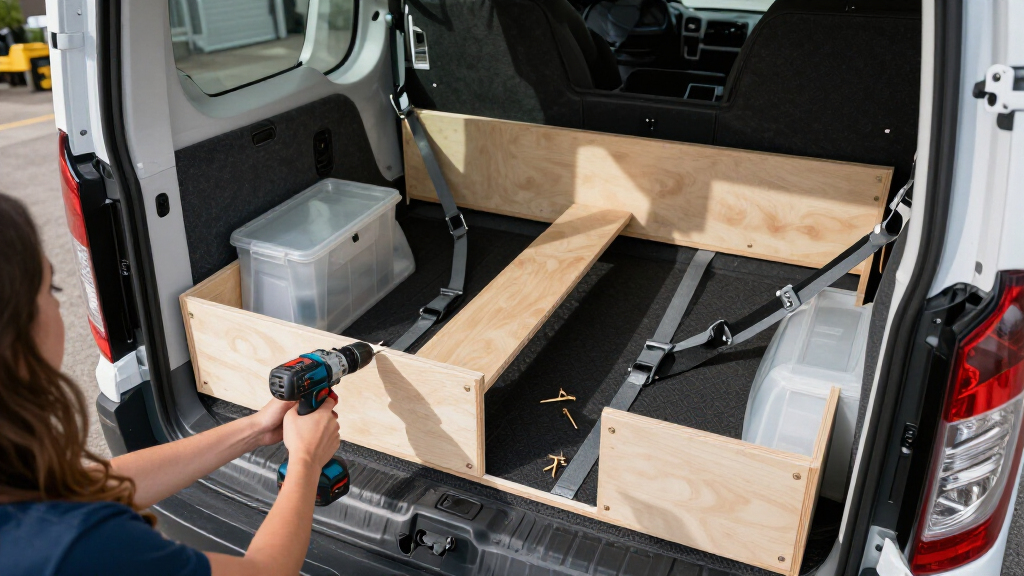

If you use a Ford Transit as a work van, the organizer decision usually comes down to two families of products: fixed steel shelving kits (the kind sold by Weather Guard, ADARAC, and similar upfitters, sized specifically for Transit wheelbases and roof heights) and modular cargo trays, drawer units, and bin systems that mount with tracks or freestanding bases. Both aim to solve the same problem — a van full of loose tools and shifting cargo — but they solve it in opposite ways. Shelving commits you to a layout: permanent shelves over the wheel wells, divided compartments, and often a bulkhead partition. Modular systems keep your options open: repositionable trays, removable bins, and lightweight panels you can strip out when you need to haul a full sheet of plywood or a pallet.

Get business pricing on garage and car supplies
- Business-only prices and quantity discounts
- Tax-exempt purchasing
- Multiple users, one account, clear invoices

MELIPRON 60" H Steel Van Shelving Storage System for Full-Size Cargo Vans
- ✔ Dimensions: 52" W x 60" H x 13" D
- ✔ Material: Powder-coated steel
- ✔ Back Panel: 5mm PP

LYNICESHOP Tailgate Storage Bag for 2012-2025 Ford Transit Custom
- ✔ Compatibility: 2012-2025 Ford Transit Custom
- ✔ Material: Double-layer Oxford cloth
- ✔ Set Includes: 2 pieces

MIKKUPPA Trunk Organizer with Lid – 95L Collapsible Car Organizer, Black
- ✔ Dimensions: 33" L x 15.7" W x 11" H
- ✔ Capacity: 95 liters
- ✔ Weight: 2.8 kg
The real tension is commitment versus flexibility, plus a hidden cost that surprises many buyers: weight. A full steel shelving package can eat 250 to 400 pounds of payload before you load a single tool, which matters enormously on a Transit 150 but barely registers on a Transit 350 HD. This guide compares both approaches across the criteria that actually drive the decision — payload impact, cargo capacity, tool access, installation, reconfigurability, security, and total cost — so you can match the organizer to how you actually work, not how a catalog photo looks.
At a Glance
| Criteria | Steel Shelving Kits (Weather Guard / ADARAC style) | Modular Cargo Trays and Bin Systems | Winner |
|---|---|---|---|
| Payload impact | Heavy: 250–400+ lbs for a full kit | Light: 40–150 lbs depending on configuration | B |
| Cargo floor space retained | Low: shelves consume floor and wall space | High: trays and bins remove in minutes | B |
| Tool access and workflow | Excellent: everything visible at arm’s height | Good to moderate: bins stack, visibility depends on layout | A |
| Installation effort | Moderate to high: drilling, brackets, 3–8 hours | Low to moderate: track-mounted, 1–3 hours | B |
| Reconfigurability | Very low: layout is essentially permanent | Very high: rearrange or remove anytime | B |
| Load security while driving | Very good: lipped shelves and divided bays | Moderate: relies on straps, lids, and track locks | A |
| Durability and warranty | Excellent: powder-coated steel, long warranties | Good: lighter materials, more wear points | A |
| Typical total cost | $800–$2,500+ installed | $200–$900 depending on components | B |
MELIPRON 60" H Steel Van Shelving Storage System for Full-Size Cargo Vans
For anyone who earns a living out of their Transit, this is the pick that changes how the van works. The MELIPRON shelving system stands out for its powder-coated steel construction and an 8-point drilled mounting system at the base, middle, and top — which is exactly what you want when the van is cornering with a full load and lesser racks would sway or rattle loose. Adjustable shelves and dividers let you reconfigure the layout as your tool collection evolves, something neither fabric option in this lineup can match.The tradeoffs are real, though. Installation requires drilling into the van body, takes one to one and a half hours with two people, and is effectively permanent unless you’re willing to patch holes later. Compared with the LYNICESHOP tailgate bags, which snap on in minutes, the MELIPRON demands commitment — but in exchange you get shelving that shrugs off jobsite abuse. The 5mm PP back panel is a thoughtful touch, dampening rattles and protecting the van wall from shifting tools. Just note that fit must be verified against your specific wheelbase and interior layout before purchase; this is sized for full-size vans, not the smaller Transit Custom.
Pros:
- Heavy-duty powder-coated steel built for daily commercial abuse
- Adjustable shelves and dividers let you reconfigure storage as needs change
- 8-point mounting keeps the unit stable even with aggressive driving
- 2-year warranty with free replacement parts adds long-term confidence
Cons:
- Drilling into the van body is required, making installation semi-permanent
- Two-person installation taking 1-1.5 hours is a real weekend project
- Fit must be verified against your specific van before ordering
Best for: Contractors, tradespeople, and fleet operators who need permanent, heavy-duty tool storage in a full-size Transit
Not ideal for: Leased vans, weekend users, or Transit Custom owners — the drilling requirement and full-size fit rule it out
Bottom line: If your Transit is a workshop on wheels, this steel shelving system is the most capable and most durable organizer in this lineup — provided you’re willing to drill.
“If your Transit is a workshop on wheels, this steel shelving system is the most capable and most durable organizer in this lineup — provided you’re willing to drill.”
LYNICESHOP Tailgate Storage Bag for 2012-2025 Ford Transit Custom
The cleverest thing about the LYNICESHOP tailgate bag set is where it lives: on your rear doors, square footage that no other organizer in this roundup touches. The MELIPRON consumes wall and floor space; the MIKKUPPA sits on your floor entirely. This 2-piece set claims territory you weren’t using anyway, which matters enormously in a van where every inch counts. The double-layer Oxford fabric with reinforced stitching feels built for regular use, and the water-repellent inner coating keeps damp tools or cleaning chemicals from soaking through to the door panels.Where it falls short of the MELIPRON is load handling — fabric pockets with no stated weight capacity simply can’t be trusted with the heavy power tools a steel shelf swallows without complaint. That said, for cleaning gear, tie-downs, small hand tools, and travel kit, the snap-on installation makes this the lowest-effort semi-permanent option here. The critical caveat: this is tailored to the Transit Custom, the smaller European-market van, not the full-size Transit sold in North America. Buyers who confuse the two will end up with bags that don’t fit, so verify your model year and variant before ordering.
Pros:
- Custom-fit design tailored specifically to the Ford Transit Custom
- Uses otherwise-wasted rear door space that shelving and floor organizers can’t reach
- Water-repellent inner coating protects contents and door panels
- Snap-on installation takes minutes with no tools or drilling
Cons:
- Only compatible with the Transit Custom, not the full-size Transit
- No stated weight capacity limits confidence for heavier tool storage
Best for: Transit Custom owners who want to convert rear door space into organized storage for lighter gear
Not ideal for: Full-size Transit owners, or anyone needing to store heavy tools — the fabric construction and unstated weight limit rule it out
Bottom line: A smart, low-commitment way to add storage to a Transit Custom — as long as your cargo is on the lighter side and your van is actually the Custom variant.
“A smart, low-commitment way to add storage to a Transit Custom — as long as your cargo is on the lighter side and your van is actually the Custom variant.”
MIKKUPPA Trunk Organizer with Lid – 95L Collapsible Car Organizer, Black
Not every Transit owner wants to modify their van, and the MIKKUPPA 95L organizer is the pick for them. Unlike the MELIPRON, which bolts in permanently, this collapsible fabric organizer adjusts to four different sizes and folds flat when you need the whole floor for sheet goods or furniture. The lid is a genuine differentiator in this lineup — neither the LYNICESHOP bags nor open shelving contain loose small items the way a zippered top does, which matters if you’re hauling groceries alongside hardware and don’t want them mingling.The non-slip bottom and two adjustable securing straps address the biggest weakness of generic trunk organizers: sliding around a bare cargo floor. That said, it can’t match the stability of a drilled-in shelf, and at 2.8 kg it’s noticeably heavier than typical soft organizers, which cuts into its portability advantage slightly. Compared with the LYNICESHOP, it’s far more universal — it moves from the Transit to an SUV to a sedan — but it consumes floor space rather than exploiting unused areas. For mixed-duty owners, campers, and anyone who occasionally needs a completely empty van, that flexibility is worth more than raw capacity.
Pros:
- Collapses to flat and adjusts to four sizes for maximum flexibility
- Lid keeps small items contained and out of sight
- Non-slip bottom plus securing straps control cargo movement while driving
- Universal design works in the Transit and any other vehicle you own
Cons:
- At 2.8 kg it’s heavier than many rival soft organizers
- Occupies valuable floor space rather than walls or doors
- Fabric construction can’t secure heavy tools the way mounted shelving can
Best for: Weekend warriors, campers, and multi-vehicle households who want removable organization they can reconfigure or fold away
Not ideal for: Full-time tradespeople who need secure, permanent tool storage — it will slide and shift where steel shelving stays planted
Bottom line: The most versatile organizer here — best for owners whose Transit sometimes needs to be empty and whose storage needs change week to week.
“The most versatile organizer here — best for owners whose Transit sometimes needs to be empty and whose storage needs change week to week.”
As an Amazon Associate we earn from qualifying purchases.
Key Differences
The first major difference is what each system does to your van’s capability. A steel shelving kit is a permanent structure: once it’s bolted in over the wheel wells and against the walls, your flat floor is gone. Long material, appliances, furniture, or anything bulky now has to fit around the shelves, and in practice a shelved Transit becomes a service vehicle, not a hauler. Modular trays and bins preserve the van’s cargo identity — pull the bins out, drop the tray, and you have a near-stock cargo area for the weekend plywood run or a vehicle resale years later. For tradespeople who occasionally haul big loads, this flexibility is often the deciding factor on its own.
The second difference is weight and its effect on legal payload. The Transit 150 has a payload rating typically in the 2,200–3,000 pound range depending on configuration, and every pound of shelving comes directly out of what you can carry in tools, parts, and ladder racks up top. A 350-pound steel kit on a Transit 150 is over ten percent of payload spent on empty structure. The same kit on a Transit 350 HD is a rounding error. This is why the same organizer can be a smart buy for one Transit owner and a mistake for another — the van’s rating changes the math completely.
The third difference is workflow. Shelving wins here, and it’s not close. Tools at waist and chest height, everything visible from the door, divided bays that keep fasteners sorted — this is why fleets standardize on shelving. Modular bins keep things contained but force more digging, more stacking, and more stooping to floor-level trays. If you visit six job sites a day, the seconds saved reaching for a tool add up; if you load out once a week, they don’t.
Detailed Comparison
Payload impact (Modular Cargo Trays and Bin Systems wins — major)
Steel shelving kits for the Transit commonly weigh 250 to 400 pounds fully configured with a partition, while modular tray-and-bin setups typically land between 40 and 150 pounds. On a Transit 250 or 350, the shelving weight is absorbable; on a Transit 150 it can consume a tenth or more of usable payload before you’ve loaded anything. Modular systems win this criterion outright, and the gap is major for lower-GVWR vans and minor for HD models.
Cargo floor space retained (Modular Cargo Trays and Bin Systems wins — moderate)
Shelving permanently occupies the walls and wheel wells, reducing your ability to carry 4×8 sheet goods flat, bulky equipment, or third-row cargo. Transit-length shelving still leaves a center aisle, but the flat-floor hauling capability is compromised. Modular trays and bins can be pulled out in minutes, restoring near-stock cargo volume. If your van doubles as a hauler, the modular approach is the only one that respects that; if it’s purely a service vehicle, this advantage is mostly theoretical.
Tool access and workflow (Steel Shelving Kits (Weather Guard / ADARAC style) wins — major)
Shelving puts tools at waist height with everything visible from the sliding door or rear doors, and divided shelf bays keep small parts sorted. Bin systems contain items well but create stacking and search time; floor trays require bending. For daily multi-stop service work — plumbing, electrical, HVAC — shelving measurably improves speed and reduces lost tools. The gap is real and favors shelving for high-frequency use.
Installation effort (Modular Cargo Trays and Bin Systems wins — moderate)
Quality steel kits are Transit-specific with pre-drilled mounting points, but expect three to eight hours with drilling, bracket alignment, and partition mounting — a real weekend job or a paid upfitting appointment. Track-based modular systems typically install in one to three hours with basic hand tools, and components can be repositioned without redrilling. Modular wins on effort, and if you lease or expect to reconfigure, it also wins on total lifetime hassle.
Reconfigurability (Modular Cargo Trays and Bin Systems wins — moderate)
Once a steel kit is in, changing your layout means unbolting, patching holes, and starting over. Modular tracks let you move trays, add bins, or remove everything for a big haul in minutes. If your work changes seasonally — say, HVAC in summer and handyman jobs in winter — modular flexibility has genuine value. If your tool loadout hasn’t changed in five years, it doesn’t.
Load security while driving (Steel Shelving Kits (Weather Guard / ADARAC style) wins — moderate)
Lipped shelves with optional doors keep tools in place over potholes and hard stops, and a bulkhead partition protects the cab from shifting cargo — a safety issue many buyers underestimate. Modular bins rely on lids, straps, and track locks; done carefully it works, but done lazily you’ll arrive at job sites to dumped bins. Shelving plus a partition is the safer, more secure configuration.
Durability and warranty (Steel Shelving Kits (Weather Guard / ADARAC style) wins — moderate)
Powder-coated steel shelving from established brands routinely outlasts the van it’s installed in, with multi-year or lifetime warranties on some lines. Modular systems use lighter-gauge steel, plastics, and more moving connection points, so wear shows sooner, especially with heavy daily use. For a van that will see a decade of hard work, shelving’s durability advantage is real.
Typical total cost (Modular Cargo Trays and Bin Systems wins — moderate)
A complete steel kit with partition commonly runs $800 to $2,500 or more once installed; modular systems assembled piece by piece typically total $200 to $900. Note that modular costs creep if you keep adding bins and accessories. Either way, both are cheap relative to the productivity and tool-protection benefit, but modular clearly costs less up front.
Steel Shelving Kits (Weather Guard / ADARAC style): Pros and Cons
Pros:
- Best-in-class tool access: everything at arm’s height and visible
- Excellent long-term durability; often outlasts the van
- Superior load security with lipped shelves and optional doors
- Bulkhead partition option adds cab safety
- Proven fleet-standard layout that supports fast, repeatable workflows
- Strong resale story for service-van buyers
Cons:
- 250–400+ pounds of payload consumed before loading anything
- Permanent: major hassle to remove or reconfigure
- Kills flat-floor hauling of sheet goods and bulky cargo
- Highest cost, especially professionally installed
- Multi-hour installation with drilling
Modular Cargo Trays and Bin Systems: Pros and Cons
Pros:
- Light: preserves payload, critical on Transit 150 models
- Fully reconfigurable and removable for big hauls
- Fast, low-effort installation with basic tools
- Low entry cost; buy components incrementally
- Easy to transfer to your next van
Cons:
- More digging and bending to reach tools
- Load security depends on your discipline with straps and lids
- Lighter materials wear faster under daily heavy use
- Costs creep upward as you add bins and accessories
- Less impressive structure if you’re outfitting a fleet for others
Who Should Choose What
Choose Steel Shelving Kits (Weather Guard / ADARAC style) if:
- You run a daily service route (plumbing, electrical, HVAC, mobile repair) with a fixed tool set
- You drive a Transit 250 or 350 HD with payload to spare
- You want maximum tool security and cab protection via a partition
- You plan to keep the van five-plus years and want a set-it-and-forget-it layout
- You’re outfitting multiple vans and need consistent, trainable layouts
Choose Modular Cargo Trays and Bin Systems if:
- You drive a Transit 150 and every pound of payload counts
- Your van must double as a hauler for sheet goods, appliances, or bulky loads
- Your tool loadout changes with the seasons or project type
- You lease the van or want to move the organizer to your next vehicle
- You want to start organizing now on a limited budget and expand later
Skip both if: You only carry a few tool bags and occasional materials — a simple cargo van partition ($150–$300) plus a couple of strapped bins solves the problem for a fraction of either system’s cost.
Value for Money
Value here depends less on price tags and more on how you use the van. The steel kit’s higher price buys durability, workflow speed, and load security — for a full-time service trade, that $1,500–$2,500 pays for itself in time saved and tools not damaged or lost, and it’s the configuration most fleets land on for good reason. For a Transit 150 owner, the steel kit’s payload cost is effectively a hidden fee on every load you carry for the life of the van; the modular system’s lower price and lighter weight make it the better value even if you replace some components along the way.
Paying more for steel is worth it when the van is a dedicated service vehicle on a heavy-duty chassis. It is not worth it when payload is tight, hauling flexibility matters, or your storage needs shift — in those cases the cheaper modular system isn’t a compromise, it’s the smarter buy. A common middle path also deserves mention: a single-sided shelving unit or one drawer module combined with modular bins on the other side captures much of the shelving benefit at half the weight and cost.
Final Verdict
For full-time tradespeople running a Transit 250 or 350 as a dedicated service vehicle, the steel shelving kit is the right call — the workflow, security, and durability advantages outweigh the cost and weight, and it’s what professional fleets use because it works. For Transit 150 owners, multi-use van owners, seasonal trades, and anyone who still needs flat-floor hauling capability, the modular tray-and-bin system is the clear recommendation: it solves 80 percent of the organization problem at a third of the cost while preserving the payload and flexibility that shelving permanently takes away.
The single biggest deciding factor is your van’s payload rating and how committed your layout is. Heavy-duty chassis plus fixed workflow: buy steel once and be done. Lighter chassis or changing needs: buy modular and keep your options. And if you’re on the fence, start with a partition and a one-sided shelving or drawer unit — you’ll learn your real storage needs in a month and can commit (or not) from there.
Frequently Asked Questions
Will steel shelving fit every Ford Transit model?
Most major shelving brands sell kits sized to specific Transit configurations — wheelbase (regular, long, extended), roof height, and whether the van has rear HVAC or step bumpers affect fit. Buy the kit matched to your exact body style rather than a generic kit, or you’ll fight the installation and lose cargo length.
How much payload does a shelving kit actually cost me?
A full steel kit with partition typically adds 250 to 400+ pounds. On a Transit 350 HD that’s a small fraction of a 4,000+ pound payload; on a Transit 150 it can exceed ten percent of usable payload, which directly reduces how much tools, parts, and rack cargo you can legally carry. Check your door-jamb payload sticker before buying.
Can I install shelving myself, or do I need an upfitter?
Transit-specific kits with pre-engineered mounting points are a realistic DIY job for anyone comfortable with a drill — budget three to eight hours. Modular track systems are easier, often one to three hours. Professional installation typically adds $200 to $500 and is worthwhile if you want a partition integrated cleanly with airbag and structural points.
Do I still need a cargo partition with either system?
A partition is strongly recommended with shelving, since unsecured cargo can still shift forward, and it protects the cab in a hard stop. With modular bins, a partition matters even more because bin systems rely on straps and lids that can fail. Either way, a $150–$300 partition is cheap cab insurance.
Can I move either system to my next van?
Modular track systems transfer easily — unbolt the tracks and re-mount. Steel shelving can be removed and reinstalled if the next van has the same wheelbase and body style, but you’ll have filled mounting holes in the old van and may need new brackets for a different configuration. If you trade vans every few years, modular retains more of its value.
Fall Picks
fall essentials
As an affiliate, we earn on qualifying purchases.