TL;DR

Get business pricing on garage and car supplies
- Business-only prices and quantity discounts
- Tax-exempt purchasing
- Multiple users, one account, clear invoices
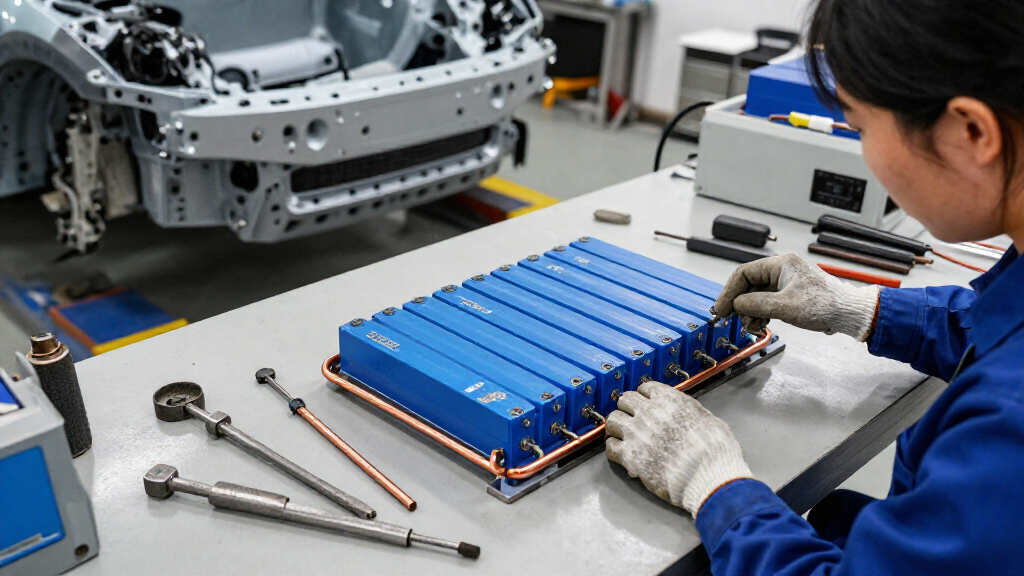
SNE Research says battery capacity installed for electric and hybrid vehicles outside China reached 426.7 GWh in the first nine months of 2026, up 24.7% year over year. Six Chinese manufacturers together held 56.4% of that market, while the combined share of three Korean suppliers fell to 26.5%. The figures cover battery use, not a direct measure of vehicle sales or manufacturing capacity.
Six Chinese battery manufacturers held a combined 56.4% of the electric and hybrid vehicle battery market outside China in the first nine months of 2026, according to a new SNE Research analysis. The market reached 426.7 GWh, up 24.7% from the same period a year earlier, as Korean suppliers lost share and Chinese firms expanded in Europe and other regions.
SNE Research’s figures cover batteries used in battery-electric vehicles, plug-in hybrids and other hybrids from January through September. The six Chinese companies in its calculation are CATL, BYD, Gotion, SVOLT, CALB and EVE Energy. Their collective share increased from 43.1% a year earlier, a gain of 13.3 percentage points. CATL and BYD alone accounted for 44.5% of the market, compared with 36.7% in the same period of 2023.
CATL ranked first, with 143.7 GWh outside China, up 47% year over year, and a 33.7% share. LG Energy Solution ranked second with 69.8 GWh, down 4.9%, while BYD placed third at 45.9 GWh, up 67%. Panasonic was fourth at 35.6 GWh, down 0.8%, and SK On ranked fifth with 28.2 GWh, down 18%.
The three South Korean suppliers—LG Energy Solution, SK On and Samsung SDI—recorded a combined 113.0 GWh outside China, a 13.5% decline. Their share fell from 38.2% to 26.5%. Samsung SDI had the sharpest decline among the top 10 suppliers, with usage down 34.4% to 15.0 GWh. Meanwhile, Gotion, SVOLT, CALB and EVE Energy each recorded strong year-over-year growth, according to SNE.
Chinese Suppliers Gain Ground Abroad
The shift matters because battery suppliers are competing for demand beyond China, including in Europe and other overseas markets where automakers need cells for electric and hybrid models. A majority market share for the six Chinese companies signals that their gains are not confined to the domestic market. It also changes the competitive position of established Korean and Japanese suppliers, whose combined results in the report weakened.
Regional results show the change was uneven. SNE says European and Asian demand helped offset continued weakness in North America. The Korean trio’s North American battery use nearly halved, from 56.1 GWh to 28.1 GWh, while its European and Asian totals increased. These figures identify where battery use changed; they do not, by themselves, establish why individual automakers or suppliers gained or lost contracts.
The chemistry mix may also shape supplier competition. SNE reported that LFP batteries rose from 15.8% to 27.7% of the non-China market. The firm linked that increase to Chinese manufacturers’ strength in LFP and growing European use in entry-level models, where price competitiveness can influence supplier selection. The analysis does not quantify how much of each company’s growth came from chemistry, specific vehicle launches or new supply agreements.
Products Worth Considering

Autel MaxiCharger AC Home 50A Level 2 EV Charger, Hardwired, J1772, Wi-Fi and Bluetooth, 25 ft Cable

Autel Home EV Charger up to 50A J1772 Hardwired Level 2 Charger with 25 ft Cable

Autel MaxiCheck MX808S Bidirectional OBD2 Diagnostic Scanner
As an affiliate, we earn on qualifying purchases.
Market Growth and Regional Differences
The non-China market grew faster than the broader total including China: SNE reported a 24.7% year-over-year increase outside China, compared with 19.7% when China was included. The figures indicate slower growth in the Chinese market relative to the non-China total, though the supplied analysis does not provide enough detail to identify the causes or compare individual countries’ demand.
Company results varied by region. CATL’s European volume rose 35% to 96.8 GWh, while its Asian volume doubled to 27.1 GWh. BYD recorded growth in Europe, Asia and South America. LG Energy Solution also gained in Europe and Asia, but its North American volume fell 45%. Panasonic’s results, SNE said, were supported by Tesla-related North American volumes, though its growth was below the non-China market rate.
The ranking reflects reported battery usage in vehicles during the period, not a count of battery factories, production capacity or vehicle registrations. Market share here is based on the battery capacity recorded by SNE outside China. Comparisons should be read within that scope and time window.
“The combined market share of the six Chinese companies … rose from 43.1 to 56.4 per cent, exceeding half of the non-China market.”
— SNE Research
Limits of the Market Data
The figures describe battery capacity used in vehicles, but SNE’s published summary does not fully detail its data collection method, the vehicle models included in each regional total or how it assigns battery use to suppliers. It also does not establish whether the reported shifts reflect durable supply arrangements or changes concentrated in particular models and launches.
The report points to North American weakness and growth in Europe and Asia but does not establish the causes behind every regional change. Nor does the supplied material give forecasts for the rest of 2026. The reported market shares are specific to January–September 2026 and the market outside China; they should not be treated as annual results or as shares of the market within China.
Full-Year Results Will Test the Trend
The next useful comparison will be a full-year account of battery use, which can show whether Chinese suppliers maintained their gains through the final quarter. Readers and automakers will also be watching whether European demand and LFP adoption continue to rise and whether North American usage for Korean suppliers recovers. SNE’s nine-month analysis does not provide a forecast or a date for a follow-up report, so those outcomes remain open.
Key Questions
What does the 56.4% market share measure?
It is the combined share of battery capacity used in electric and hybrid vehicles outside China from January to September 2026, according to SNE Research. It is not a measure of vehicle sales or factory capacity.
Which Chinese companies were included?
SNE grouped CATL, BYD, Gotion, SVOLT, CALB and EVE Energy in the combined figure.
Which supplier ranked first?
CATL ranked first outside China, with 143.7 GWh of battery use and a 33.7% market share in the first nine months of 2026.
Why did Korean suppliers lose share?
SNE reported a combined decline for LG Energy Solution, SK On and Samsung SDI, alongside a particularly sharp fall in their North American battery use. The report also recorded growth in Europe and Asia, but its summary does not establish a single cause for the overall decline.
What does the report say about LFP batteries?
SNE said LFP’s share of the non-China market rose from 15.8% to 27.7%. Its analysts cited Chinese manufacturers’ strength in LFP and increased European adoption, particularly in entry-level models.
Source: electrive.com