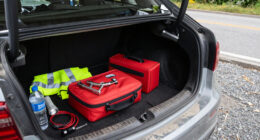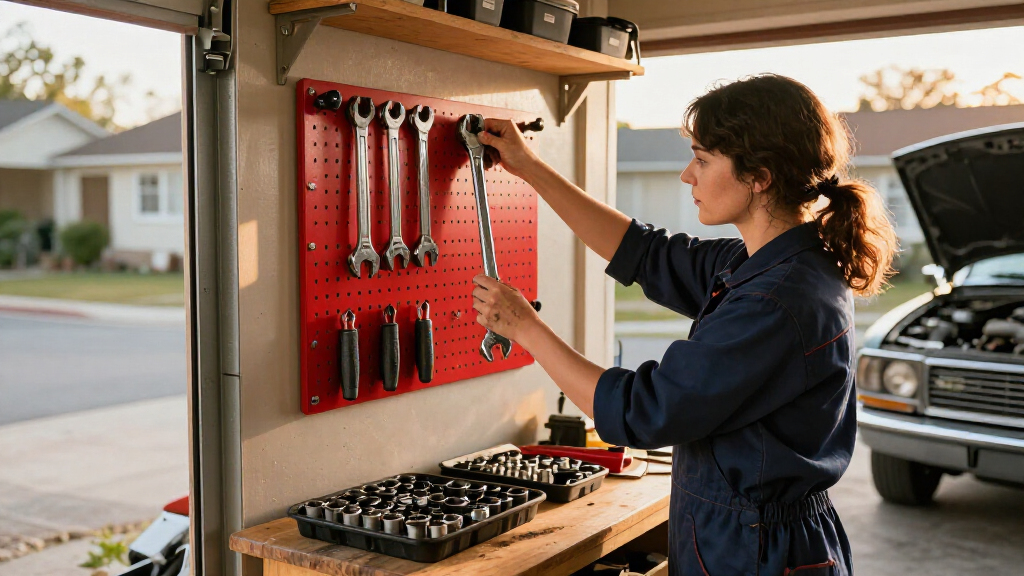

Choosing automotive garage organization tools often comes down to where you work and how you use your tools. Wall-mounted storage systems, such as pegboards, slat walls, shelves, and fixed cabinets, put tools and supplies along the garage perimeter. Mobile tool cabinets keep them in drawers that can roll beside a vehicle or workbench. Both can make a garage more orderly, but they solve different problems: walls preserve open floor area, while rolling cabinets bring secure storage to the job.

Get business pricing on garage and car supplies
- Business-only prices and quantity discounts
- Tax-exempt purchasing
- Multiple users, one account, clear invoices

Power Tool Organizer Wall Mount, 4 Tier Heavy Duty Tool Storage Rack
- ✔ Storage format: Four-tier wall-mounted rack
- ✔ Material: Alloy steel
- ✔ Claimed shelf capacity: 400 pounds

OEMTOOLS 26052 4-Pc Collapsible Magnetic Tray Set 4-1/2" for Small Parts
- ✔ Set size: Four trays
- ✔ Tray footprint: 4.5 inches square
- ✔ Expanded depth: 2 inches

Magnetic Tool Box Labels – 15-Pack, Reusable Magnetic Toolbox Labels Suitable for Garage Organization, Tool Cabinets,Toolbox Orga…
- ✔ Set size: 15 labels
- ✔ Label size: 3 by 1 inches
- ✔ Material: Plastic
Wall storage is usually the stronger fit for a compact garage, a stable workbench, and tools used in predictable routines. A mobile cabinet is more useful when work shifts between bays, tools need to be locked away, or heavy equipment is best stored in drawers. The comparison below focuses on cost, access, capacity, flexibility, protection, and safety so you can choose based on the work your garage actually needs to support.
At a Glance
| Criteria | Wall-mounted storage systems | Mobile tool cabinets | Winner |
|---|---|---|---|
| Typical cost | Often lower for basic hooks, pegboard, and shelves; system costs rise with fitted panels and cabinets | Usually a larger upfront purchase, especially for heavy-gauge, high-capacity cabinets | A |
| Floor-space use | Keeps tools off the floor and opens walking and vehicle space | Occupies floor area even when parked; can be rolled out of the way if space permits | A |
| Access during a job | Tools are visible and quick to grab, but the user returns to the wall | Can be positioned beside the vehicle or bench, reducing trips back and forth | B |
| Storage capacity | Good for hand tools and common supplies; bulky or deep items may need separate storage | Drawer layouts handle a broad range of hand tools and accessories; weight limits vary | Depends |
| Flexibility | Layout can be rearranged, though fixed panels and cabinets stay put | Rolls between work zones, but needs clear paths and a parking spot | B |
| Tool protection and security | Open tools are easy to inspect but exposed to dust, moisture, and unauthorized access | Drawers protect tools from dust and can often be locked; locks and seals vary | B |
| Installation and upkeep | Requires secure wall mounting and suitable wall structure; periodic hook and fastener checks | Ready to use with modest setup; wheels, latches, and drawer slides need maintenance | Depends |
Power Tool Organizer Wall Mount, 4 Tier Heavy Duty Tool Storage Rack
When tools are accumulating on a bench or floor, this four-tier steel wall rack addresses more of the garage organization problem than the other two picks. Its listed layout combines pegboards, a screwdriver and pliers rack, six drill slots, and adjustable hooks, giving power tools and hand tools separate places. That makes it a better fit for keeping equipment visible and returning it to a consistent spot than the OEMTOOLS trays, which focus on parts during a repair, or the labels, which identify drawers without holding anything.The claimed 400-pound capacity is substantial, but it should not be read as permission to load the rack without checking the wall and fasteners. The product description says it suits concrete, brick, pegboard, and wood walls and includes mounting hardware; actual installation still depends on the surface and instructions. This is a larger commitment than portable trays or repositionable labels: once mounted, its location defines where tools are stored. It also offers less granular containment for tiny fasteners than a tray or drawer system.For a garage that needs a visible home for drills and frequently used hand tools, this is the most comprehensive pick in the lineup. Choose the trays instead if the immediate issue is sorting parts at the vehicle, or labels if your cabinets already work but are hard to navigate. We would skip the rack when wall space is limited or when secure mounting is not practical.
Pros:
- Four tiers and multiple tool-specific zones combine several storage functions.
- Six drill slots and adjustable hooks help keep frequently used tools visible.
- Steel construction is described as corrosion resistant and suitable for garage or workshop use.
- Includes mounting hardware and instructions according to the product description.
Cons:
- Requires wall space and a secure installation suited to the surface.
- The stated 400-pound capacity depends on correct mounting and should not be assumed for every wall.
- Open rack storage does not contain small loose parts as securely as magnetic trays.
Best for: Garage owners with usable wall space who want one fixed, zoned home for power tools, hand tools, and workshop accessories.
Not ideal for: Renters or anyone without a suitable mounting surface, and buyers whose main organizational need is containing small fasteners during repairs.
Bottom line: For a garage that can support a permanent wall installation, this rack offers the broadest tool-storage solution in the comparison.
“For a garage that can support a permanent wall installation, this rack offers the broadest tool-storage solution in the comparison.”
OEMTOOLS 26052 4-Pc Collapsible Magnetic Tray Set 4-1/2" for Small Parts
Fasteners removed from an engine bay or interior trim can disappear into the same clutter as tools. The OEMTOOLS four-tray set is built for that temporary, job-specific problem: each tray has a magnetic base, and the four colors let us separate hardware by location or repair step. Compared with the wall rack, it contributes little to permanent tool storage, but it is more useful at the vehicle when a job produces nuts, bolts, clips, and other small parts.Each tray measures 4.5 inches square and expands to two inches deep, with a stated capacity of up to two pounds. Flexible walls collapse to about three-quarters of an inch for storage, making this set easier to tuck away than rigid bowls. The magnetic base can attach to metal work surfaces, toolboxes, or lift arms, according to the description. That can keep a tray close to the work without requiring a dedicated bench spot.There are limits: four small trays are not a complete storage system, and the listed capacity is per tray, not a guarantee that every fastener arrangement will be secure in every position. Magnetic attachment also depends on having a compatible metal surface. Unlike the labels, these trays actively contain parts; unlike the wall rack, they do not give larger tools a permanent home. They make the most sense as a job companion for mechanics and DIYers who often disassemble assemblies.
Pros:
- Four colors make it easier to keep parts from different steps separate.
- Magnetic bases help hold trays to compatible metal surfaces.
- Flexible trays collapse flat for more compact storage.
- Each tray is listed to hold up to two pounds of parts and tools.
Cons:
- The 4.5-inch square trays have limited room for bulky components or large quantities.
- Magnetic attachment is useful only on compatible metal surfaces.
- Does not organize or store larger hand and power tools between jobs.
Best for: DIY mechanics and technicians who want to separate fasteners by component or repair stage while working at a vehicle.
Not ideal for: Anyone looking for permanent wall or drawer storage, or who usually works where no compatible metal surface is nearby.
Bottom line: Choose this set when keeping repair hardware sorted at the vehicle matters more than adding permanent garage storage.
“Choose this set when keeping repair hardware sorted at the vehicle matters more than adding permanent garage storage.”
Magnetic Tool Box Labels – 15-Pack, Reusable Magnetic Toolbox Labels Suitable for Garage Organization, Tool Cabinets,Toolbox Orga…
If a toolbox is already doing its job structurally but drawers are difficult to scan, magnetic labels offer a low-commitment way to make locations clearer. This 15-piece set comes with pre-printed labels for common tools and attaches to metal drawers, carts, cabinets, or toolboxes. Because the labels can be moved without adhesive residue, they are easier to adapt when a tool layout changes than fixed stickers. Compared with the OEMTOOLS trays, they help organize where tools live between jobs rather than where repair parts sit during a job.Their usefulness depends on the garage already having compatible metal storage. The labels do not create compartments, hold tools, or replace a drawer insert, so they are less of a standalone organization upgrade than the wall rack. The supplied details describe plastic labels measuring three by one inches, with abrasion, oil, and dust resistance claimed. Those properties suit a working garage, though the set size and pre-printed wording may not match every cabinet layout or collection.This is the most compact, least involved option in the roundup, and also the narrowest in scope. It makes sense for someone who has steel drawers or a mechanic cart and wants quicker visual cues. If tools need a place to go, choose the wall rack; if loose fasteners are the issue, choose the collapsible trays. We would pass on these labels for nonmetal storage or a toolbox that needs physical dividers rather than identification.
Pros:
- Magnetic attachment allows repositioning without adhesive residue.
- Pre-printed labels are ready to use for common tool categories.
- Compact three-by-one-inch format fits drawers and carts.
- Product description claims resistance to abrasion, oil, and dust.
Cons:
- Only 15 labels are included, which may not cover a large toolbox.
- Requires a compatible metal surface and does not create storage capacity.
- Pre-printed categories may not match every tool collection or drawer layout.
Best for: Owners of metal toolboxes, cabinets, or mechanic carts who want to identify common tool locations and rearrange labels as storage changes.
Not ideal for: Buyers without metal storage surfaces, or anyone who needs new tool capacity, drawer dividers, or a place to hold parts during repairs.
Bottom line: These labels are a focused add-on for an existing metal toolbox, not a substitute for racks, trays, or drawer organizers.
“These labels are a focused add-on for an existing metal toolbox, not a substitute for racks, trays, or drawer organizers.”
As an Amazon Associate we earn from qualifying purchases.
Key Differences
The central tradeoff is fixed access versus movable access. Wall-mounted tools stay in a consistent place and remain visible, which helps with quick selection and makes missing tools easier to spot. A cabinet can follow the work, saving repeated trips when a repair requires many sockets, wrenches, and small parts. That convenience matters most in a larger garage or where work shifts between vehicles; in a tight single-car space, the cabinet’s footprint can become a daily obstacle.
Cost and capacity depend heavily on the exact products. A simple wall setup can be inexpensive, but durable panels, fitted cabinets, and shelves add up. A substantial rolling cabinet costs more, yet concentrates storage in one secure unit and may reduce the need for multiple organizers. Neither option automatically holds every automotive item: long tools, fluids, bulky parts, and seasonal supplies may need shelves or dedicated storage. Measure the wall, floor, door swing, vehicle clearance, and access route before buying.
Detailed Comparison
Typical cost (Wall-mounted storage systems wins — moderate)
Basic wall hooks, pegboard, and shelves usually cost less to start with than a rolling cabinet, so wall storage wins for a budget-conscious setup. The gap is moderate: a complete wall system with fitted panels and cabinets can approach or exceed the price of an entry-level cabinet. In practice, buy only the wall components your tools require; pay the cabinet premium when lockable drawers and mobility will see regular use.
Floor-space use (Wall-mounted storage systems wins — major)
Wall storage wins clearly because tools and supplies are stored above the floor. This is a major advantage in a compact garage where a cabinet could narrow the path around a vehicle or block access to another storage area. A rolling cabinet can be moved, but it still needs a clear route and a parking position. Choose wall storage when preserving usable floor area is the priority.
Access during a job (Mobile tool cabinets wins — moderate)
A mobile cabinet wins when repairs happen in several locations. It can sit beside the car or bench, keeping drawer tools nearby and reducing trips across the garage. The difference is moderate for a single, fixed workbench and major for a garage with multiple work zones. Wall storage is still fast when tool locations are familiar and the work stays close to the wall.
Storage capacity (moderate difference)
Neither format has a universal capacity advantage. Cabinets often use drawers efficiently for hand tools and small accessories, while wall systems can spread tools across a large area and accommodate shelves for irregular items. The gap depends on the chosen sizes and load ratings. Compare usable drawer dimensions and wall area against your actual inventory, including the bulky items that do not fit a typical tool drawer.
Flexibility (Mobile tool cabinets wins — moderate)
A mobile cabinet wins for changing work zones because its storage moves with the job. Wall panels can be reconfigured, but their location remains fixed and added storage depends on available wall space. The difference is minor in a one-bay garage with a permanent bench, and more meaningful in a shared or larger workspace. Check that cabinet casters can cross the floor surface and that aisles remain clear.
Tool protection and security (Mobile tool cabinets wins — moderate)
A cabinet generally wins because closed drawers shield tools from some dust and make it easier to lock them away. The advantage is moderate, since lock quality, drawer fit, and exposure to moisture vary by model. Wall storage offers visibility and quick inventory checks, but open tools remain exposed. If security or a cleaner appearance matters, choose a cabinet with a dependable lock; it is not a substitute for appropriate moisture control.
Installation and upkeep (minor difference)
The result depends on the garage and the product. A cabinet typically needs little assembly beyond setup and wheel checks, while a wall system must be attached securely to suitable framing or masonry. Once installed, wall storage has few moving parts; cabinets rely on wheels, drawer slides, and latches. For renters or anyone unsure about the wall structure, a freestanding cabinet can be the simpler choice. For a permanent setup, careful wall mounting is manageable.
Wall-mounted storage systems: Pros and Cons
Pros:
- Preserves floor space and vehicle clearance
- Keeps commonly used tools visible and easy to identify
- Basic hooks and shelves can be added gradually
Cons:
- Tools stay in one location, so users may walk back and forth
- Open storage offers limited protection from dust and unauthorized access
- Secure installation requires a suitable wall and careful mounting
Mobile tool cabinets: Pros and Cons
Pros:
- Moves tools close to the vehicle or workbench
- Drawer storage protects contents from view and can be locked
- Organizes hand tools and small accessories in a compact footprint
Cons:
- Costs more than a simple wall setup in many cases
- Uses floor area and requires a safe parking location
- Wheels and drawer hardware need upkeep, and heavy units can be difficult to move
Who Should Choose What
Choose Wall-mounted storage systems if:
- You have limited floor space and want more room around a parked vehicle.
- Your work happens at one bench or in a predictable part of the garage.
- You want to start with a lower-cost setup and add storage over time.
Choose Mobile tool cabinets if:
- You move between vehicles or work zones and want tools to follow the job.
- You own a substantial hand-tool collection that benefits from drawer organization.
- You value enclosed, lockable storage and can spare a clear floor area.
Skip both if: Neither is a complete fit if your main need is storing bulky parts, tires, fluids, or long equipment; pair a suitable shelf or dedicated rack with the organizer that matches your hand tools.
Value for Money
Wall storage is usually the better value when the goal is to clear the floor, organize a modest tool collection, or build a setup in stages. Basic components cost less, and visible tools make it easy to see what belongs where. Paying more for a large wall system makes sense when you need its extra shelf, cabinet, and panel capacity, not just because a uniform finish looks appealing.
A mobile cabinet earns its higher price when it saves time on frequent repairs, secures valuable tools, or consolidates many drawers and organizers. If it will stay parked beside one bench, much of its mobility value goes unused; a wall system may be the better purchase. For a busy garage, the two formats can work together: keep common tools on the wall and put specialized or valuable tools in a rolling cabinet. Buy the cabinet premium only when its mobility, drawer layout, or security solves a real recurring problem.
Final Verdict
For most home garages with a fixed work area and limited floor space, start with wall-mounted storage. It costs less to build in stages, keeps everyday tools in sight, and leaves more room around the vehicle. Choose a mobile tool cabinet if you regularly move between work zones, own enough hand tools to justify organized drawers, or need tools secured behind a lock. The deciding factor is where your work takes place: fixed tasks favor the wall; shifting tasks favor the cabinet. A cabinet is worth paying more for when you will roll it to the job often.
Frequently Asked Questions
Are wall-mounted systems or mobile cabinets better for a small garage?
Wall-mounted systems are usually better when every inch of floor space matters. They store tools off the ground and keep pathways clearer. A cabinet can still work if it has a dedicated parking spot and can roll out of the way without blocking the vehicle or door.
Is a rolling tool cabinet worth the extra cost?
It is worth paying more when you often move tools between a vehicle and a bench, need organized drawers, or want lockable storage. If the cabinet will sit in one fixed place, compare its usable drawer capacity with a wall setup before spending more.
Can wall storage hold heavy automotive tools?
Some wall systems can support heavy items, but the safe load depends on the panel, shelf, fasteners, wall material, and mounting method. Check the manufacturer’s ratings and attach supports to suitable structure. Put heavy tools on a properly rated shelf or cabinet rather than assuming every pegboard hook can carry them.
Should I use both wall storage and a mobile cabinet?
Yes, if the garage has room and the tools have distinct roles. Keep frequently used items visible on the wall and store specialized or valuable tools in drawers that can move to the work. This combination costs more and needs planning, so measure clearances before adding a cabinet.